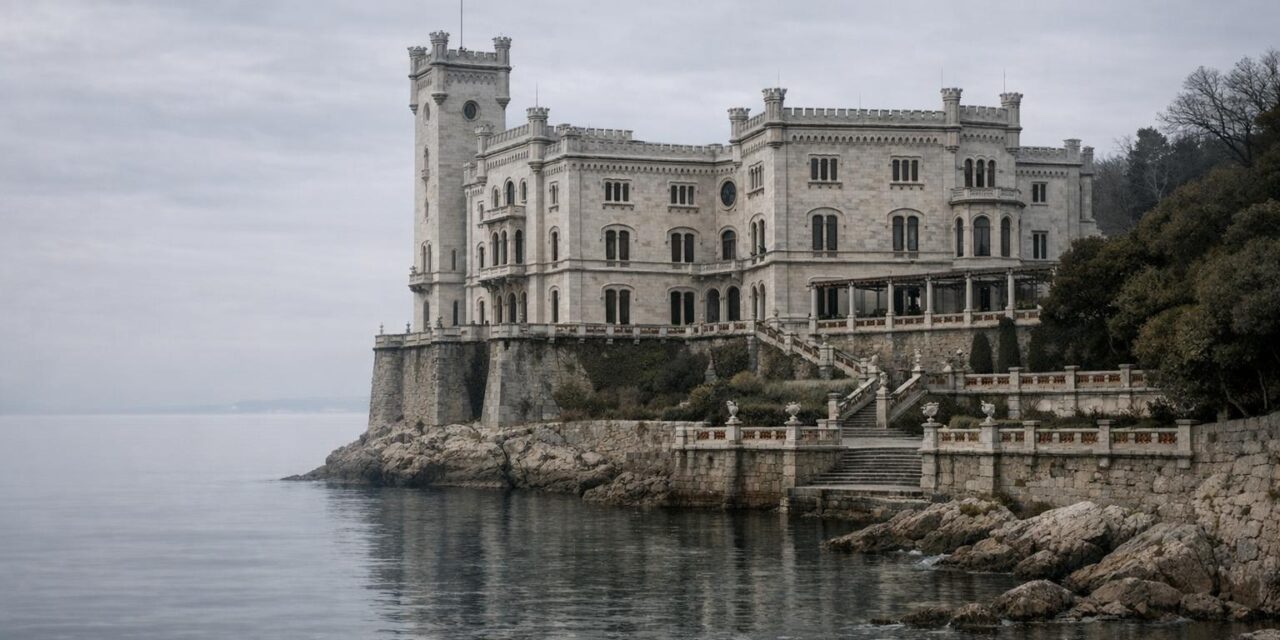
On a promontory above the Gulf of Trieste, a white-walled castle looks out to sea and waits for owners who are never coming back. Miramare was built between 1856 and 1860 by Archduke Maximilian of Austria — the younger Habsburg brother, naval commander, and aesthete who designed the gardens himself and furnished the interiors with the attention of a man who knew exactly what he wanted. In April 1864, he and his wife Charlotte sailed from Miramare for Mexico to accept a throne backed by Napoleon III. He was executed by firing squad in Querétaro on June 19, 1867. He was thirty-four. He never returned.
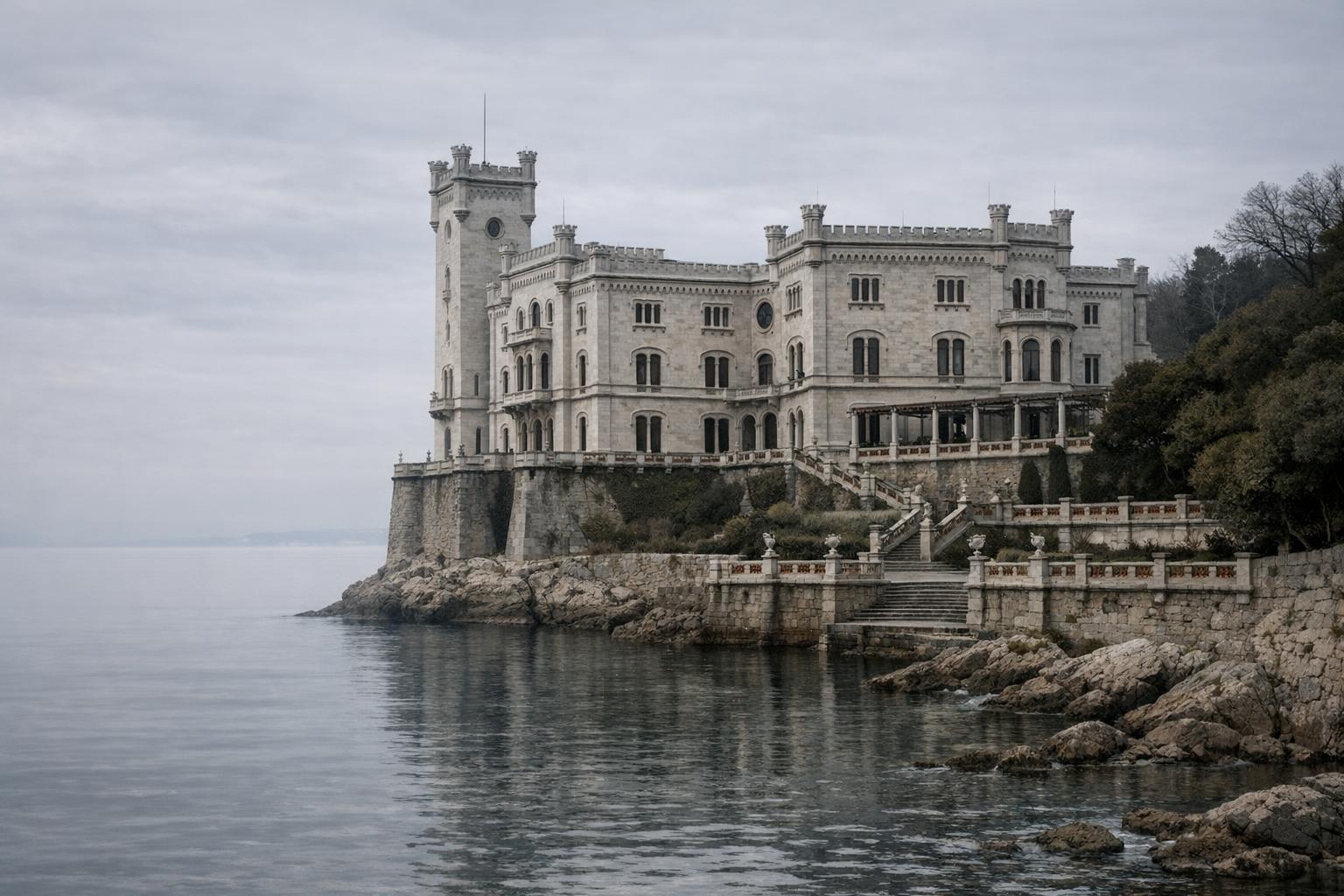
Charlotte survived him by sixty years, confined in Belgium in a mental collapse she never recovered from. The castle passed through the hands of the Habsburg family and the Italian royal house of Savoy; the pattern of subsequent occupants meeting violent or early deaths became attached to Miramare as the “Habsburg Curse.” Archduke Franz Ferdinand reportedly spent a night there before his 1914 assassination in Sarajevo. The Duke of Aosta, given the castle by Mussolini, died a prisoner of war in Kenya in 1942. Whether the castle caused these fates or merely attracted people in Europe’s age of catastrophe is a question the record cannot settle.
Miramare is now an Italian state museum. The rooms are original — furniture in place, collections intact, the naval-cabin bedroom still arranged as Maximilian left it. Visitors consistently describe an atmosphere of suspension, as if the house has not accepted the departure of its builders. The staff are appropriately skeptical about the curse. The castle is not. It faces the Adriatic and keeps waiting.
Story Source: miramare.cultura.gov.it
Address: Viale Miramare, 34151 Trieste, Italy
Accessibility Rating: Open to All — Freely accessible to the public with no advance requirement. Includes hotels, restaurants, bars, and public historic sites where visitors may walk in without prior booking.
Google Map
What Others Have Experienced
Most visitors describe Miramare as one of the most visually striking sites in the Trieste region — a white castle rising from a rocky coastal promontory above the Adriatic, surrounded by formal gardens with open sea on three sides. The beauty of the setting and the documented tragedy of its history create a combination that is difficult to separate, the melancholy grandeur feeling entirely appropriate once the story of its builder is known.
— from TripAdvisor
The interior has been preserved largely as Maximilian of Habsburg left it, with original furnishings, navigational charts, and personal objects still in place. Visitors who know he was executed in Mexico in 1867 — just three years after completing this as his retirement dream — find the rooms unusually affecting, the preserved normalcy of the domestic spaces carrying a weight that more explicitly memorialized sites often fail to achieve.
— from TripAdvisor
The Miramare curse — the belief that anyone who spends the night meets a tragic end — is referenced in virtually every visitor account. The documented historical record gives it unusual credibility: Maximilian executed, Archduke Franz Ferdinand assassinated after a stay, Duke Amedeo dying in captivity. Whether or not one believes in curses, the pattern is documented enough to give most visitors pause.
— from Wanderlog
The park surrounding the castle provides free access and is widely described as worth visiting independently of the paid interior. Visitors walk coastal paths among mature trees with the Adriatic visible through the branches — a setting described as unexpectedly peaceful and restorative, a tonal contrast to the castle’s historical weight that many find genuinely necessary after the rooms inside.
— from WhichMuseum
The sea-facing rooms preserve the Adriatic views that Maximilian loved enough to build his home above them. Visitors describe looking out over the same water from the upper windows as among the quietly most affecting moments in the visit — the knowledge that Maximilian died in Mexico without ever returning to see them gives the ordinary act of looking through a window a specific and unusual weight.
— from Miramare Castle