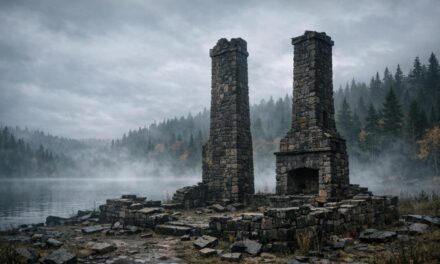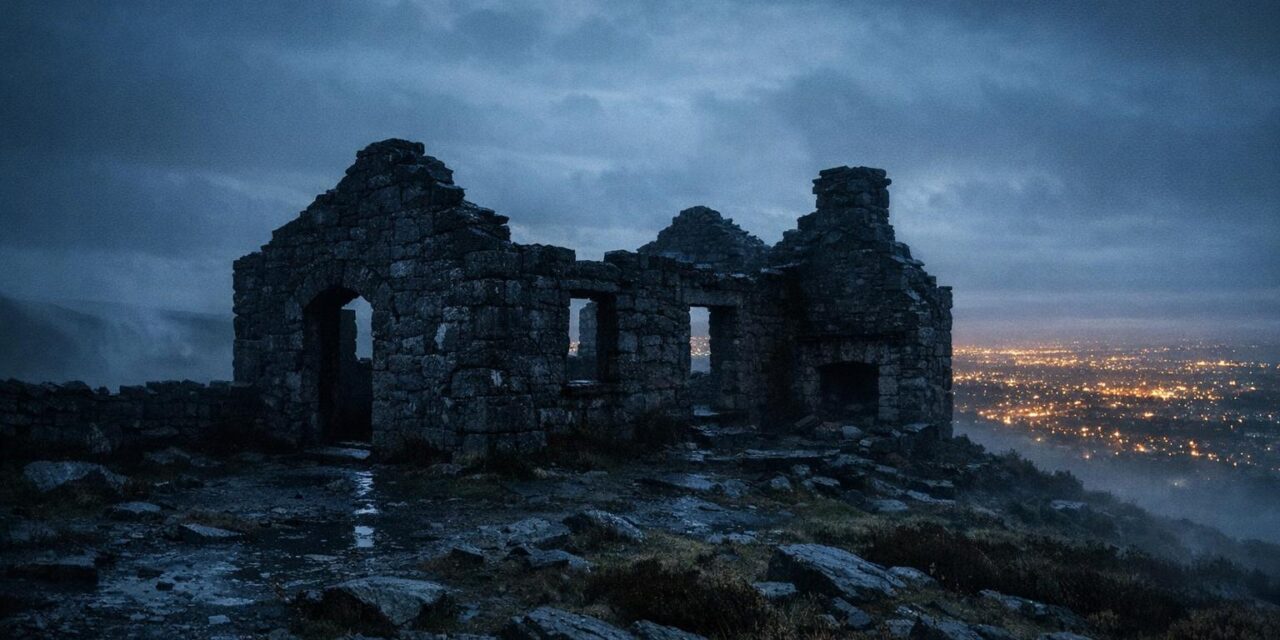
The path up Montpelier Hill outside Dublin begins in easy countryside—gorse, heather, the city spreading below. Then the ruin appears: roofless, blackened, its windows open to the Dublin Mountains sky. The old hunting lodge has been called the Hellfire Club for nearly three centuries. Not the name given when it was built—the name that attached itself because of what happened inside, and because of what came through its door uninvited one night in the eighteenth century and sat down at the table.
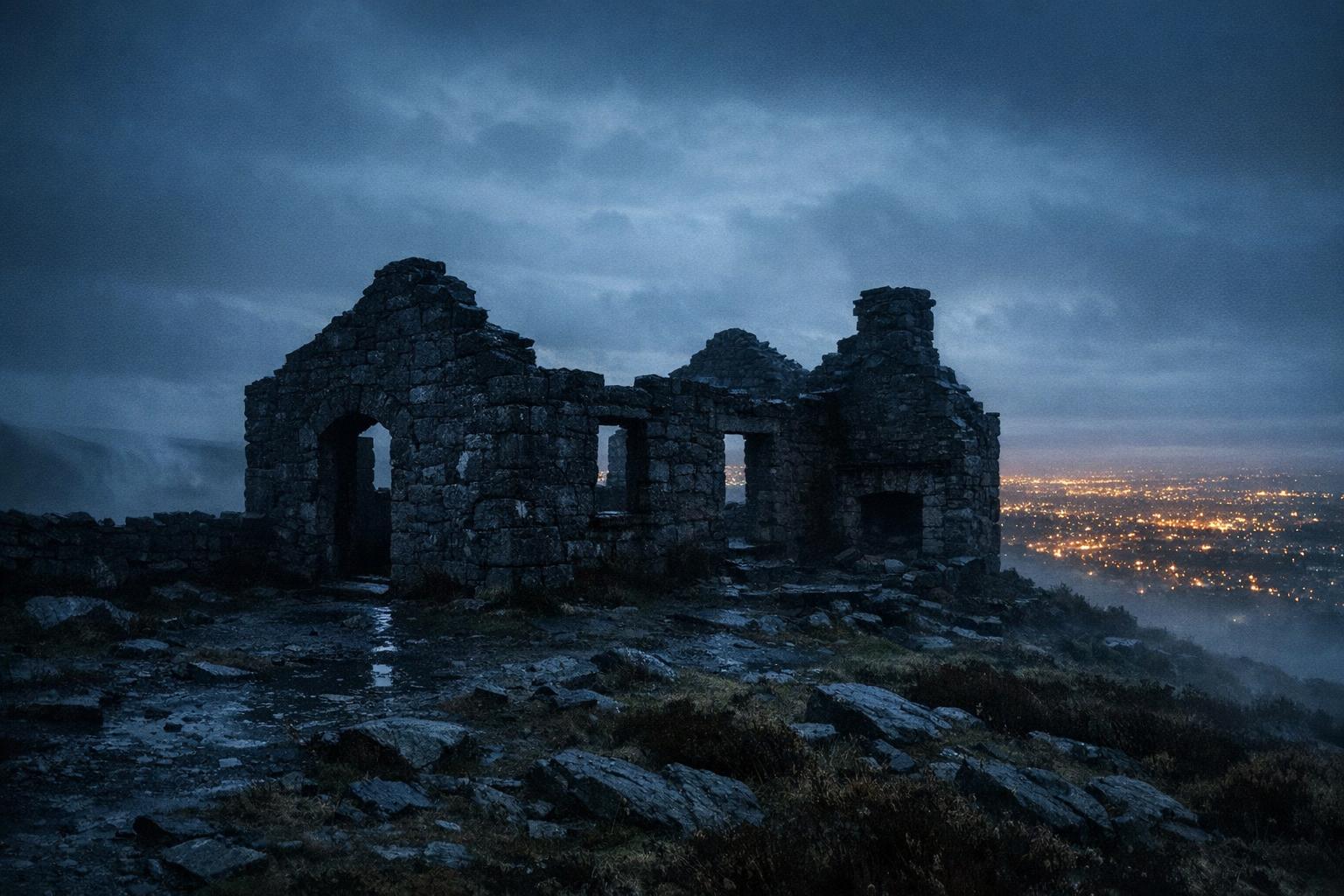
In the mid-eighteenth century, the isolation of Montpelier Hill drew wealthy young Dublin men who called themselves the Hellfire Club—a deliberate provocation, a theater of irreverence far from the city’s watching eyes. They gathered to drink, gamble, and push their evenings toward darkness. Then one night a stranger arrived and took the fourth chair. When a playing card fell to the floor and a member bent to retrieve it, he found himself looking at the stranger’s feet from floor level: not boots, but cloven hooves. The stranger vanished. The room erupted in fire. The roof of the lodge has been burned away ever since.
Today the trail is maintained by the Dublin Mountains Partnership, and the twenty-minute hike from Massy’s Estate is well-traveled. Visitors walk inside the roofless shell and stand where the table once stood. Paranormal investigators rank this among Ireland’s most persistently active sites. What gives the legend its weight is not vague dread but precision—the dropped card, the angle of sight, the exact detail of the fourth chair. Most haunted places in Ireland are defined by tragedy. The Hellfire Club is defined by invitation.
Story Source: www.dublinmountains.ie
Address: Montpelier Hill, Rathfarnham, Dublin, Ireland
Accessibility Rating: Open to All — Freely accessible to the public with no advance requirement. Includes hotels, restaurants, bars, and public historic sites where visitors may walk in without prior booking.
Google Map
What Others Have Experienced
The ruin at the top of Montpelier Hill carries an atmosphere that feels distinct from the cheerful family activity visible on the trails below. The charred interior walls are still visible centuries after the fire, and the combination of pre-Christian passage tomb stones built into the structure, summit views over Dublin Bay, and the accumulated legend of the Hellfire Club members creates a visit with more layers than most Irish historical sites.
— from Your Irish Adventure
Most visitors describe the hike up from the car park as an essential part of the experience — a 2km climb through forest that opens onto the hilltop ruin with sweeping views of the city below. The contrast between the pleasant landscape and the building’s dark reputation creates an unusual tonal quality that many reviewers mention finding difficult to shake even after descending.
— from TripAdvisor
At dusk and after dark, visitors report feelings of being watched, unexplained smells, and a stifling atmosphere that contrasts sharply with the open hilltop setting. The site sits on top of a Bronze Age passage tomb, and the belief that using the tomb’s stones for the hunting lodge’s roof disturbed something ancient is cited repeatedly as the underlying source of Montpelier Hill’s persistent dark reputation.
— from Spirited Isle
A student blogger described the site as one of those rare places where documented history and legend are equally disturbing — the real events of the Hellfire Club members, including excessive drinking, gambling, alleged black masses, and acts of deliberate cruelty, require no embellishment. The ruined shell of the hunting lodge on its isolated hilltop provides exactly the setting those stories need without adding anything artificial.
— from IES Abroad
The site is particularly atmospheric in the early morning or at dusk, when the light changes and the hilltop empties of day hikers. Visitors who time their visit for these windows consistently describe an experience that feels less like a tourist site and more like an encounter with something the landscape has been holding onto for a long time.
— from The Life of Stuff