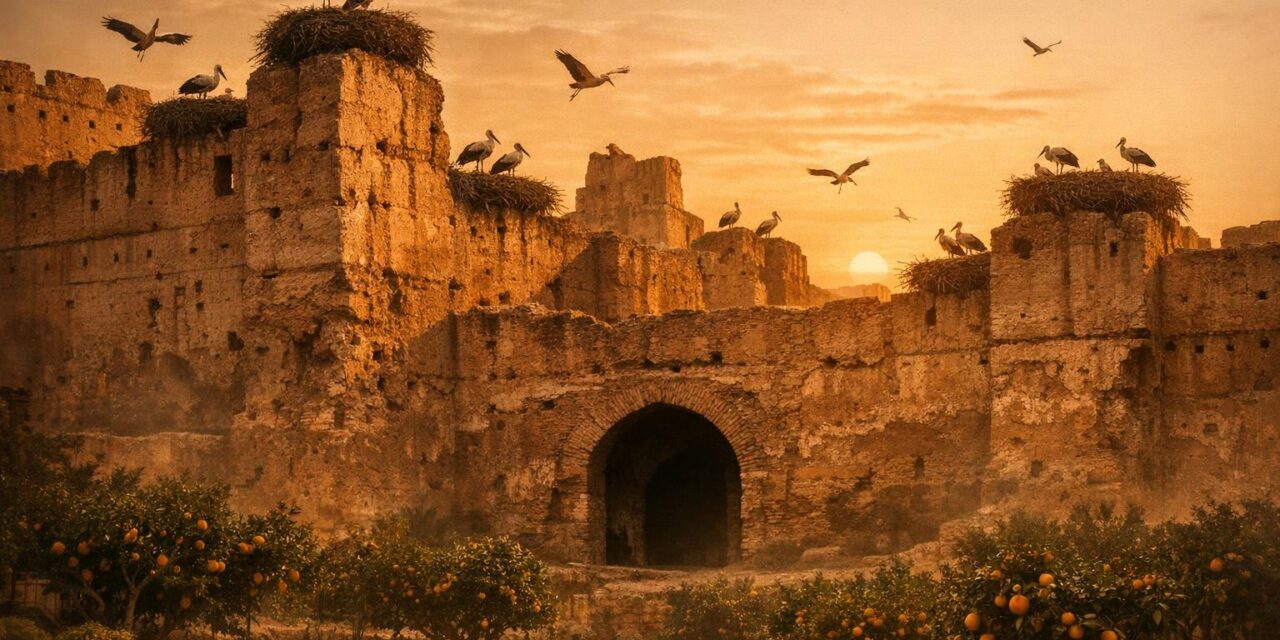
The courtyard smells like orange blossom and old stone and something beneath those things you cannot quite name. You walk through the towering entrance into the roofless expanse of what was once the reception palace of a sultan so wealthy he called his home the Incomparable One, and the first thing you notice is the silence — not absolute silence, because the storks are always talking to each other up on the walls, rattling their bills, but a silence beneath the sound, a hollow at the center of this place that all the noise of Marrakech cannot seem to fill.
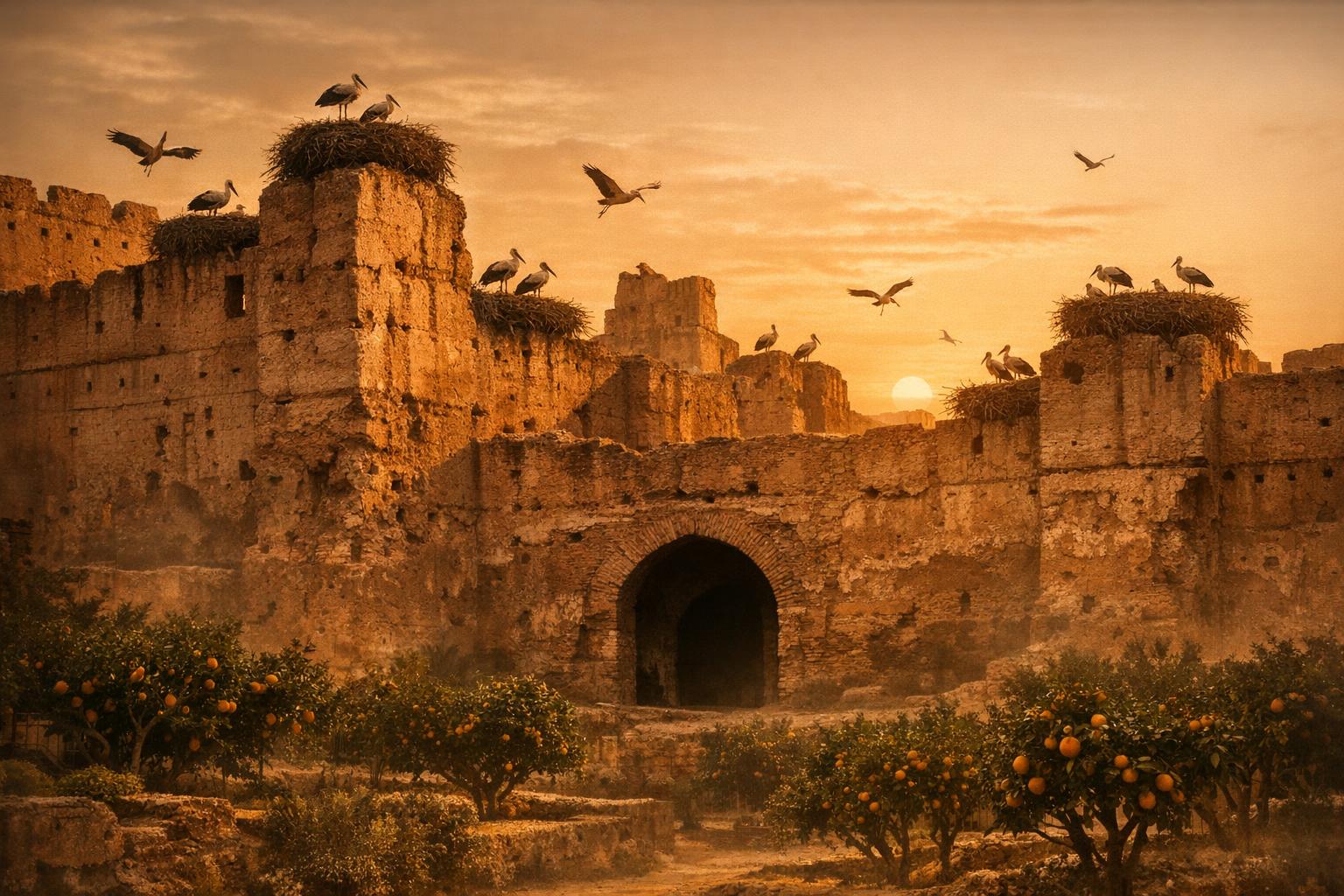
Moulay Ismail came here in the 1680s and spent more than a decade taking El Badi apart. He was thorough. He was vindictive. He stripped every surface worth stripping — the zellij tile, the carved cedarwork, the Carrera marble from Italy, the gold from Sudan — and carted it all north to Meknes to build a palace for his own dynasty. What he left behind was the skeleton. What he left behind were the underground chambers where enslaved workers had lived and captives had been held during the palace’s sixteen years of construction. Not worth taking. Just left there in the dark beneath the ruined courtyard, preserved by his indifference.
The storks on the walls are holy animals in the Berber tradition — transformed humans, souls in feathers, circling what they could not leave in life. Their nests crown the highest points of the crumbling ramparts, enormous and permanent and impossible to ignore. You look up at them and want to decide what you believe. The underground chambers are still there if you want to go down. Most people do. Most people do not stay very long.
Story Source: www.thenotsoinnocentsabroad.com
Address: Ksibat Nhass, Marrakech 40000, Morocco
Accessibility Rating: Open to All — Freely accessible to the public with no advance requirement. Includes hotels, restaurants, bars, and public historic sites where visitors may walk in without prior booking.
Google Map
What Others Have Experienced
Arriving expecting chaos, one visitor found the opposite — a ruined complex so spacious and unhurried it felt like a different city. The crumbling walls and sunlit terraces gave the place a raw, melancholic quality that stayed with them long after leaving Marrakech.
— from TripAdvisor
The underground portion of the site left one visitor unexpectedly moved — rooms beneath the main courtyard where enslaved laborers had once lived and worked now sit silent and shadowed. Standing within the thick outer walls, they found the emptiness made it easier, not harder, to feel the scale of what had once stood there.
— from TripAdvisor
A couple described watching swifts swooping into nests built directly into the ancient stonework, completely unbothered by the visitors below. Something about the birds having quietly taken over the ruins gave the visit a particular atmosphere — less a place that had been lost, more one that was still being inhabited by different occupants.
— from TripAdvisor
With portions of the site under renovation, one visitor found the drained reflecting pools and cordoned courtyards unexpectedly affecting — the absence of what should have been there made the ruins feel more complete, not less. Walking where opulent water features had once been, the compounding losses this place had absorbed over centuries felt suddenly very present.
— from TripAdvisor
One traveler recommended visiting after the nearby Bahia Palace because the contrast made El Badi land differently — where Bahia presses its ornamentation close, El Badi spreads wide across open ground, its scattered orange trees and fractured walls feeling more like a landscape than a building. They described it as the skeleton of something once undeniably magnificent.
— from TripAdvisor