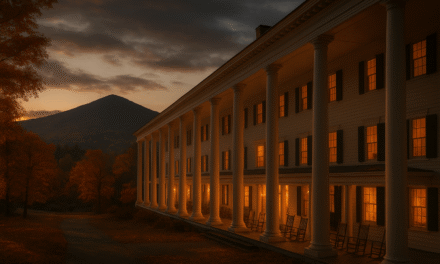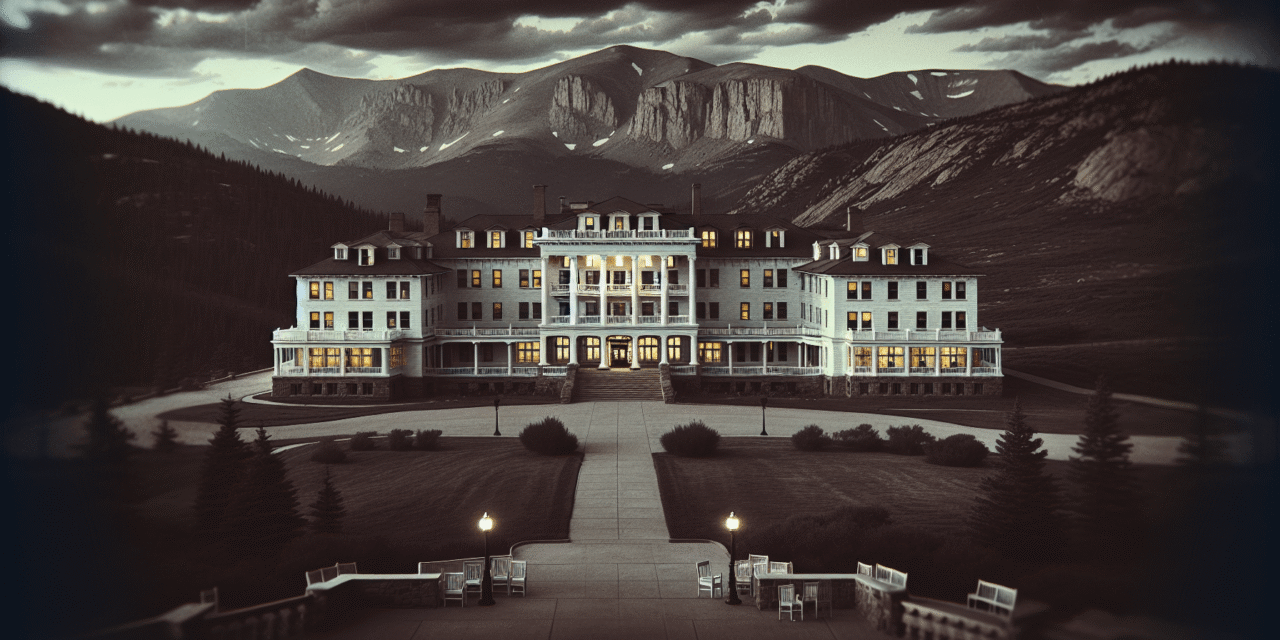
The road bends around lodgepole pines and suddenly there it is — four stories of white Georgian Revival rising against Colorado’s Front Range, symmetrical windows and cream-painted wood set against raw stone and elk country. The Stanley Hotel has stood above Estes Park since July 4, 1909. F.O. Stanley built it after the dry mountain air cured the tuberculosis his doctors had given months to kill him. His wife Flora’s seven-and-a-half-foot Steinway occupied the music room. The hotel had 142 rooms. F.O. Stanley died in 1940 at ninety-one. Neither he nor Flora entirely left.
In the autumn of 1974, Stephen King arrived with his wife Tabitha, nearly alone in a hotel days from closing for winter. Carrie had just been published. They dined in an empty room served by a single bartender, then retired to Room 217 — the one the hotel would become famous for. That night King dreamed of a fire hose chasing his young son through the corridors. He woke, lit a cigarette at the window, and by the time he finished it, The Shining was complete in his head. It was published three years later.
The hotel’s documented strangeness predates King by decades. Elizabeth Wilson, the head chambermaid, entered Room 217 to light gas fixtures with a candle. The leaking gas ignited. The explosion sent her through the floor. She survived and never, by most accounts, left. Flora Stanley’s Steinway has been witnessed moving on its own in an empty music room. F.O. himself appears in the billiard room and bar — tall, formally dressed, vanishing when approached. The Stanley discloses its case files openly and calls it history.
Story Source: www.stanleyhotel.com
Address: 333 E Wonderview Ave, Estes Park, CO 80517
Accessibility Rating: Open to All — Freely accessible to the public with no advance requirement. Includes hotels, restaurants, bars, and public historic sites where visitors may walk in without prior booking.
Google Map
What Others Have Experienced
The Stanley is a working luxury hotel, which means visitors can experience the property simultaneously as a staying guest, a day visitor taking the ghost tour, or someone who simply drives up for a look at the building and grounds. The combination of Rocky Mountain setting, Edwardian architecture, and documented association with The Shining gives it a layered quality that pure haunted-attraction venues lack.
— from Fora Travel
Room 217 — where Stephen King stayed when the idea for The Shining came to him, and where both paranormal investigators and ordinary guests report a disproportionate frequency of unexplained experiences — is the most requested room in the hotel. Guests who have stayed there describe a range from disturbed sleep to objects moved by morning, and the room is reportedly booked months in advance for most of the year.
— from Addie Abroad
The Night Tour, 90 minutes, is consistently described as the best way for non-guests to experience the hotel’s paranormal history. Guides cover both the historical context of the building’s ghosts — including founders F.O. and Flora Stanley — and the recent investigative record, with the ballroom and Room 217 producing the highest concentration of reported accounts across independent visitors.
— from The Well Worn Shoes
The ballroom is identified alongside Room 217 as one of the hotel’s two primary paranormal focal points. Overnight guests describe hearing music from the ballroom at night when the room is empty and locked, a phenomenon reported by staff and visitors across decades. The room’s formal Victorian grandeur and use for public events make reports of out-of-hours activity particularly difficult to attribute to misidentification.
— from Colorado.com
The hotel’s location at the entrance to Rocky Mountain National Park means the surrounding landscape contributes to the experience in a way urban haunted sites cannot replicate. Visitors who stay overnight during winter, when Estes Park largely empties out, describe an isolation that comes closest to what King captured in The Shining — the hotel enormous against the mountains, the town quiet, and the high altitude adding a physical disorientation of its own.
— from TripAdvisor