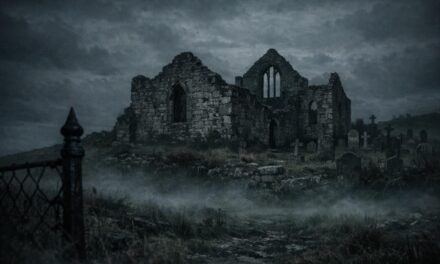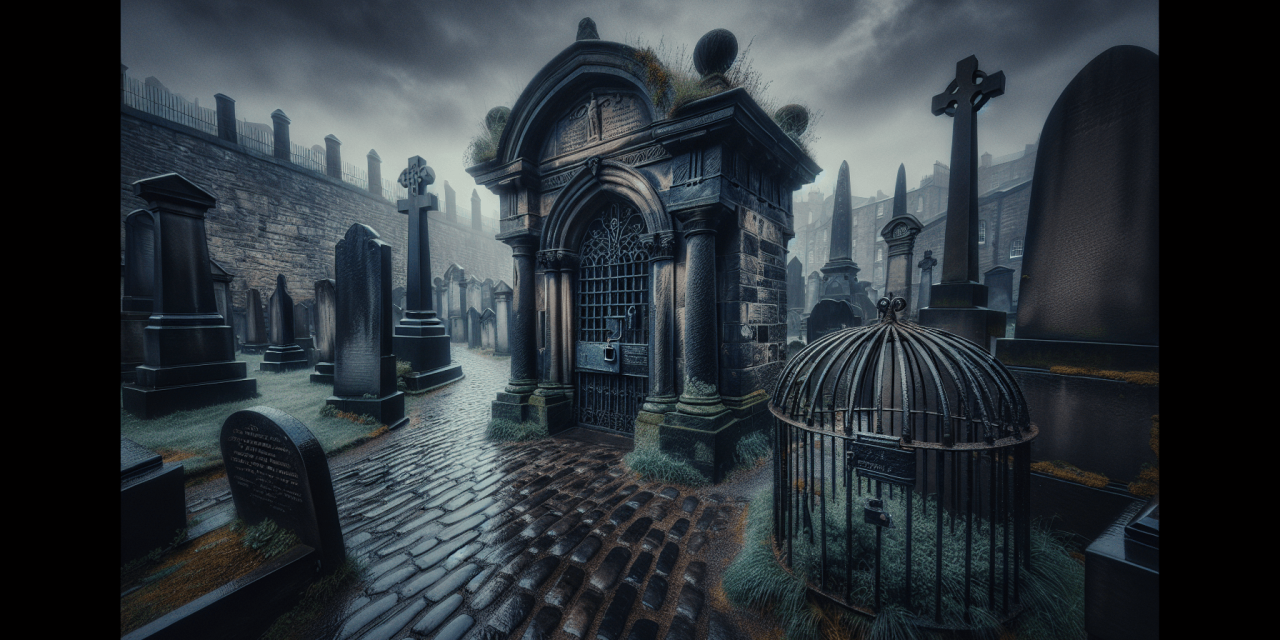
The kirkyard looks, at first, like any other historic Scottish churchyard — leaning headstones, Greyfriars Bobby’s statue worn smooth at the gate. Come at dusk in November, when the Edinburgh wind has actual cold in it and the sky closes down early. Iron mortsafes clamp over the older tombs. In the southwest corner, behind a locked iron gate, sits the Black Mausoleum: rectangular, dark with age, sealed with a heavy padlock. The padlock is not there for show.
The mausoleum holds Sir George Mackenzie of Rosehaugh — Lord Advocate under Charles II and James VII, buried here in 1691. History named him Bluidy Mackenzie for his prosecution of Scottish Covenanters during the Killing Time of the 1680s, a campaign of Crown suppression estimated to have killed 18,000. In 1679, following the Battle of Bothwell Bridge, approximately 1,200 Covenanting prisoners were marched to Edinburgh and confined in this kirkyard’s southwest enclosure — an open-air prison with no roof and minimal provisions. By the early 2000s, reports of visitors leaving the Black Mausoleum with unexplained marks on their bodies had accumulated enough that Edinburgh Council commissioned two formal exorcisms, both conducted by minister Colin Grant. Over 180 people have collapsed at this single location. The activity continued after both.
Researchers cite infrasound, electromagnetic fluctuations, and the amplifying effect of suggestion. None fully accounts for the physical marks or the sustained collapse rate. The mausoleum now anchors nightly ghost tours; the guide relocks the padlock when each group exits. Whatever continues to happen inside to those who enter skeptical and leave marked — the walk out always feels shorter than the walk in. It always does.
Story Source: www.scotsman.com
Address: Greyfriars Kirkyard, Candlemaker Row, Edinburgh EH1 2QQ, Scotland
Accessibility Rating: Open to All — Freely accessible to the public with no advance requirement. Includes hotels, restaurants, bars, and public historic sites where visitors may walk in without prior booking.
Google Map
What Others Have Experienced
Greyfriars Kirkyard is freely accessible during daylight hours, and many visitors describe the graveyard as atmospheric enough without any guided context — the old stones crowded on the slope beneath the castle, the density of the inscriptions, and the accumulated sense of time create an environment that needs no ghost story to affect visitors. The Covenanter’s Prison at the rear, accessible only via the City of the Dead tour through a locked gate, is where the majority of paranormal incidents are concentrated.
— from Eat Drink Travel
The City of the Dead Tours describe the Mackenzie Poltergeist not as a ghost story but as a documented phenomenon — over 3,500 visitor encounters recorded since 1999, including physical attacks in the form of scratches, bruises, and bites on witnesses’ bodies in the area around the Black Mausoleum. Tour operators specifically warn participants that the entity can cause genuine physical and mental distress.
— from City of the Dead Tours
Visitors who enter the Covenanter’s Prison describe the atmosphere change as immediate and difficult to attribute to suggestion — the air heavier, the temperature noticeably lower, and the ambient city noise from the Royal Mile completely absent behind the old walls. This specific combination of sensory shifts is described consistently across unrelated visitor accounts, including those of people who were openly skeptical before entering.
— from Worth Your Wallet
A visitor account described approaching the Black Mausoleum and feeling a distinct “tightening hush before something happens in a horror film” — a description that reappears in variant form across many independent accounts of the same spot. The consistency of specific sensations in specific locations within the kirkyard is what distinguishes Greyfriars from sites where paranormal claims are diffuse and unlocalized.
— from The Scotsman
The Mackenzie Poltergeist phenomenon is unusual in paranormal research for the specificity and physical nature of reported attacks. Unlike the vague impressions typical at most haunted sites, the Greyfriars incidents include injuries documented by medical professionals and reported to police over a 25-year period, which gives the site a degree of evidential weight that few comparable locations can claim.
— from Paranormal Field Investigators