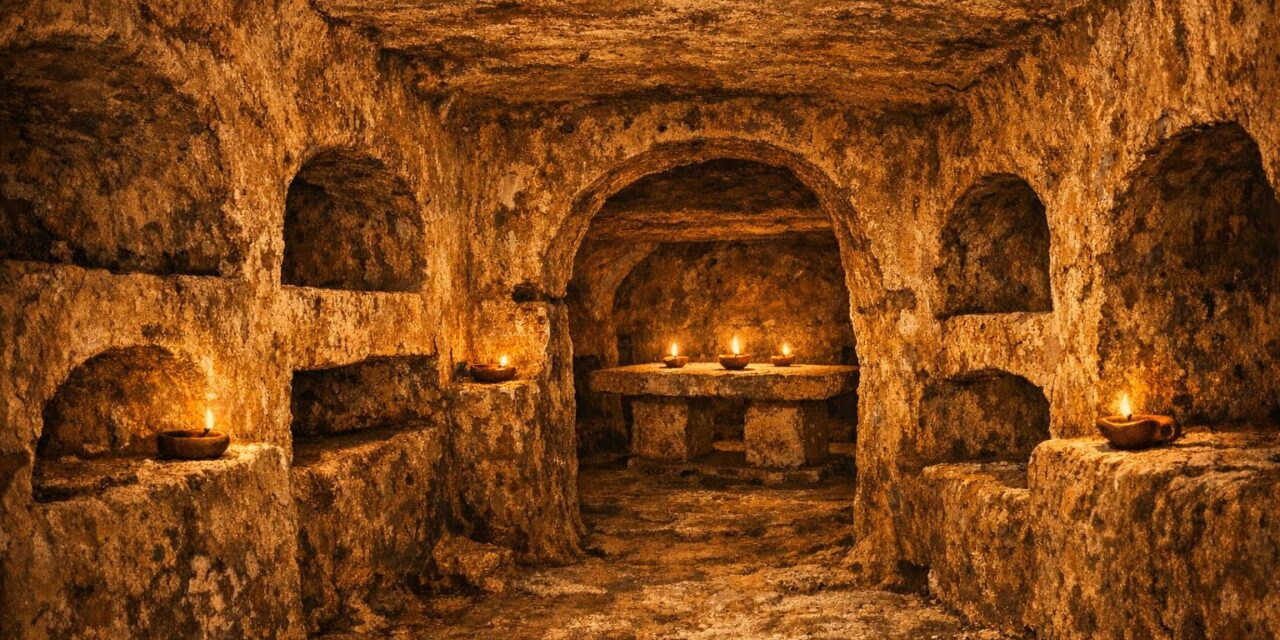
The stairs at St. Agatha Street in Rabat descend into soft limestone, and within a few meters the light from above is gone. Passageways open into chambers, chambers connect to galleries, the galleries branch through more than two thousand square meters of carved rock in which the dead of Malta’s earliest Christian community were placed across several centuries. St. Paul’s Catacombs are among the most extensive underground burial sites in the Mediterranean outside of Rome — a fact that becomes clear once you are inside and the scale of what was cut from the rock by human hands reveals itself.
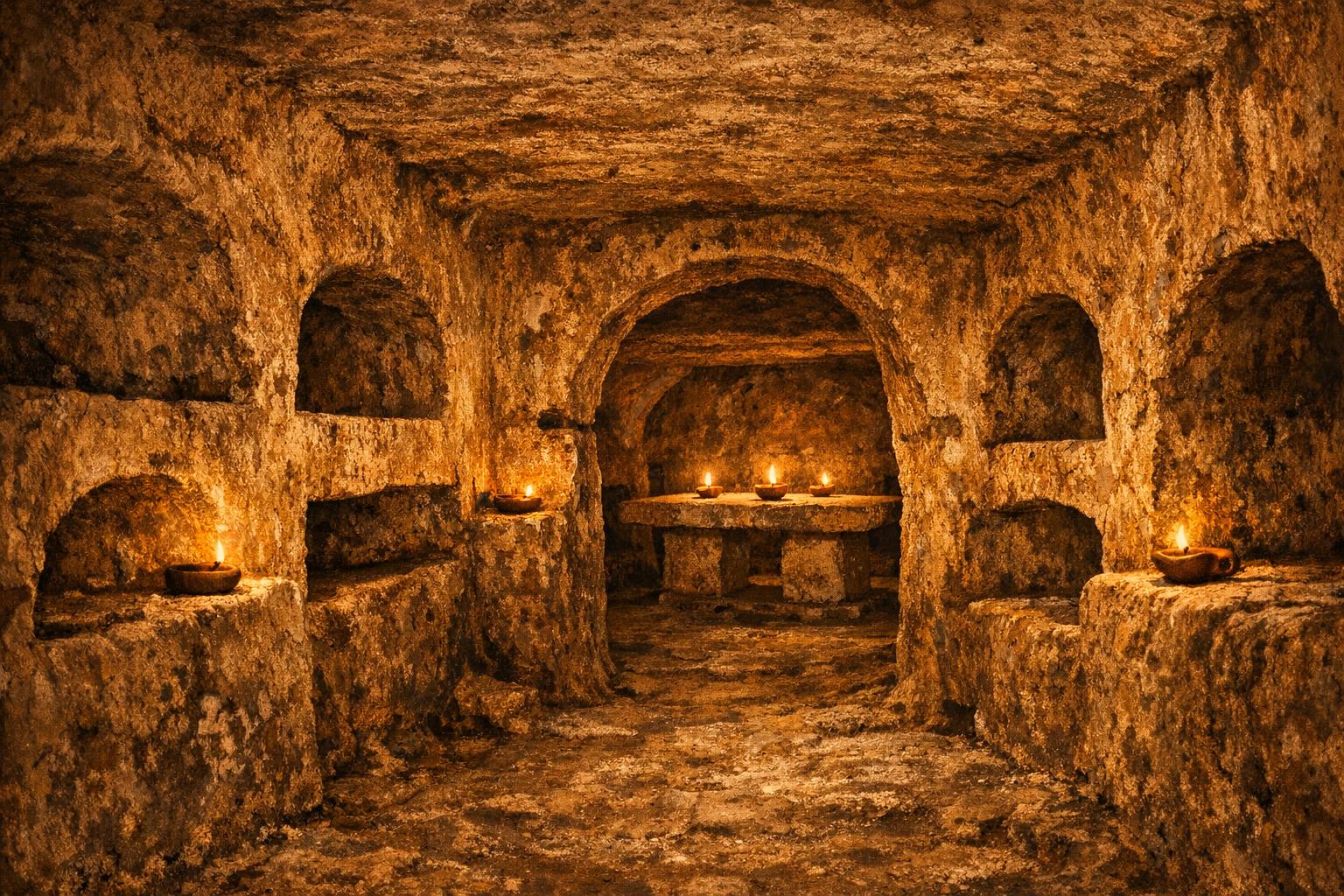
The burials began in the third century AD and continued through the early medieval era. The community doing the burying was among the earliest Christian communities in Europe, its origins traced to the shipwreck of the Apostle Paul on Malta around AD 60. The tombs take multiple forms — simple wall niches, elaborately carved baldacchino canopies reserved for higher-status individuals, and arched arcosolia framing stone slabs. Most distinctive are the agape tables: circular stone platforms cut from the bedrock, surrounded by benches, used for ritual funeral meals at which the living gathered near their dead to eat and commemorate them. Two thousand years later, those tables are still there in exactly the form they were carved.
Heritage Malta manages the catacombs and opens them to visitors year-round with walkways and lighting. The site does not dramatize itself. It does not need to. The stone is unchanged. What was made for the dead remains exactly as it was cut, and standing inside it produces a quality of temporal compression that most historical sites cannot match.
Story Source: heritagemalta.mt
Address: St Agatha Street, Rabat, RBT 2013, Malta
Accessibility Rating: Open to All — Freely accessible to the public with no advance requirement. Includes hotels, restaurants, bars, and public historic sites where visitors may walk in without prior booking.
Google Map
What Others Have Experienced
Visitors to St. Paul’s Catacombs describe the scale as unexpectedly vast — a sprawling network of ancient burial chambers extending far beyond what the modest entrance suggests. Low stone ceilings, rough-carved passageways, and visible ancient burial niches create an atmosphere that feels genuinely removed from the modern world overhead, with the air growing cooler and stiller the deeper one goes.
— from TripAdvisor
The contrast between St. Paul’s and St. Agatha’s is frequently noted by visitors who tour both. St. Paul’s is well-lit and self-guided; St. Agatha’s — accessible only with a guide — is described as considerably more unsettling, with ancient frescoes still visible on the walls, skeletal remains resting in some burial niches, and an atmosphere that more closely approximates what the catacombs must have felt like in daily use.
— from TripAdvisor
The catacombs date to the 4th and 5th centuries AD and functioned as communal burial grounds for Christians, Jews, and pagans in the same network — a rare historical arrangement. Visitors who understand this context find the site carries a layered significance that extends well beyond any single religious narrative, the physical proximity of different burial traditions lending the space an unusual stillness.
— from Malta Culture
Claustrophobia is a genuine concern that multiple visitors flag. Some passages require ducking, with stone pressing close on both sides, and the air grows noticeably cooler and stiller with depth. Those prone to confined spaces are consistently warned to proceed carefully or to stay within the more accessible upper sections near the visitor center.
— from TripAdvisor
A travel reviewer noted that the medieval streets of Rabat above ground reward exploration before or after the descent — the ancient above-ground town and the Roman-era necropolis below creating a layered, time-bending experience. The transition from bright Maltese sunlight into the cool dark of the catacombs adds a physical dimension to the historical distance the site spans.
— from Expedia