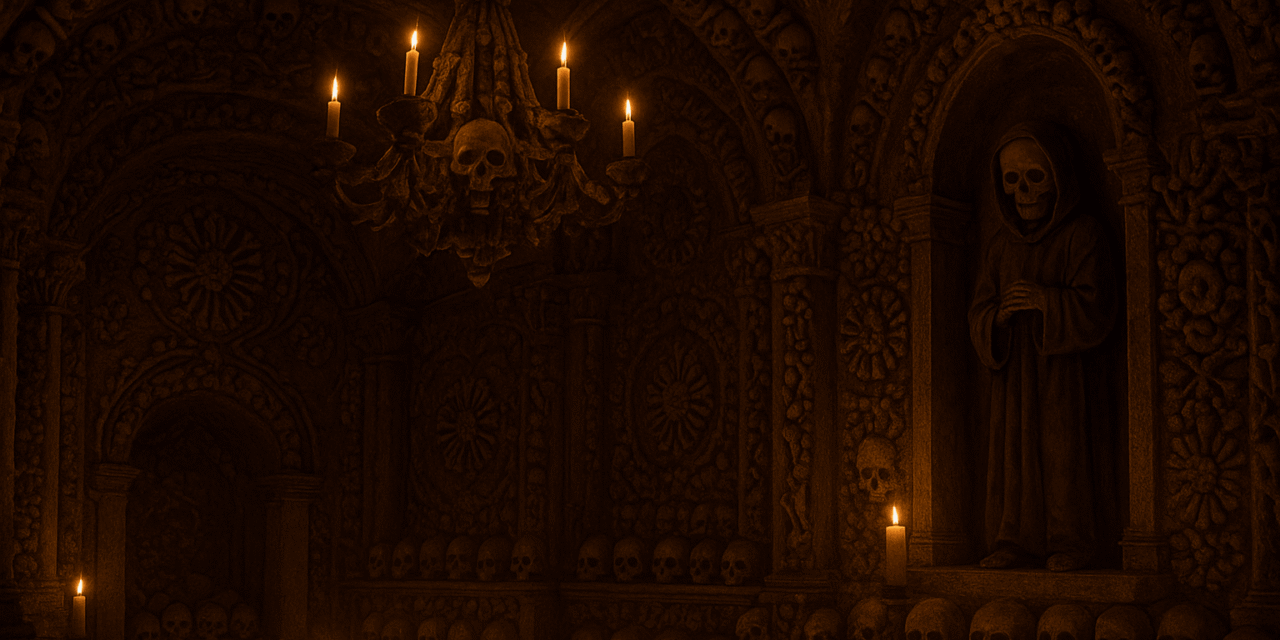
Beneath the church of Santa Maria della Concezione on Rome’s Via Veneto lies a crypt unlike anything else in a city full of extraordinary things: six underground chapels decorated with the arranged bones of approximately 3,700 Capuchin friars who lived and died here between 1631 and 1870. Vertebrae form rosettes. Pelvises arch into doorways. Femurs create geometric patterns across the walls. Skulls tile entire vaulted ceilings. The friars who built these arrangements were not morbid for the sake of it — they were Franciscans practicing memento mori, a meditative tradition that uses confrontation with death to clarify the priorities of life. The result is something that functions simultaneously as charnel house, art installation, and theological argument.
The bones are largely anonymous — the community’s dead rather than named individuals — with one exception: a small robed child, a young Barberini relation, preserved in a niche in the final chapel with a scythe in one hand and a scale in the other. He is the only figure presented as an individual, and he is the one most visitors cannot look at for long. At the end of the crypt, a placard offers the sentence associated with this tradition since the eighteenth century: “What you are now, we once were; what we are now, you will be.” The Marquis de Sade visited in 1775 and left unsettled. Most visitors report the same.
Ghost accounts from the crypt are quieter than most haunted sites produce — no screaming, no dramatic apparitions. What visitors consistently describe is a directional cold that does not match the ambient temperature, a mounting sense of being observed that intensifies with depth, and in the final chapel, something that a few long-term staff members describe as intentional rather than random: the impression of communication from the space itself, from bones arranged by hands that knew exactly what they were doing and why they were doing it.
Story Source: www.cappucciniviaveneto.it
Address: Via Veneto 27, 00187 Rome, Italy
Accessibility Rating: Booking Recommended
Google Map
What Others Have Experienced
In the Crypt of the Skulls, one of the standing friars in his brown habit leans slightly forward, as though bowing to visitors. Another appears to have turned his head sideways, as if averting his gaze. The third friar, positioned between them, has his empty eye sockets aimed directly at whoever enters the room — a detail that one dark tourism reviewer described as genuinely spine-chilling.
— from Dark Tourismm
The Crypt of the Shin Bones and Thigh Bones is flanked by eight Capuchin friars in traditional brown habits, four on each side. At the rear wall, the Franciscan crest is formed from a mummified naked arm representing Christ crossed with a clothed arm representing St Francis. The floor in front of them is cemetery soil, with crosses pressed into it — raising the uneasy question of whether the friars still bury their dead there.
— from Dark Tourismm
Fixed to the ceiling of the Crypt of the Three Skeletons is a small skeleton — a child’s, by the look of it — holding a bone-made scythe in one hand and a set of scales also constructed from bones in the other. The figure functions as a miniature Grim Reaper, suspended overhead while visitors pass beneath. The rest of the chapel’s walls and ceiling are covered in geometric patterns of additional bones arranged into decorative designs.
— from Dark Tourismm
A plaque inside the crypt states its message in five languages: “What you are now we used to be; what we are now you will be.” Famous visitors over the centuries — including the Marquis de Sade, Nathaniel Hawthorne, and Mark Twain — all left written accounts of the crypt, their reactions described as a mixture of disbelief, horror, and awe. The crypt forbids photography, enforced by CCTV cameras, with a loudspeaker announcement publicly calling out anyone caught trying.
— from Walks of Italy
Several of the chapels also contain semi-mummified bodies still wearing their brown Capuchin habits — some retaining remnants of dried skin on the face and hands. Visitors who have walked the crypt describe these partially preserved bodies as even more unsettling than the pure bone arrangements, because the presence of remaining flesh makes the figures look less like relics and more like the recently dead.
— from Dark Tourismm