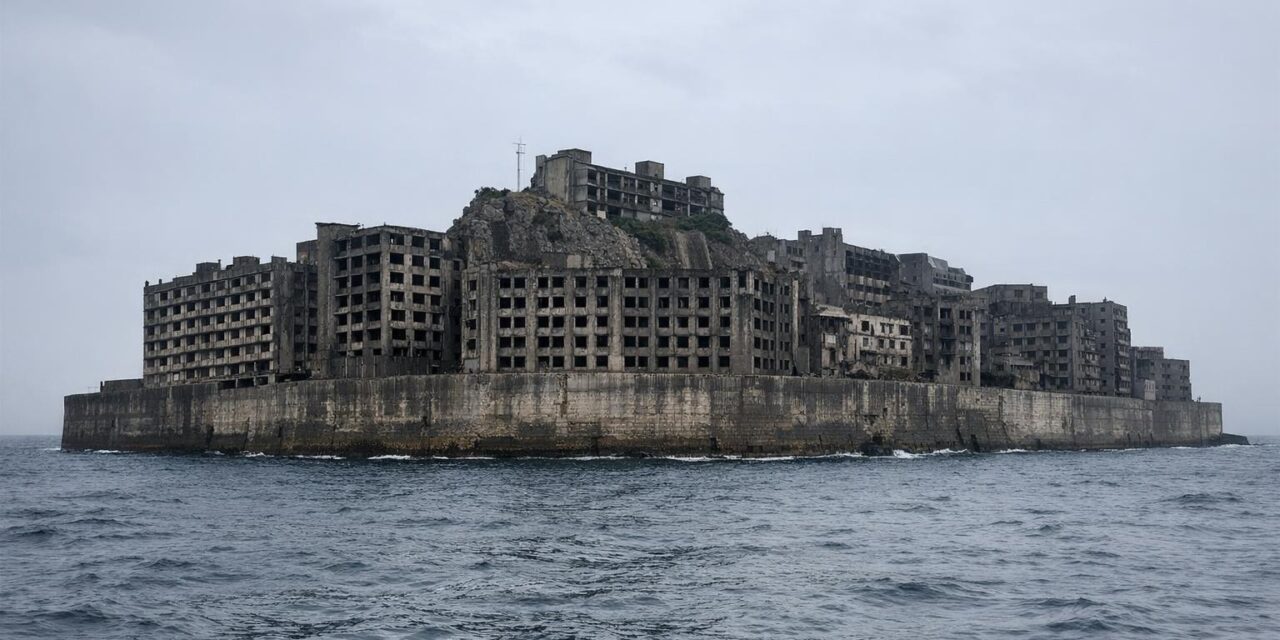
Fifteen kilometers off the coast of Nagasaki, a concrete island rises from Tachibana Bay looking like nothing so much as a warship at anchor — blocky, angular, dark with salt and age. The Japanese sailors who named it Gunkanjima were not wrong. Hashima Island is barely six hectares, yet at its peak in 1959 it held over 5,200 people inside a ring of seawalls and apartment blocks, all built on coal. Mitsubishi’s undersea mine drove the island’s existence from 1890 until April 1974, when the last residents boarded a ferry and the gates closed behind them.
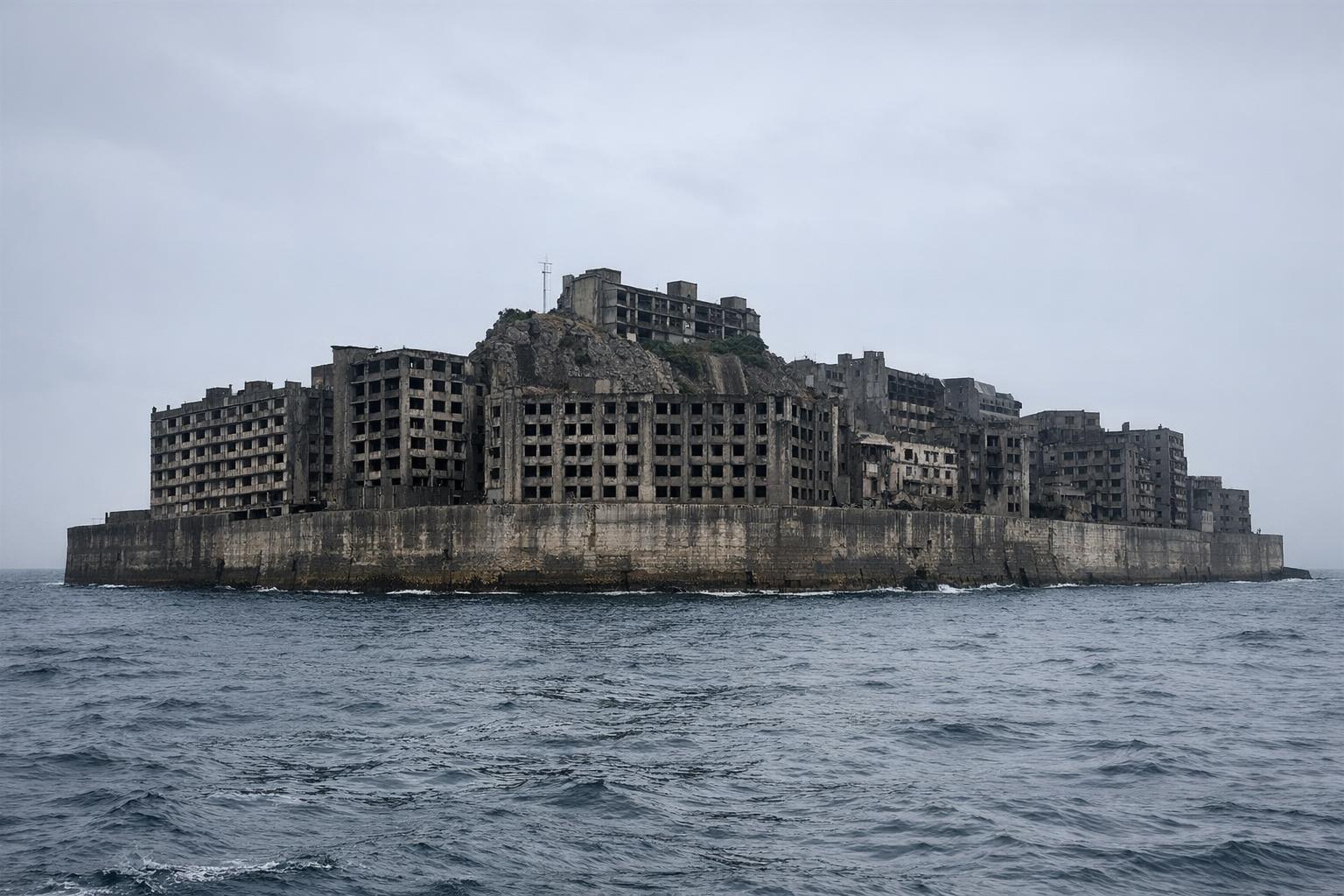
The departure happened fast — less than three months from announcement to closure — and an island that had accumulated nearly a century of human life could not be fully packed up in ninety days. Calendars stopped on winter dates. Textbooks stayed stacked on school desks. Bicycles leaned in corridors. Beneath the surface nostalgia, something darker: during the Second World War, Korean and Chinese laborers were brought to Hashima under compulsion to work the undersea seams, and an estimated 1,300 of them died on the island. Their cemetery on the northern end has been largely reclaimed by the sea.
Hashima reopened to limited tourism in 2009 and became a UNESCO World Heritage Site in 2015. Visitors are confined to a small walkway on the southern end, watching the ruins at a distance — collapsed floors, dark windows, apartment blocks stripped of everything except their concrete frames. Former residents describe the island as haunted not by theatrical apparitions but by a density of accumulated life that the silence cannot quite absorb. The buildings remember more than the official record acknowledges.
Story Source: www.japan.travel
Address: Hashima Island (Gunkanjima), Nagasaki, Japan
Accessibility Rating: Guided Tours Only — Access permitted only as part of an organized tour. Independent exploration not allowed.
Google Map
What Others Have Experienced
Visitors describe the approach by boat as among the most striking moments of any Nagasaki trip — the island’s dense grid of concrete apartment blocks and rusting industrial towers rising from the open sea, the profile resembling a battleship from certain angles. The knowledge that no one has lived there since 1974 makes the skyline feel impossible as the ferry draws close.
— from Japan Guide
The time actually spent on the island surprises many visitors with its brevity — roughly 45 minutes on three designated observation decks. But what is visible from those positions leaves a lasting impression: crumbling apartment buildings with empty windows, rusting infrastructure pressing up against the sea wall, and vegetation forcing through concrete floors that once held thousands of residents.
— from Japan Cheapo
Weather cancellations are the single most common frustration in visitor accounts — a significant number describe arriving at the port only to have the tour cancelled due to wave height, sometimes after planning specifically around this visit. The universal advice is to allow two to three days in Nagasaki to accommodate likely rescheduling before giving up.
— from TripAdvisor
The island carries particular weight for visitors who learn during the tour about the conditions imposed on Korean forced labourers during WWII. The already-claustrophobic abandoned settlement gains an additional layer of historical gravity, and some visitors describe an emotional discomfort that goes beyond the dramatic visual environment of the ruins.
— from GaijinPot Travel
The visible deterioration of the island’s structures year on year lends the experience a quality of urgency — visitors describe a sense of witnessing something that will not exist in the same form much longer, with walls crumbling into the sea and floors collapsing into lower levels. The UNESCO designation provides institutional permanence, but the physical reality remains one of accelerating decay.
— from Fun Japan