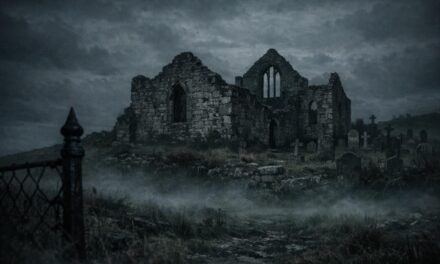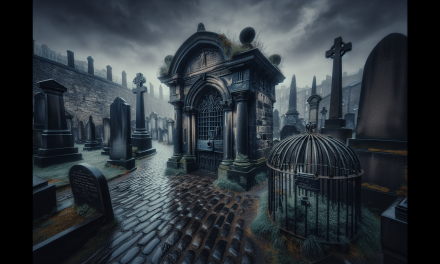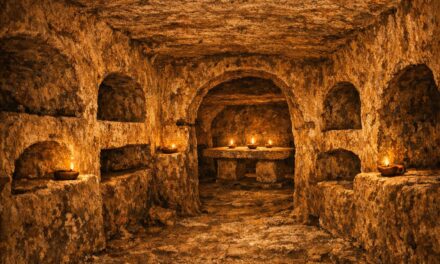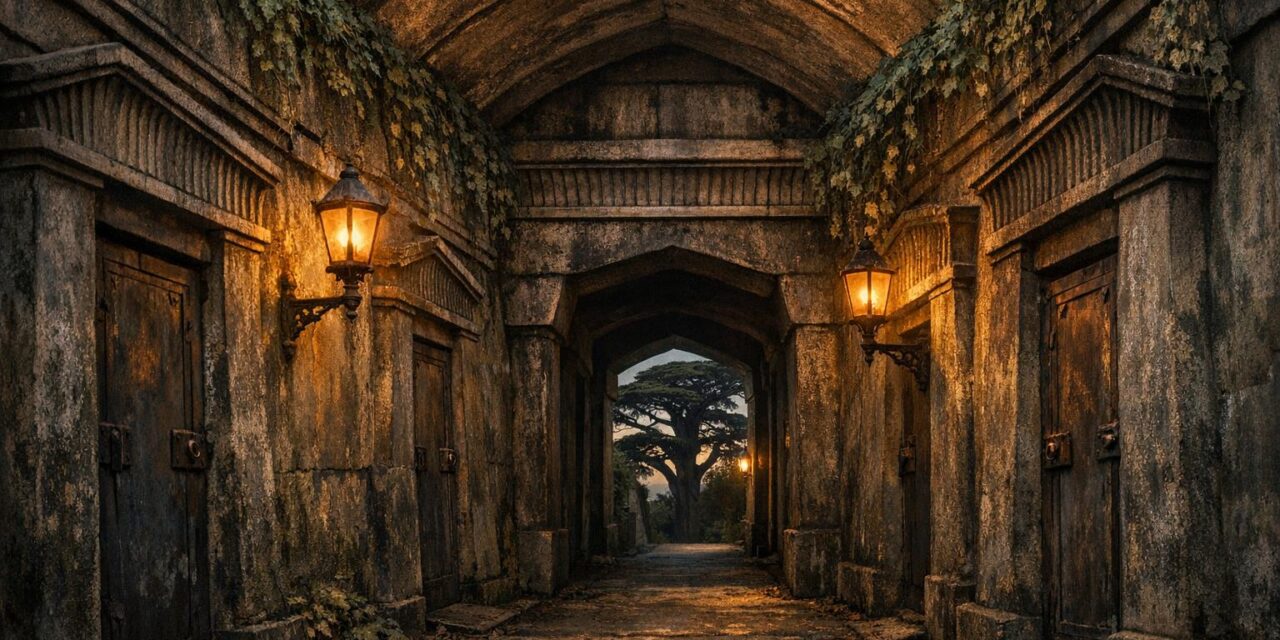
Highgate Cemetery spreads across seventeen acres of Victorian Gothic drama on a steep North London hillside — the Egyptian Avenue lined with family vaults, the Lebanon Circle curving around an ancient cedar, catacombs running beneath the paths in long galleries. By the late 1960s, ivy had consumed obelisks, roots had lifted monuments, and the West Cemetery’s overgrowth made midday feel like dusk. The place was already the kind of landscape that produces legends before anyone arrived to make one.
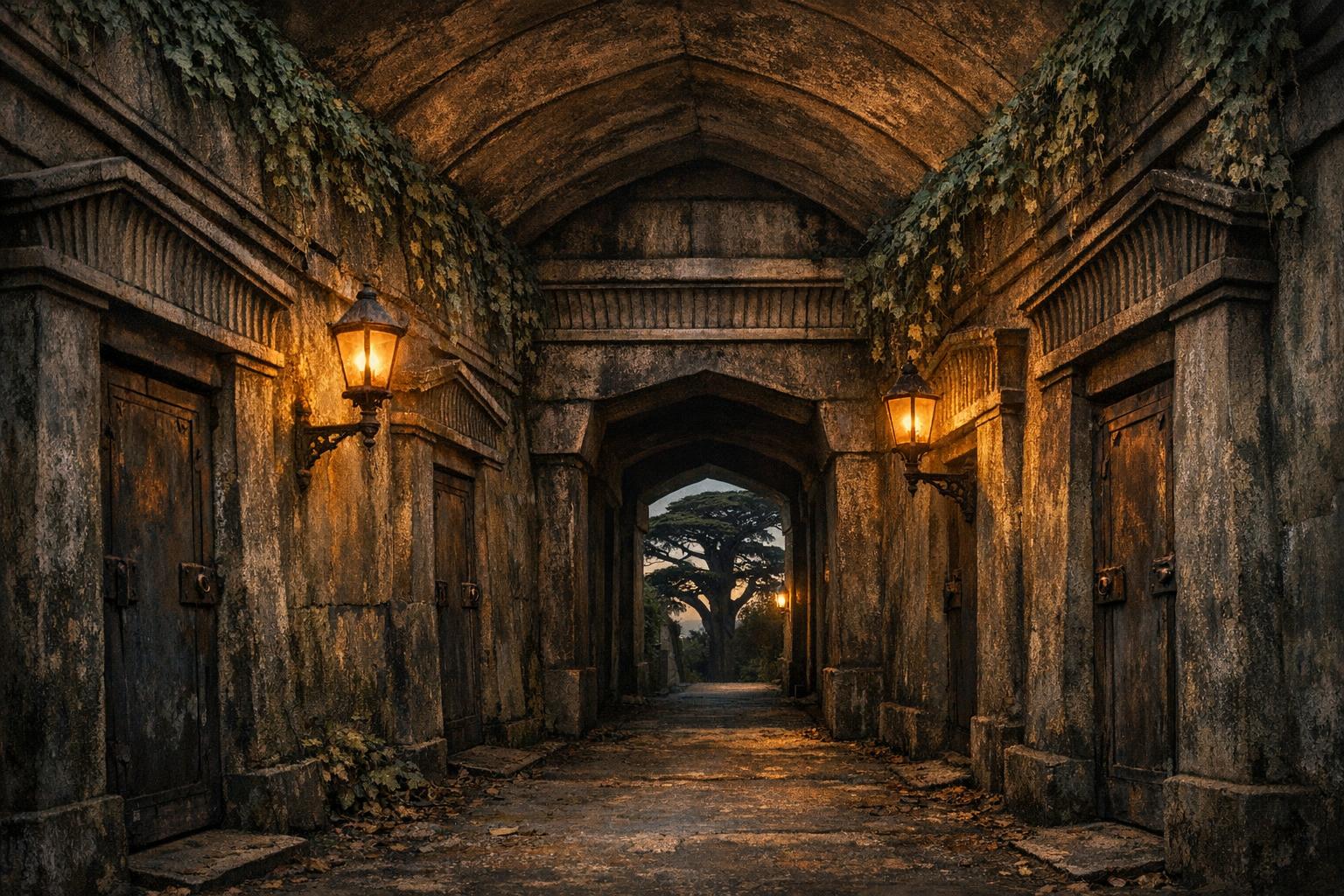
In late 1969, David Farrant reported seeing a grey figure near the cemetery gates on Swain’s Lane. Sean Manchester — a self-styled vampire hunter — announced publicly that the entity was a Transylvanian King Vampire of the Undead, transported to England in the eighteenth century. On a BBC broadcast on New Year’s Eve 1969, Manchester declared his intention to hunt the creature. Hundreds descended on Highgate the following night, some carrying stakes. Gates were stormed, vaults broken into, monuments damaged. A sustained period of desecration followed. Farrant was convicted of grave desecration in 1974. Manchester later claimed to have staked the vampire in a nearby house basement — a claim he maintained for the rest of his life.
The Friends of Highgate Cemetery, established in 1975, rescued the site from dereliction and now manage both sections. Karl Marx, George Eliot, and Christina Rossetti are among the buried. The West Cemetery is accessible by guided tour only; the East is self-guided. For the adventure traveler, Highgate offers what few places can: a genuinely extraordinary Victorian landscape that became the site of a genuinely extraordinary modern story — and still carries both.
Story Source: highgatecemetery.org
Address: Swain’s Lane, Highgate, London, N6 6PJ
Accessibility Rating: Guided Tours Only — Access permitted only as part of an organized tour. Independent exploration not allowed.
Google Map
What Others Have Experienced
In the early 1970s, multiple independent witnesses reported encounters with a tall figure in dark clothing with burning eyes near the cemetery gates and within the grounds, sparking a media frenzy that culminated in an organized vampire hunt that drew hundreds of people to the cemetery. The chaos caused significant damage to memorials and led to criminal prosecutions, but the underlying sightings — which predated the press attention by years — were independently corroborated by people with no apparent connection to each other.
— from Amy’s Crypt
Beyond the vampire legend, Highgate Cemetery has accumulated a roster of other reported apparitions including a spectral cyclist moving along the paths, a faceless man observed standing motionless between headstones, and a floating nun described by multiple independent witnesses who encountered her in the same section of the grounds. The diversity of the accounts — each involving a different entity with its own consistent description — is noted by paranormal researchers as unusual even for a site of this size and age.
— from Lundun
The West Cemetery — where the vampire legend is centered and where the most Victorian-era funerary architecture is concentrated — is accessible only by guided tour, which visitors consistently describe as one of London’s most atmospheric experiences regardless of paranormal interest. The combination of Egyptian Avenue, the Circle of Lebanon, and the dense canopy of overgrowth creates an environment that tour guides describe as one of the few places in London where time genuinely seems to stop.
— from Little House of Horrors
The cemetery fell into severe neglect from the 1960s onward, a period of decay that coincided precisely with the emergence of the vampire accounts. The overgrown Victorian monuments and collapsing vaults of that era created conditions that regular visitors described as genuinely frightening even in daylight, and paranormal researchers argue that the period of neglect — during which the boundary between maintained space and wilderness blurred — created the conditions for the sightings to begin.
— from Moon Mausoleum
Paranormal researcher and author David Farrant, one of the original investigators of the Highgate case, maintained until his death that what he and others witnessed at the cemetery in the late 1960s and early 1970s was genuine — a presence that he described as non-human, intelligent, and aware of being observed. His accounts are considered among the most detailed first-person records of the Highgate phenomena and have remained consistent across decades of subsequent interviews.
— from David Castleton Blog