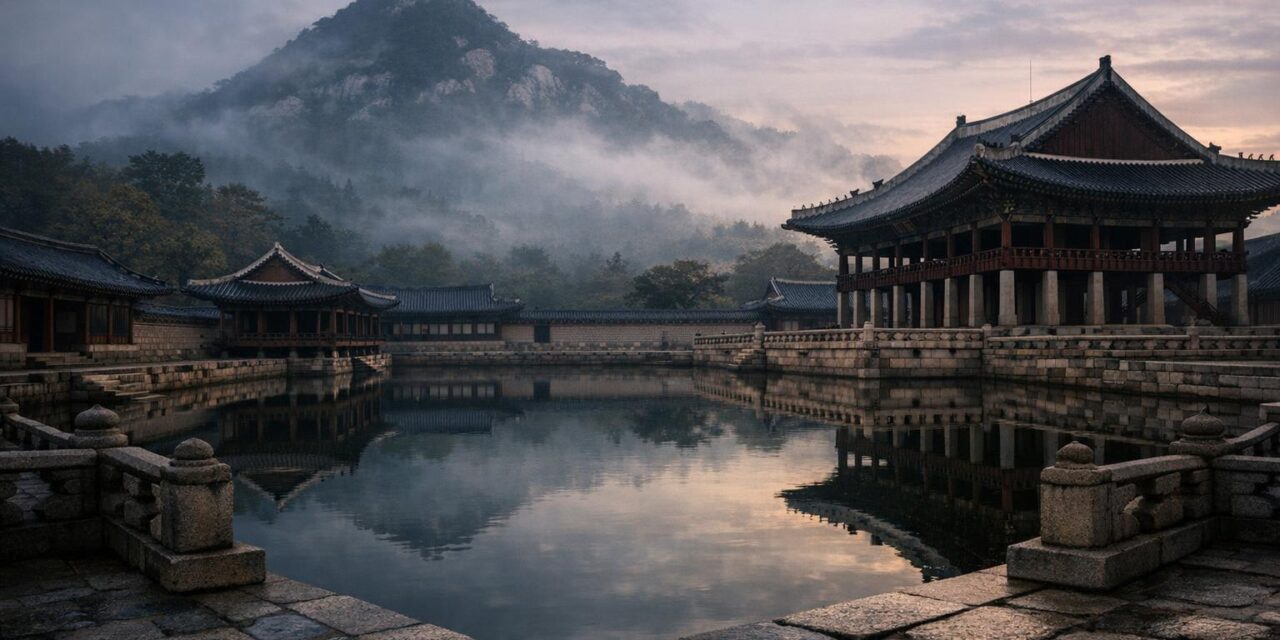
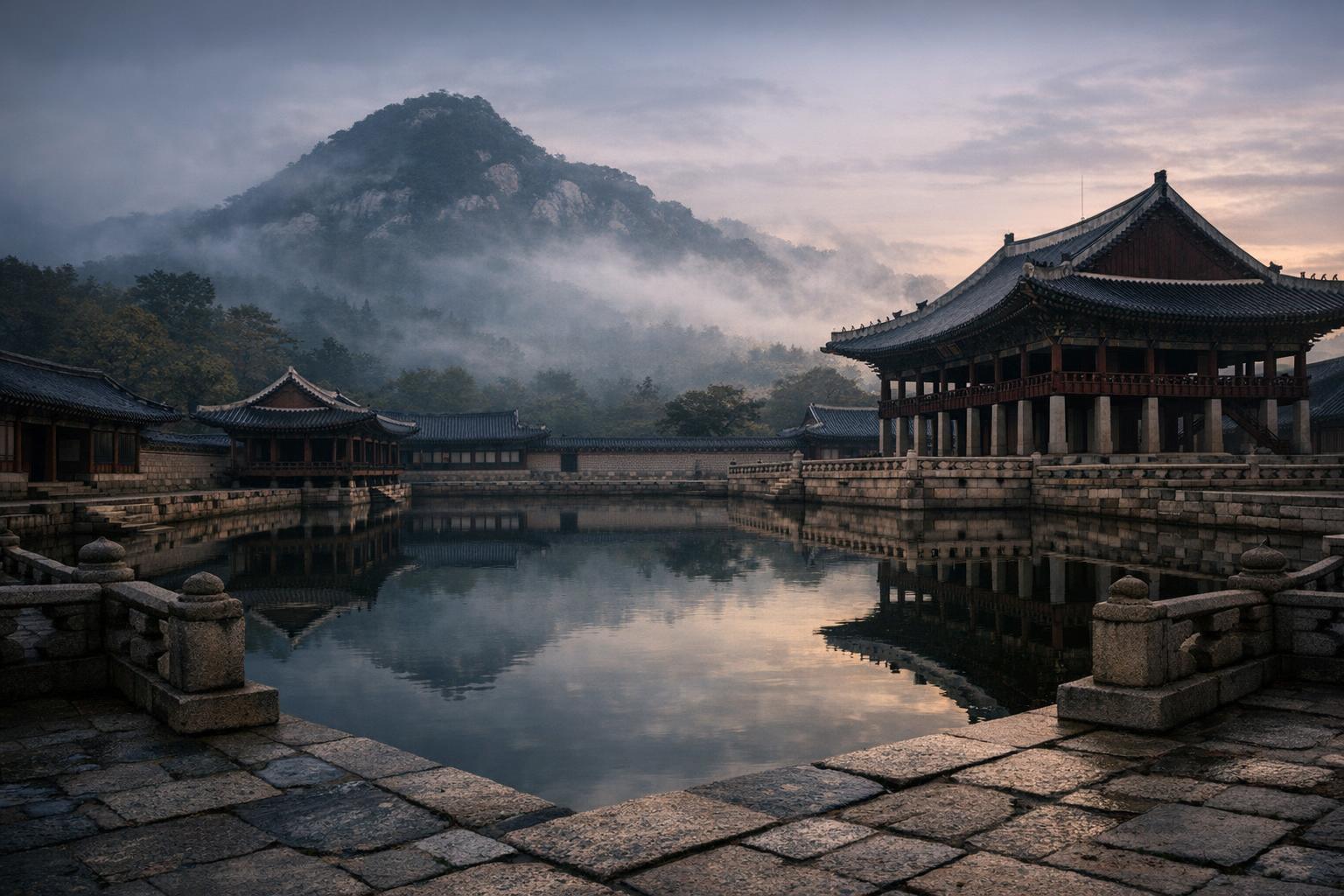
Gyeongbokgung Palace has stood in the heart of Seoul since 1395, a formal statement of Joseon Dynasty power arranged across stone courtyards and pavilion pools, with the northern mountains visible above its walls. In the early morning of October 8, 1895, a group of Japanese agents entered the palace through the northwest gate with a specific purpose: the assassination of Empress Myeongseong. The empress had been working to counter Japanese influence over Korea by seeking Russian support, and this effort had made her a target. The agents found her in the Okhoru Pavilion. She was killed. Her body was burned in the garden of the palace grounds. The event is recorded in the historical archive under the name the Eulmi Incident.
The aftermath unfolded across decades. Japan formalized its control over Korea through protectorate status in 1905 and annexation in 1910. During the colonial period, the Japanese administration dismantled Gyeongbokgung systematically — of the original five hundred or more buildings, only a handful survived to liberation. Restoration has been ongoing since, but the palace that exists today is partly reconstruction and partly the residue of a building that was deliberately taken apart. In the grounds that remain, palace guards and early-morning visitors have long reported encountering a woman in traditional Joseon court hanbok near the pavilion structures — a figure that does not approach or speak and is absent when directly observed. The accounts are consistent and old, and they carry the quality of a presence asserting a territorial claim on the space where the most consequential thing happened.
Gyeongbokgung is open to the public daily except Tuesdays, accessible from Gyeongbokgung station on Seoul Metro Line 3. The early morning hours — before the crowds, when the mountains show above the northern wall and the pavilions reflect in still pools — are when the grounds have the quality the historical accounts describe. For the adventure traveler, the palace is one of those sites where documented history and paranormal tradition arrive at the same conclusion: something happened here in 1895 that has not fully resolved, and the grounds make that legible in a way that no amount of restoration has managed to address.
Story Source: kculture.com
Address: Sajik-ro 161, Jongno-gu, Seoul, South Korea
Accessibility Rating: Open to All — Freely accessible to the public with no advance requirement. Includes hotels, restaurants, bars, and public historic sites where visitors may walk in without prior booking.
Google Map
What Others Have Experienced
A visitor to the Okho-ru Pavilion in the palace’s rear compound described the air around the site as having a distinctly different quality from the rest of the grounds — a heaviness that was difficult to attribute to the heat alone. Knowing that the empress was murdered in that exact space in 1895 made the feeling something more than atmospheric, and they described the pavilion as one of the most affecting historical sites they had visited in Korea.
— from KoreabyMe
An NPR journalist who visited haunted sites in South Korea described Gyeongbokgung as carrying a particular historical weight related to the empress’s assassination, with guides and locals noting that the compound where Myeongseong was killed remains a site of unofficial mourning. Visitors frequently leave flowers at the pavilion, and staff who work in that section of the palace have reportedly described an unsettled quality to the space.
— from NPR
A travel writer exploring Seoul’s darker history described the Geoncheonggung compound within the palace — the private royal residence where the empress was killed — as a space where the violence of the 1895 assassination refuses to recede entirely into history. Local legends hold that the spirits of servants who witnessed the murder and later died of shock still wander the area, and multiple visitors have described the atmosphere of the inner compound as one of persistent grief.
— from Dark Side of Seoul
A visitor who joined a ghost and dark history tour of Seoul described the Gyeongbokgung stop as the most historically weighty part of the experience. Learning that the empress was dragged from her chambers, killed, and her body burned in the garden made the palace’s restored grandeur feel like a deliberate erasure of something that was still present in the ground beneath it.
— from Karli in Korea
A visitor described the experience of standing in the spot where Empress Myeongseong was murdered as one that demanded a kind of attention the rest of the palace did not. The pavilion is well-maintained and clearly labeled, and the specificity of that documentation — here, in this place, at this hour — made the weight of the event feel less historical than immediate. They said they had visited dozens of UNESCO sites and had never felt quite that particular feeling before.
— from Medium / Haunted Korea