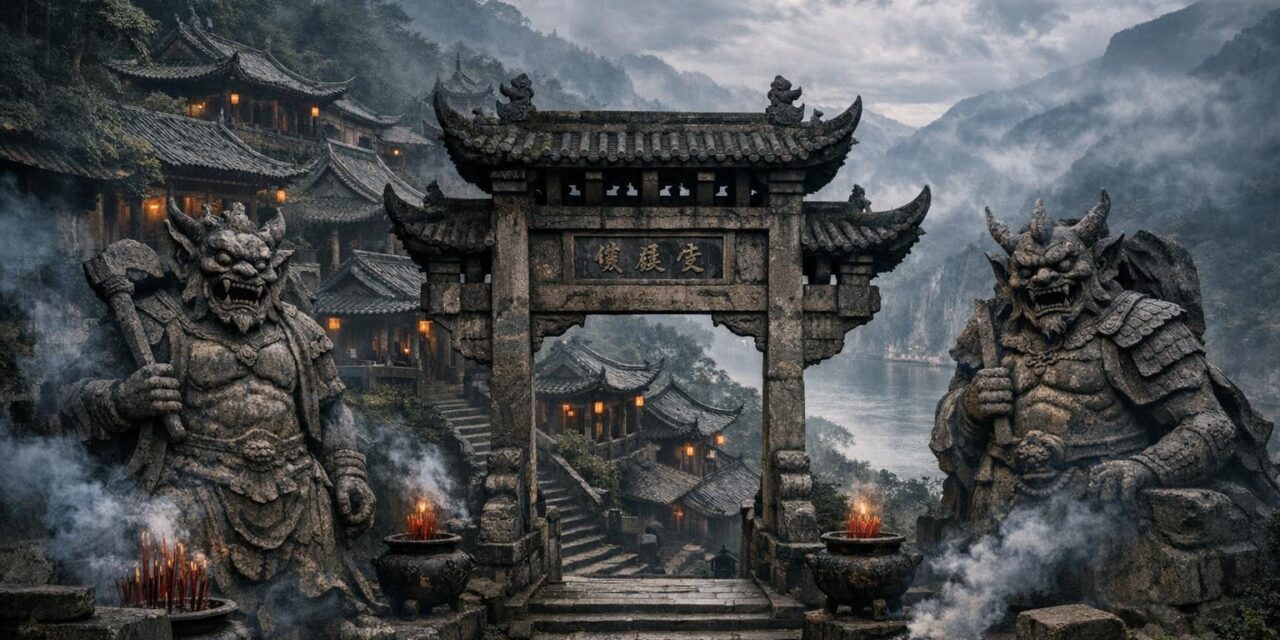
Ming Mountain rises from the south bank of the Yangtze at Fengdu County with a single purpose: it is the mountain China has dedicated, for more than two thousand years, to the dead. The temples on its slopes form one of the world’s most elaborate architectural representations of the afterlife — Ghost Torturing Pass at the entrance gate, Nothing-to-Be-Done Bridge crossing into the underworld, Last Glance at Home Tower at the summit — a literal map of what happens after death, built in stone and timber on a Chinese hillside and maintained across dynasties. Taoist and Buddhist tradition holds that Ming Mountain is the dwelling place of the King of Hell. The mountain has been arranged, with extraordinary sustained effort, to make that claim feel as close to true as architecture can make it.
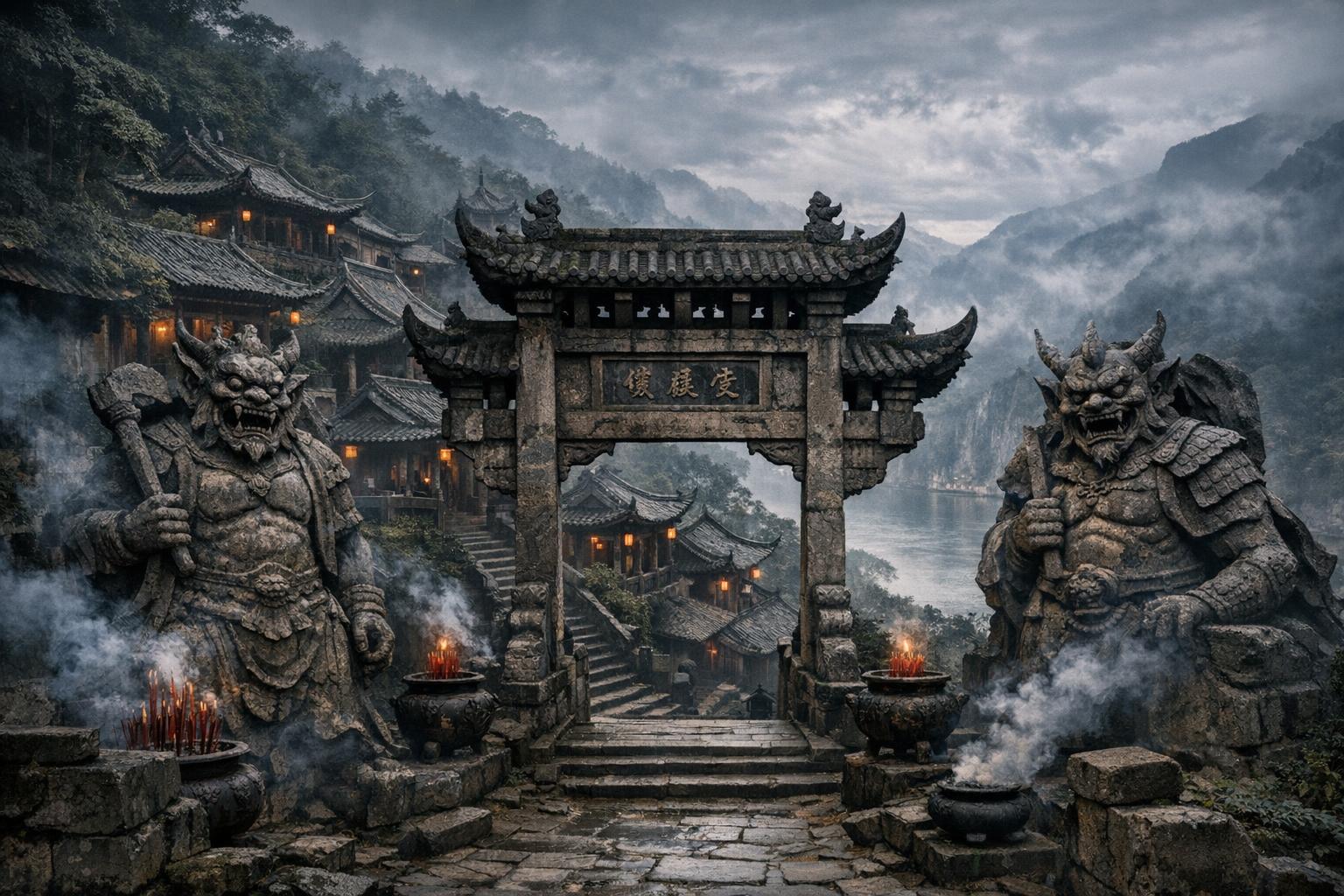
The connection between Fengdu and death dates to the Han Dynasty, when two court officials named Wang Fangping and Yin Changsheng came to Ming Mountain to practice Taoist cultivation. Their combined surnames — Wang and Yin — sound in Chinese like “Yanwang,” the name for the King of Hell. The linguistic coincidence embedded itself permanently into Fengdu’s identity, and for two thousand years the mountain has accumulated temples, shrines, and ritual spaces depicting the underworld bureaucracy in vivid detail: demons evaluating souls, the moral logic of judgment, the specific architecture of what comes next. The Three Gorges Dam changed the physical landscape — rising Yangtze waters submerged the old town at the base of Ming Mountain, relocating its population and leaving the mountain’s temples intact above a flooded ghost city of a more literal kind. The drowned town lies beneath the same water the temples overlook.
Fengdu Ghost City is open as a scenic area in Chongqing municipality, accessible by Yangtze River cruise or road. The ascent through the temple complex passes the full sequence of afterlife architecture, and active pilgrimage continues among the incense and the demon figures of the upper shrines. For the adventure traveler, Fengdu offers an experience with no precise equivalent: two thousand years of one culture’s most serious thinking about death, built at the scale of a mountain, still functioning, and still open. The King of Hell has been in residence on Ming Mountain for a very long time. The gate is there. The bridge is there. The view from the top, across the reservoir and the relocated town below, is exactly as final as it was designed to be.
Story Source: www.travelchinaguide.com
Address: Mingshan Scenic Area, Fengdu County, Chongqing, China
Accessibility Rating: Open to All — Freely accessible to the public with no advance requirement. Includes hotels, restaurants, bars, and public historic sites where visitors may walk in without prior booking.
Google Map
What Others Have Experienced
A travel writer described the climb to the summit of Ming Mountain as part of what makes Fengdu work as an experience — the physical effort of ascending past increasingly elaborate depictions of the underworld, judgment halls, and torture chambers builds a cumulative sense of dread that a flat theme park could never achieve. By the time visitors reach the peak with its panoramic views over the Yangtze, the weight of two thousand years of death mythology feels genuinely present.
— from J.H. Moncrieff
A visitor who arrived in fog described the atmospheric conditions as transforming the site entirely — the elaborate spirit statues and demon carvings emerging from the mist between temple buildings creating an effect that no amount of deliberate staging could replicate. They said the fog made it easy to understand why ancient people had chosen this particular mountain as the gateway between the living world and the realm of the dead.
— from TripAdvisor
One visitor noted that the Fengdu experience is most affecting not for its horror elements but for the directness with which Chinese folk culture confronts death and judgment. Standing before the grotesque torture tableaux depicting the punishments awaiting the unworthy, they described a sense of genuine discomfort that surprised them — not because the imagery was crude, but because it was clearly meant seriously.
— from Moon Mausoleum
A cruise passenger who visited the site as part of a Yangtze River tour described the nighttime version of the site as a categorically different experience from the daytime visit. With 3D holographic projections, actors portraying underworld figures, and the mountain temples dramatically lit against the dark sky above the river, the line between theatrical performance and something harder to categorize became difficult to locate.
— from China Highlights
A visitor from outside China described the experience of walking through the judgment halls as unexpectedly affecting. The specificity of the iconography — particular sins, particular punishments, particular deities overseeing each — conveyed a cosmology that had been thought through in serious and systematic detail over centuries, and the weight of that seriousness made the site feel more genuinely unsettling than any Western haunted attraction they had encountered.
— from Into Travel China