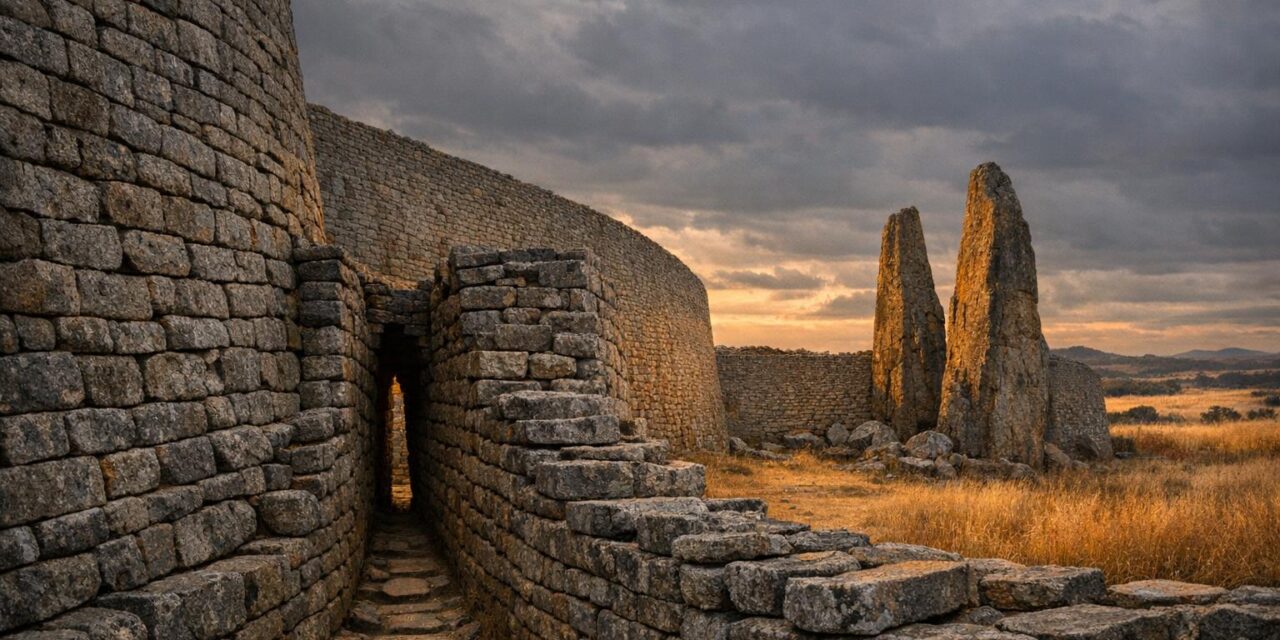
The entrance passage is narrow and deliberate, and when you step through it into the Great Enclosure the sound of the surrounding plateau drops away. The walls are dark granite, fitted without mortar, rising more than five meters in great curved sweeps. They have stood this way since the eleventh century, when the ancestral builders — the Lemba or the Shona, the question remains disputed — began stacking granite in this valley in southeastern Zimbabwe and did not stop for four hundred years. The finished city covered seven hundred and twenty-two hectares and housed up to eighteen thousand people. Visitors today describe a consistent sensation once inside: the walls feel watched over, as if whatever the kingdom left behind when it departed did not go all the way.
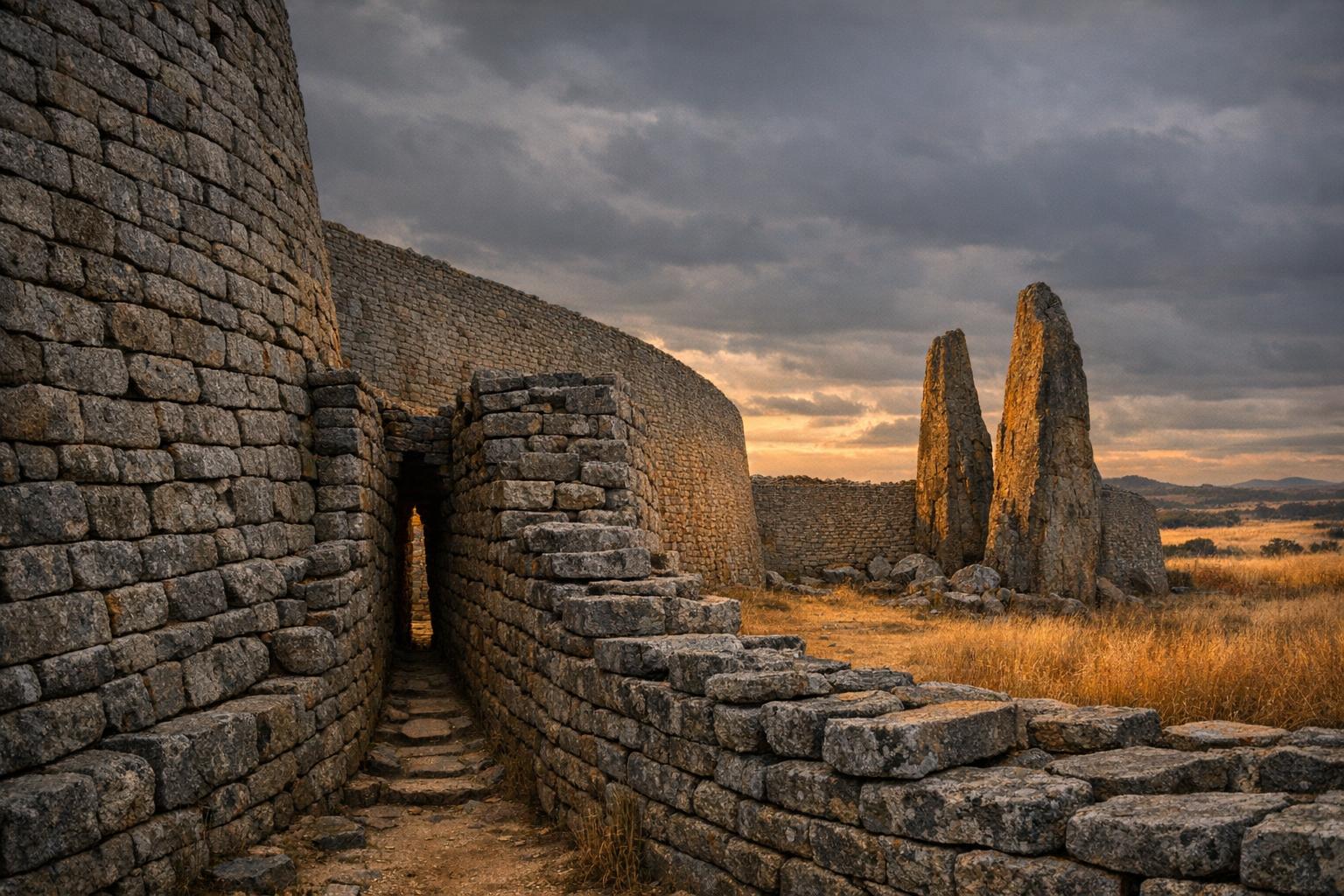
At its peak Great Zimbabwe was the royal capital of a trading kingdom whose networks reached the Indian Ocean coast. It was abandoned by the mid-fifteenth century, and what it left in the ground is almost nothing — no burials, despite centuries of occupation, which archaeologists read as evidence that the site may have been primarily sacred rather than residential. The Hill Fortress above cannot be defended and has no water; its controlled entrances and astronomical alignments suggest ritual rather than military purpose. Stone monoliths on the Great Enclosure’s eastern arc align with the sun and stars at solstices and equinoxes. A conical tower lines up with a supernova known to have exploded in the Vela constellation seven to eight hundred years ago. The site was first mentioned in writing in 1531, by which point it had already been standing for four centuries.
Today Great Zimbabwe is a UNESCO World Heritage Site and national monument, open to visitors outside Masvingo. The country is named for it. Walk in through that narrow entrance passage, stand inside walls that were being built before the first European traveler came anywhere near this plateau, and feel the space around you. Eighteen thousand people knew what this place felt like when it was alive. Almost nothing of them remains except the stone and the particular quality of the silence it holds.
Story Source: sacredsites.com
Address: Great Zimbabwe National Monument, Masvingo, Zimbabwe
Accessibility Rating: Open to All — Freely accessible to the public with no advance requirement. Includes hotels, restaurants, bars, and public historic sites where visitors may walk in without prior booking.
Google Map
What Others Have Experienced
The Great Enclosure’s walls rise 36 feet without a single drop of mortar — a feat of precision that still baffles visitors centuries later. What lingers longest is something less tangible: a spiritual quality in the stones themselves, as though the site still carries the weight of kings, trade routes, and ceremonies long since gone.
— from TripAdvisor
Climbing through rock walls to the hilltop where the king once held court — some 350 metres above the valley — is hard work, but the payoff is extraordinary. Below, the queen’s enclosure is ringed by walls ten metres high, all cut granite with no mortar. Everything about the construction feels impossible given the era.
— from TripAdvisor
A guide makes all the difference. Without one, you are walking through stones; with one, you are walking through a kingdom. Allow 2–3 hours to cover the hill fort, the valley enclosure, and the recreated village. Keep an eye out for baboons near the top.
— from TripAdvisor
Arriving at dawn, when the site first opens, is the right call — the climbs are far easier before the heat builds, and the place feels almost otherworldly in the early light. The museum houses the original soapstone bird sculptures that gave Zimbabwe its name, and they are worth the trip alone.
— from TripAdvisor
The rocky climb to the hilltop takes about 30 minutes and is steep in places, but standing at the top it is easy to understand why this served as a royal capital for four centuries. The sense of scale — the walls, the views, the silence — settles over you in a way that is difficult to shake.
— from TripAdvisor