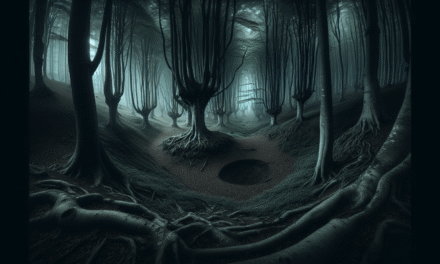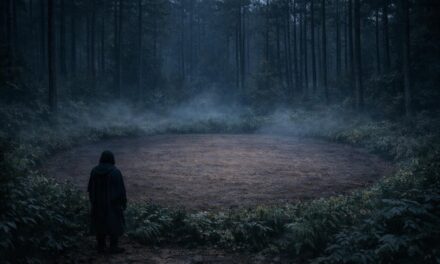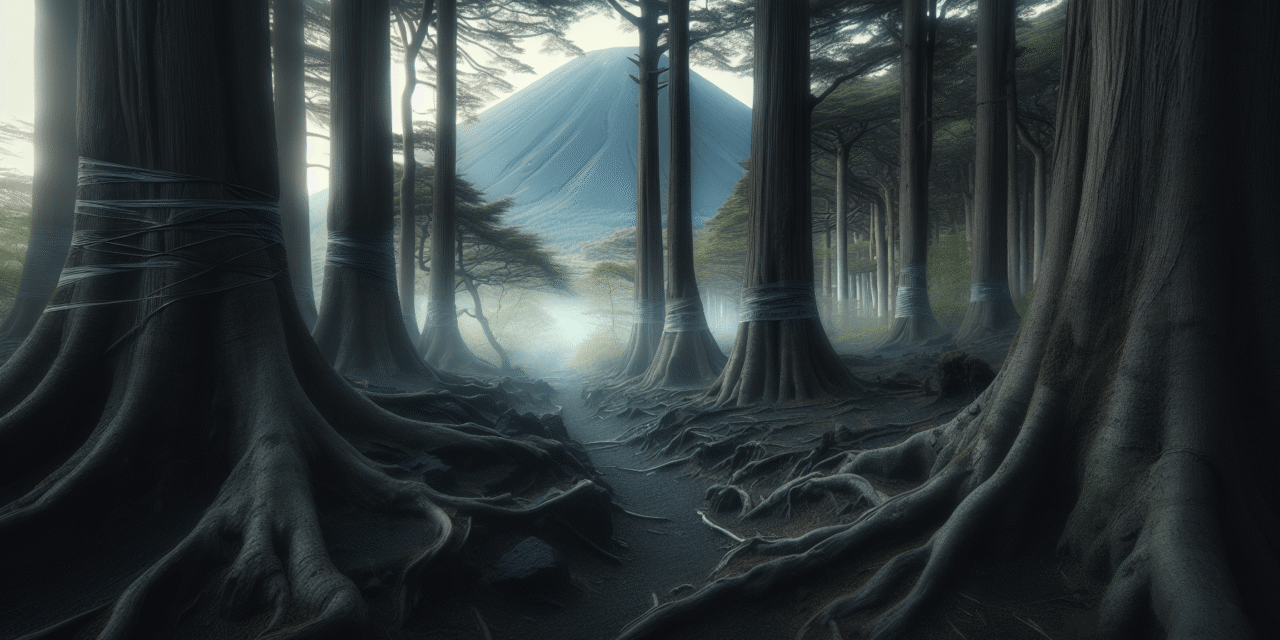
Aokigahara grows on the hardened lava fields at the base of Mount Fuji, thirty square kilometers of ancient cypress and cedar so dense that afternoon light rarely reaches the forest floor. The Japanese call it Jukai—the Sea of Trees. The porous volcanic rock beneath absorbs sound the way deep water absorbs light. Voices lose their edges. Footsteps disappear. The forest does not echo.
The iron-rich lava beneath the forest disrupts compass needles; GPS signals grow unreliable in the densest sections. Experienced hikers carry string or colored tape to mark their return. Aokigahara’s contemporary association was shaped by two works: Seichō Matsumoto’s 1961 novel Nami no Tō, in which the forest became the setting for a doomed love affair ending in suicide; and Wataru Tsurumi’s 1993 Kanzen Jisatsu Manyuaru, which described it as a place of ideal solitude. Organized searches of the interior have been conducted since at least 1970. In 2002, searchers found 78 people who had died there; in 2003, the figure reached 105—the highest on record. Local authorities subsequently stopped releasing annual totals.
Today the forest is a UNESCO World Heritage site receiving hundreds of thousands of visitors each year, most drawn by the ice caves and views of Fuji. Blue signs are posted along the trails in Japanese and English, offering a crisis line number. Volunteers patrol the interior year-round and, by their own accounts, save roughly twice as many lives as they recover. Searchers describe the silence as active rather than passive. Among the personal effects found deep in the trees—shoes arranged in pairs, bags leaned against trunks, photographs—some appear to have been placed with deliberate care, as though not abandoned but left.
Story Source: www.japan.travel
Address: Aokigahara Forest, Narusawa, Fujikawaguchiko, Yamanashi, Japan
Accessibility Rating: Open to All — Freely accessible to the public with no advance requirement. Includes hotels, restaurants, bars, and public historic sites where visitors may walk in without prior booking.
Google Map
What Others Have Experienced
The forest is freely accessible from the road at the base of Mount Fuji, with marked walking trails leading to lava caves and through the dense tree cover. Visitors describe the forest as genuinely beautiful — the ancient lava rock creating an uneven floor, gnarled trees pressing closely together, shafts of light through a thick canopy — with a quality of stillness and compression that is distinct from other forests and difficult to attribute purely to the density of the trees.
— from Yamanashi Official Tourism Guide
The forest’s magnetic iron-rich geology causes compass needles and GPS signals to behave unreliably within it — a documented physical phenomenon that adds a practical dimension to the disorientation visitors report. Those who stray from marked trails describe becoming genuinely lost within minutes, with the dense, directionally uniform canopy removing all the usual spatial reference points, a real survival risk that makes the area’s folklore feel less metaphorical.
— from Magical Trip
The forest carries a specific kind of weight that visitors describe as impossible to fully separate from the knowledge of what has happened there, and attempting that separation is itself part of what makes the visit demanding. The Japanese concept of yŮrei — spirits of those who died in pain or isolation without the proper rites — is referenced by local guides not as folklore but as a framework their culture genuinely uses to explain what the forest feels like.
— from Outlook Traveller
Visitors who come specifically for the paranormal history describe the personal objects left tied to trees — ribbons, tape, notebooks, mementos left by those who came for darker reasons — as the most affecting dimension of any visit. These objects, still present throughout the interior forest, transform the abstract history of the place into something immediate and specific in a way that signage and visitor centres cannot.
— from Young Pioneer Tours
The forest’s appearance on international top-ten haunted lists has not made it feel like a tourist attraction to those who visit with genuine engagement — the combination of the physical environment, the documented cultural significance, and the Japanese approach to honoring rather than exploiting its history creates a visit that visitors consistently describe as requiring emotional preparation in a way that most dark tourism destinations do not.
— from Tokyo Travel Assist