The path across Gberefu Island ends at the sea. Before it does, it passes a well — square, red brick, thatched roof on poles — with a sign reading “Original spot slaves spirit attenuation well.” Captives walking this path were forced to drink from it, in the belief that the water caused forgetting: of homeland, family, name. It was a technology of erasure. On the mainland, the 1840s Seriki Faremi Williams Abass Slave Museum shows what came before the walk: forty people per three-by-three-meter room, chained in iron leg irons, held for weeks or months while Europeans priced them in guns, liquor, and cannons.
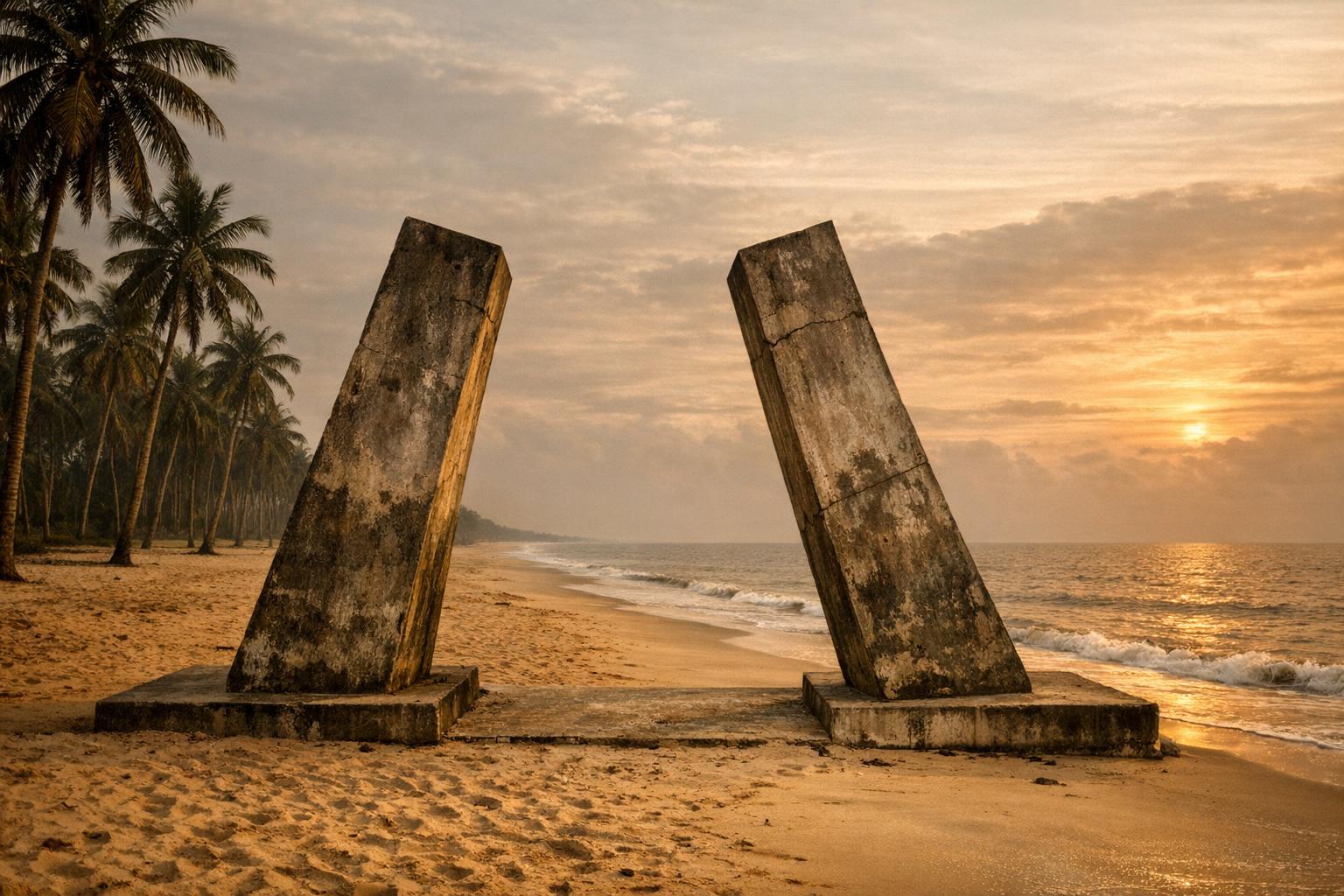
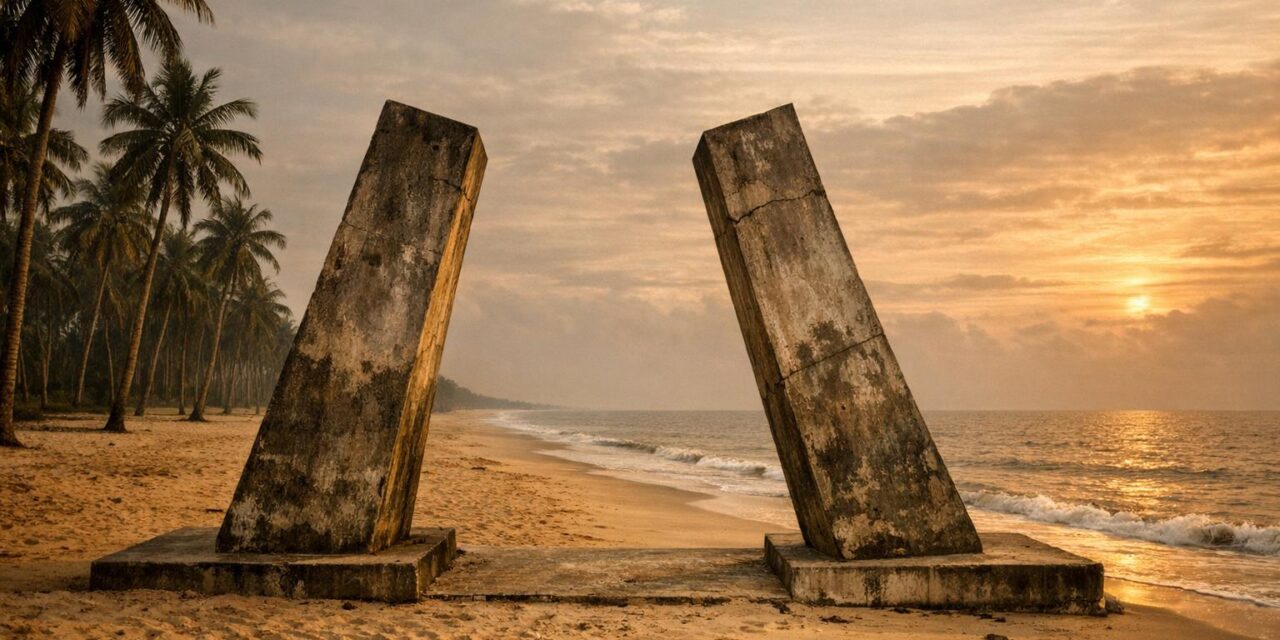
The Point of No Return is the long straight beach at the island’s ocean side, lined with coconut palms, where captives were loaded onto boats to reach the ocean-crossing ships. A memorial marks the spot: two concrete forms leaning slightly inward, designed to represent a man and a woman linked by a chain. The chain has dissolved in the salt air. A newer structure, the Ark of Embarkation, was added around the forms but construction was abandoned; it is closed. Visitors consistently describe a heaviness to the beach and the path that the surf and the palm trees do not lift.
Today Gberefu Island is reached by boat from Badagry, roughly two hours by road from central Lagos. The baracoon museums on the mainland are open most days. The walk from the landing to the beach is deep sand and full sun, and the spirit well is clearly marked along the path. Most visitors come with guided groups; independent travel requires planning. This is one of the few places where the scale of the transatlantic slave trade becomes physical — where the path, the well, the broken monument, and the water hold what the historical record keeps mostly in numbers.
Story Source: rachelsruminations.com
Address: Point of No Return, Gberefu Island, Badagry, Lagos State, Nigeria
Accessibility Rating: Open to All — Freely accessible to the public with no advance requirement. Includes hotels, restaurants, bars, and public historic sites where visitors may walk in without prior booking.
Google Map
What Others Have Experienced
Walking the path on Gberefu Island down to the Point of No Return is surreal — a guide brings each historical landmark to life, making the full weight of the transatlantic slave trade feel immediate and present. The island is essential for anyone drawn to history in its most honest form.
— from TripAdvisor
The Spirit Attenuation Well and slave embarkation point are the heart of this visit. Historically it is extraordinary — the physical place where the trade ended and lives were forever changed. The site needs better infrastructure, but the weight of the place makes up for what it lacks.
— from TripAdvisor
Gberefu Island carries enormous historical meaning: this was the precise point where enslaved people were loaded onto ships and sent to an unknown fate, never to return. Standing here, that history feels anything but abstract.
— from TripAdvisor
Visiting with family felt like stepping back through time — the guides are welcoming and the site has a way of making a chapter of history that happened centuries ago feel deeply present and undeniable.
— from TripAdvisor
Walking the slave route is unlike any other historical experience. The path that survivors of the holding cells were forced to walk to the sea is still there, and walking it yourself leaves a lasting impression that no museum exhibit could replicate.
— from TripAdvisor