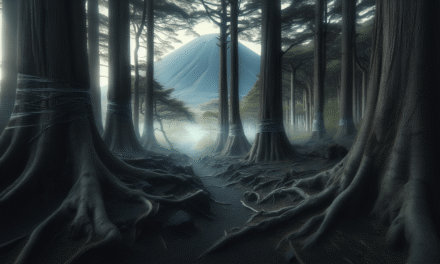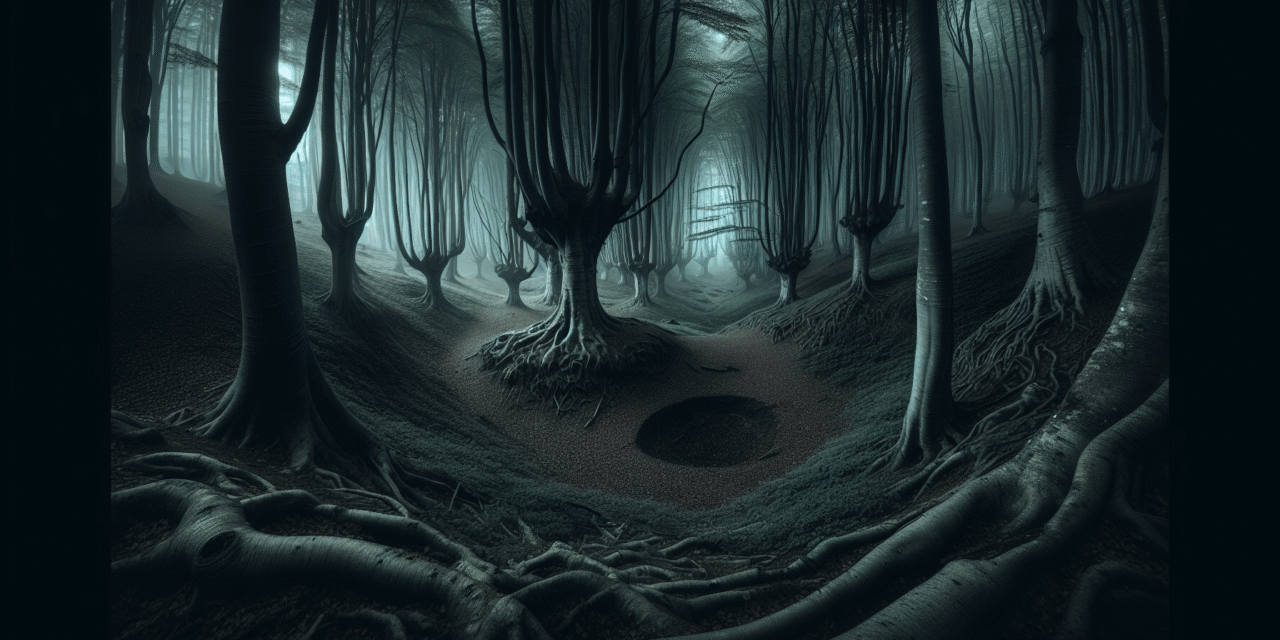
Three kilometers west of Cluj-Napoca, where the Transylvanian plateau softens into farmland, there is a forest that seems to have refused the ordinary terms of nature. Hoia-Baciu covers some 250 hectares of beech and oak, dense enough that afternoon light arrives as a diffused gray. What distinguishes it from other forests is what happens to the trees: at their bases, many trunks twist and spiral, then lean at hard angles—not the gradual curve of trees bending toward light, but something closer to contortion. No documented disease or wind pattern accounts for the shapes. They have been growing this way for as long as the forest has been studied.
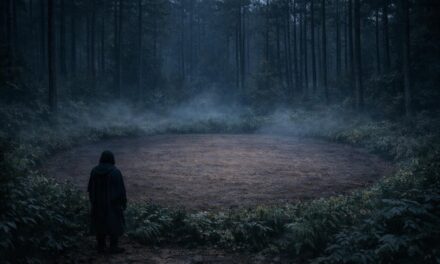
At the center lies a clearing called The Circle. Vegetation will not grow there. Soil tests have not resolved why. In the 1960s, a biologist named Alexandru Sift began photographing the area and reported that his developed film revealed luminous orbs and shapes that had not been visible to the naked eye; skeptics attributed these to film artifacts or darkroom error, though Sift documented his work systematically. Visitors frequently report a cluster of physical sensations upon entering: sudden intense anxiety, headaches, nausea, and unexplained skin rashes that appear and fade. Compasses, cameras, and mobile phones have been reported to malfunction in proximity to The Circle.
Researchers have proposed geomagnetic anomalies as a partial explanation—measurable distortions in the local magnetic field that might account for equipment failures and the disorientation visitors describe. The forest has drawn investigators from multiple countries and remains one of the most studied alleged paranormal sites in Europe. No consensus explanation has emerged for the tree deformations, the barren clearing, or the consistent pattern of reported symptoms. It continues to be visited, documented, argued over, and—by most accounts—experienced as something that resists comfortable categorization.
Story Source: TV episode titled “Haunted Forest/Alux” (Destination Truth, Syfy, 2009)
Address: Hoia-Baciu Forest, Cluj-Napoca, Romania
Accessibility Rating: Open to All — Freely accessible to the public with no advance requirement. Includes hotels, restaurants, bars, and public historic sites where visitors may walk in without prior booking.
Google Map
What Others Have Experienced
The forest is freely accessible as a public green space on the outskirts of Cluj-Napoca, with marked trails and no admission fee. Visitors on guided nighttime tours describe the experience as transitioning quickly from the ordinary suburban edge of the city into an environment that feels genuinely detached from it — the trees dense and irregular, the path narrowing, and the circular clearing where compass instruments are said to behave strangely emerging without warning.
— from Romania Travel Tips
The circular clearing at the heart of the forest — a near-perfect ring of dead or stunted vegetation within otherwise healthy woodland — is the focal point of the site’s paranormal reputation and the destination of most guided tours. Visitors describe standing in it as producing a specific discomfort they find difficult to localize, distinct from the general unease of the surrounding forest, and the EMF readings some investigators record there add an instrumental dimension to what is otherwise a subjective experience.
— from Rolling in Romania
Visitor accounts frequently cite headaches, nausea, and skin rashes developing during visits and resolving after leaving, a pattern consistent enough across unrelated accounts to be noted in paranormal research literature on the site. The overwhelming sensation of being watched — described across dozens of independent visitor accounts — is the most universal reported experience and the hardest to attribute to the physical environment alone.
— from The Dark Atlas
The forest’s documented history of strange photographs dates back to the 1960s and 1970s, when Romanian biologist Alexandru Sift began capturing images of unidentified flying objects above the clearing. Multiple subsequent investigators have reported camera and electronics malfunctions specifically within the circular clearing, a detail that has been repeated across enough independent visits to function as one of the site’s defining characteristics.
— from Little House of Horrors
Tour guides who have led hundreds of visits describe the forest as behaving inconsistently — tours that produce nothing on one night generating intense activity the next, with no reliable pattern for when the forest will and won’t deliver an experience. Visitors who have returned multiple times describe this unpredictability as part of what keeps them coming back, and as one of the things that distinguishes Hoia-Baciu from staged haunted attractions.
— from Romanian Friend