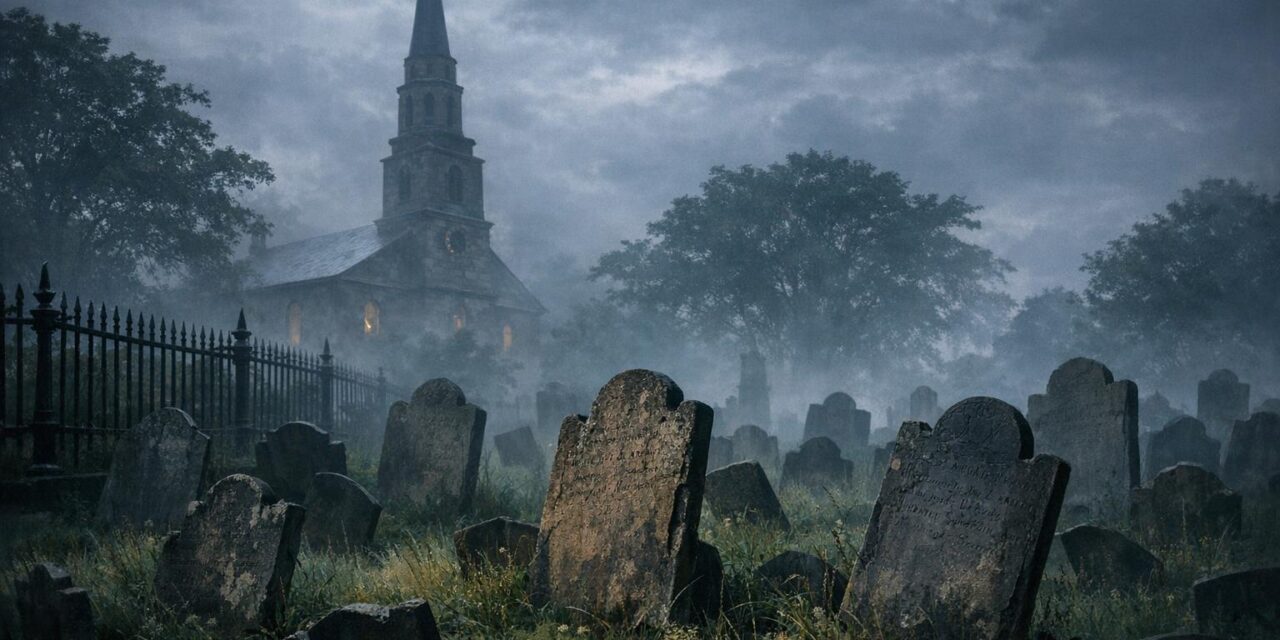
The Old Burying Ground sits at the corner of Spring Garden Road and Barrington Street in downtown Halifax, separated from the sidewalk by an iron fence low enough to look over. Founded in 1749 — the same year as the city itself — it is Nova Scotia’s oldest cemetery, and it holds an estimated ten thousand souls beneath a surface marked by only twelve hundred surviving headstones. The arithmetic is the first thing that strikes you: for every inscription still legible, eight more people lie beneath your feet with nothing left to say their name. At dusk, when the Atlantic light drops and the older sandstone markers lose their edges in the gray, the figures begin to appear — seen at distance, moving between the stones, and then simply not there.
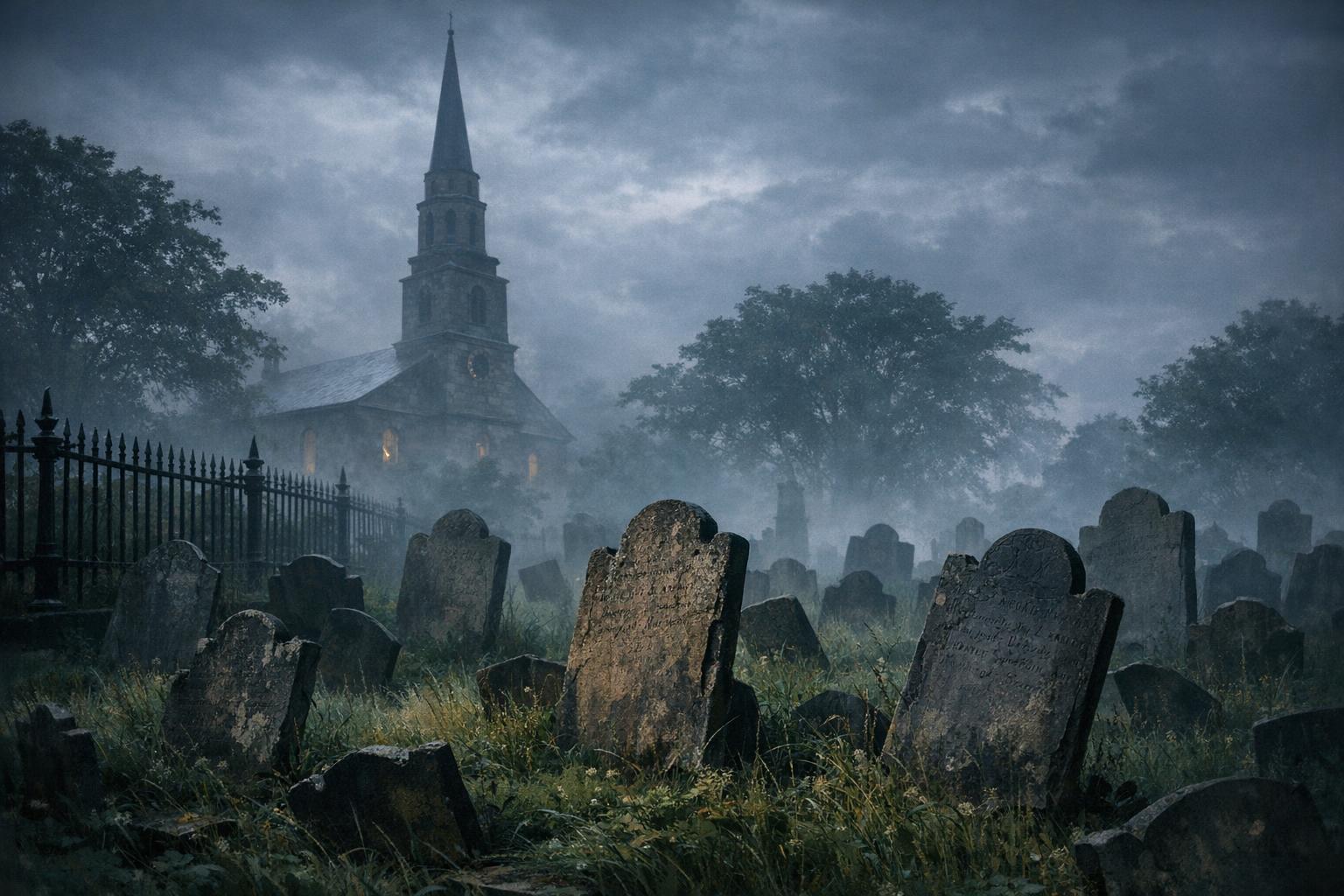
Halifax came into existence in June 1749, when more than 2,500 settlers arrived from England and immediately began the work of dying. Military men, civilians, children, governors — the Old Burying Ground received them all for ninety-five years, along with the victims of the epidemics that swept through the garrison settlement repeatedly: smallpox, typhus, yellow fever. By the time it closed to new burials in 1844, the ground was full in a way that the surface gives no visible indication of. The reports of shadowy figures among the headstones have been part of Halifax’s local knowledge for generations — not celebrated, not dismissed, just quietly present, consistent in character, attached to the low-light hours when the city’s oldest dead seem nearest.
The Old Burying Ground Foundation manages the site today, undertaking preservation of the surviving markers and archival research to recover names that stone can no longer hold. The cemetery is open year-round, with guided interpretive programs in summer, adjacent to St. Paul’s Church — the oldest Anglican church in Canada, built in 1750. For the visitor who understands what the ground contains, no apparition is strictly necessary. The fence is low. From the pavement, on a clear day, you can read the dates: 1751. 1768. 1803. Nova Scotia’s oldest dead have been here for three centuries, in the center of a living city that walks past them every morning without looking in.
Story Source: oldburyingground.ca
Address: Spring Garden Road & Barrington Street, Halifax, Nova Scotia B3J 1Y9, Canada
Accessibility Rating: Open to All — Freely accessible to the public with no advance requirement. Includes hotels, restaurants, bars, and public historic sites where visitors may walk in without prior booking.
Google Map
What Others Have Experienced
A visitor described the Old Burying Ground as one of the most historically affecting places they encountered in Halifax — the sheer age of the headstones, many from the 1700s and worn nearly to illegibility, gave the space a quality of accumulated time that felt genuinely different from newer cemeteries. They said the sensation of walking above three centuries of the city’s dead was one that lingered well after leaving.
— from TripAdvisor
A ghost tour guide described witnessing a figure materialize approximately 30 feet ahead of their tour group one night, cross their path unhurriedly between the headstones, and disappear into the darkness with no sound. No member of the group was near that position, and the figure left no evidence of its passing when they crossed to where it had been.
— from There Be Ghosts
Locals and paranormal researchers visiting the graveyard have described encountering sudden and unexplained cold spots while walking among the graves, with temperature drops that were localized and inconsistent with the surrounding weather. The apparition of a woman believed to be Elizabeth Crowley, who died in childbirth in 1751, is among the most frequently reported by visitors and tour participants.
— from The Signal Halifax
A visitor on the Ghost Walk of Historic Halifax described the Old Burying Ground stop as the most affecting of the evening. The guide’s account of the 1750 typhoid epidemic — which killed more than 1,000 settlers in a single winter and forced the expansion of the original cemetery — made the scale of death beneath their feet feel immediate rather than abstract.
— from TripAdvisor
A visitor noted the striking contrast between the cemetery’s position in the heart of busy downtown Halifax and the profound silence that seems to settle over the grounds once inside the gates. They described stepping in as a kind of temporal displacement, as if centuries of accumulated death were pressing against the present moment in a way that was difficult to process and harder to shake.
— from The Best Halifax