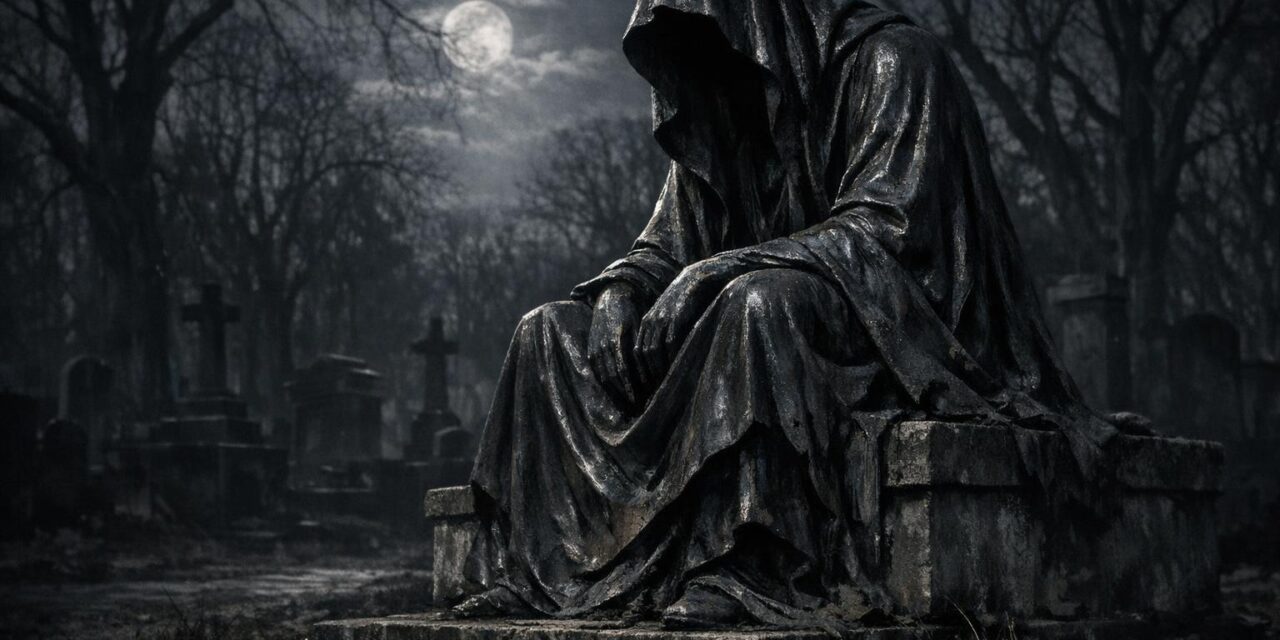
Black Aggie is one of the more genuinely strange objects in American supernatural history — a statue with a traceable origin, a documented relocation, and a reputation that outlasted its physical presence at the site where the reputation was built. The original she was copied from is Augustus Saint-Gaudens’ “Grief,” one of the most powerful works of American sculpture, commissioned by Henry Adams as a memorial for his wife Marian, who died by suicide in 1885. The unauthorized copy was purchased by General Felix Agnus, a French-born Civil War general, and placed on his family monument at Druid Ridge Cemetery in Pikesville, Maryland in the early 1900s. The legends accumulated over several decades: eyes that glowed red at midnight, grass that refused to grow in her shadow, fraternity initiates crushed in her stone hands, a young man found dead at her feet. In 1962, someone cut off one of her arms and was caught with it in the trunk of his car. He claimed she gave it to him.

The statue was donated to the Smithsonian in 1967 by the Agnus family, by then unable to manage the vandalism and nightly trespassing. The Smithsonian gave her away to the National Museum of American Art, which stored her in a dusty room for years. A writer named Shara Terjung tracked her down in 1996 and found her in the courtyard of the Dolly Madison House in Washington, D.C., where she remains today.
At Druid Ridge Cemetery in Pikesville, the pedestal is still there. Grass now grows where it once would not. The cemetery still receives weekly calls asking about her. The story of what she was, what people believed about her, and what she made people do across forty years in that Maryland graveyard is a more interesting document of American fear than most ghost stories manage to be.
Story Source: baltimorefishbowl.com
Address: 7900 Park Heights Avenue, Pikesville, Maryland 21208
Accessibility Rating: Open to All — Freely accessible to the public with no advance requirement. Includes hotels, restaurants, bars, and public historic sites where visitors may walk in without prior booking.
Google Map
What Others Have Experienced
Author E.A. Black wrote that she finally stood before Black Aggie in the early 1980s at the Dolley Madison House courtyard in Washington, D.C., touching the cool marble in broad daylight and feeling oddly reverent rather than afraid, even as her childhood fears of the statue’s glowing red eyes came flooding back.
— from Cemetery Travel (E.A. Black)
A man identified only as Frank told historian Troy Taylor that he visited Black Aggie with friends in the early 1950s, and that his friend Freddy snuffed out a cigarette in the statue’s hand against everyone’s warnings; about a decade later, Frank said, Freddy turned up shot dead in a South Carolina dump, and he never forgot the feeling he had standing in front of Aggie that night.
— from American Hauntings (Troy Taylor)
A commenter named Lloyd said he was raised on Long Meadow Road, less than half a mile from Druid Ridge Cemetery, and spent many evenings with Black Aggie as a kid, adding that her current replacement statue is even eerier than the original.
— from Baltimore Fishbowl (Lloyd)
A commenter recalled being thoroughly spooked by the Black Aggie story back in the early 1970s, saying it was a relief to finally read the full, true tale and learn what really happened to the statue decades later.
— from Baltimore Fishbowl visitor comment
A Druid Ridge Cemetery spokesman told historian Troy Taylor that decades after the statue’s removal, the cemetery still fields calls about Black Aggie almost every week, with people regularly showing up and asking to see her.
— from American Hauntings (Troy Taylor)