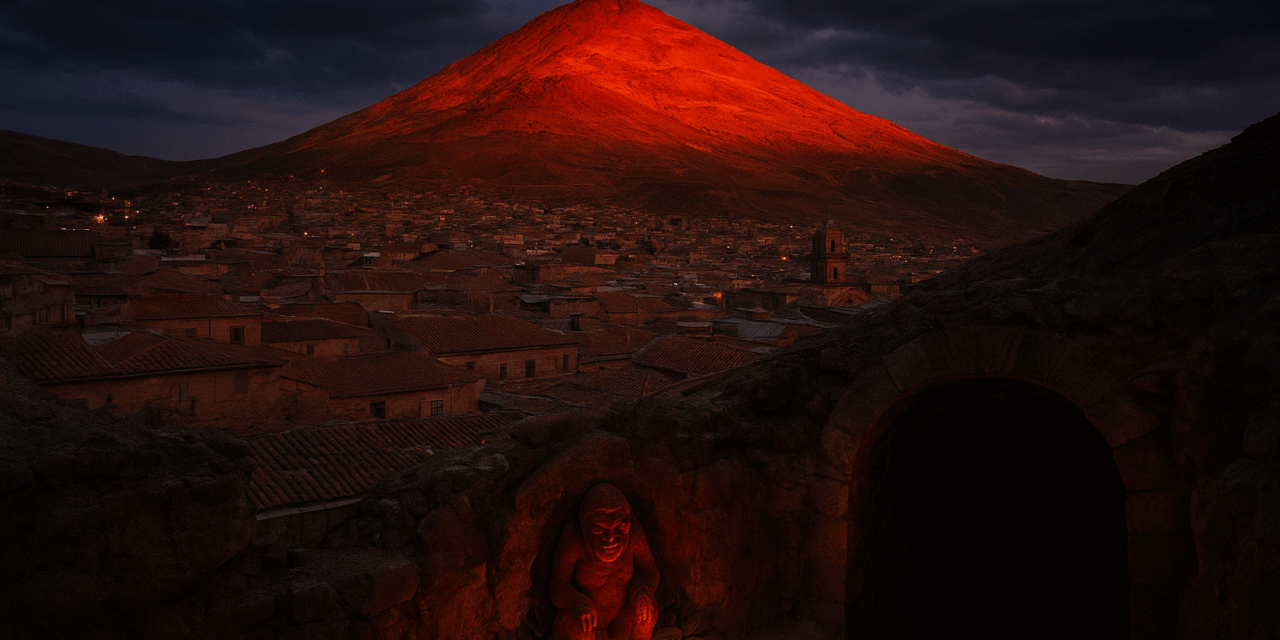
Deep in the Bolivian Andes, Cerro Rico rises over Potosí like a landlord over a tenant who can never leave. The Spanish arrived in 1545, found silver veins thick enough to fund an empire, and extracted both the ore and the lives of everyone forced to work it. The mit’a system conscripted indigenous Andean men into the tunnels; enslaved Africans followed. Estimates place the colonial death toll as high as eight million — killed by silica dust, mercury poisoning, and collapsing tunnels. The wealth built cathedrals on other continents. The mountain kept the bodies.
Inside Cerro Rico, miners have always known who runs the underground. El Tío — The Uncle — is a horned clay deity enthroned in shrines throughout the tunnels, surrounded by offerings of coca leaves, cigarettes, and alcohol. On Fridays, miners perform the challa, a ritual of shared drinking and offering that has continued uninterrupted for centuries. El Tío decides who finds silver and who the mountain swallows. Workers report hearing their names called from sealed passages, tools working in empty chambers, breathing in sections no one has entered in decades. The mountain is collapsing under its own excavated weight, and the sounds it makes are difficult to explain away.
The mine is still active today. Cooperative miners descend every morning using methods their colonial predecessors would recognize, and the mountain still kills — dozens per year by some estimates. No one enters without making an offering first. The line between practical and spiritual dissolved here long ago, by the second million dead. Cerro Rico holds its living and its dead in the same dark interior, and does not distinguish between them.
Story Source: thewholeworldornothing.com
Address: Cerro Rico, Potosí, Bolivia
Accessibility Rating: Guided Tours Only — Access permitted only as part of an organized tour. Independent exploration not allowed.
Google Map
What Others Have Experienced
Inside the mine, visitors encounter El Tio — the devil-like deity the miners believe rules the underworld beneath the mountain — represented by horned statues in each mine shaft, surrounded by coca leaves, cigarettes, 95% alcohol, and half-melted candles offered before every shift. Visitors are struck by the reality that these offerings are not symbolic: miners make them because they genuinely believe El Tio controls their fate and will cause accidents if left unfed. The atmosphere around the shrines, with blood-splashed walls and burning offerings, is described by multiple visitors as deeply unsettling even for those who share none of the belief.
— from The Whole World Or Nothing
The physical experience inside Cerro Rico is described consistently as disorienting and claustrophobic: pitch-black tunnels lit only by headlamps, dust that limits visibility and makes breathing difficult, and passages so narrow that visitors must crouch continuously or crawl. The environment swings from swelteringly hot to sharply cold in seconds between tunnel sections, and the distant rumble of dynamite blasts deeper in the mountain fills the air throughout, creating a feeling that the mountain itself is alive and actively hostile to the living bodies moving inside it.
— from The Whole World Or Nothing
Several visitors have described dreaming vividly and badly the night after the mine tour, waking with the mine’s atmosphere still pressing on them in ways they struggled to explain. One traveler described the experience as leaving them feeling physically exhausted from the constant crouching and crawling, but more lastingly affected by the psychological weight of what they had witnessed — something they said took days to begin processing and never fully left them.
— from The Whole World Or Nothing
The history of the mountain saturates the tour at every level: an estimated eight million lives were lost in Cerro Rico over the centuries of its operation, and a Spanish-era proverb holds that enough silver was extracted to build a bridge to Spain — and enough bones to build another one back. Visitors who understand this while watching young men push three-tonne carts through darkness describe a profound sense of disorientation and guilt that follows them long after they surface.
— from The Whole World Or Nothing
Tourists who purchase dynamite sticks and coca leaves at the miners’ market before entering — standard gifts for the workers — report an additional layer of surreality when handing them over to miners working deep underground, who receive the items with the pragmatic gratitude of men for whom explosives are routine equipment. The sense of operating in a parallel reality, where death is normalized and the mountain itself is treated as a sentient and dangerous entity, is something multiple visitor accounts describe as impossible to convey to anyone who has not been inside.
— from The Whole World Or Nothing