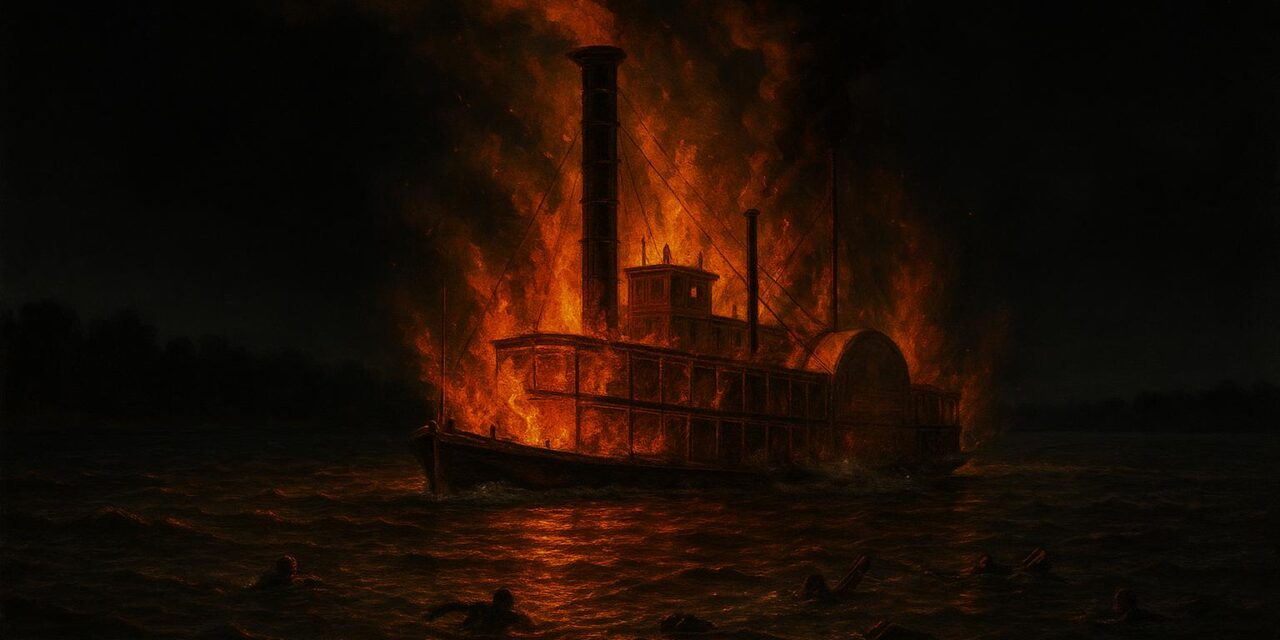
The Mississippi River does not give up its dead. When the steamboat Sultana’s boilers exploded in 1865, approximately 1,800 Union soldiers went into the water — men freed from Confederate prisons who had survived the war and were going home. The wreck never surfaced. The precise location of the hull is uncertain, buried under sediment as the Mississippi changed course over the decades. America’s deadliest maritime disaster happened in the final weeks of the Civil War, was displaced from the front pages within days, and has never fully entered public memory.
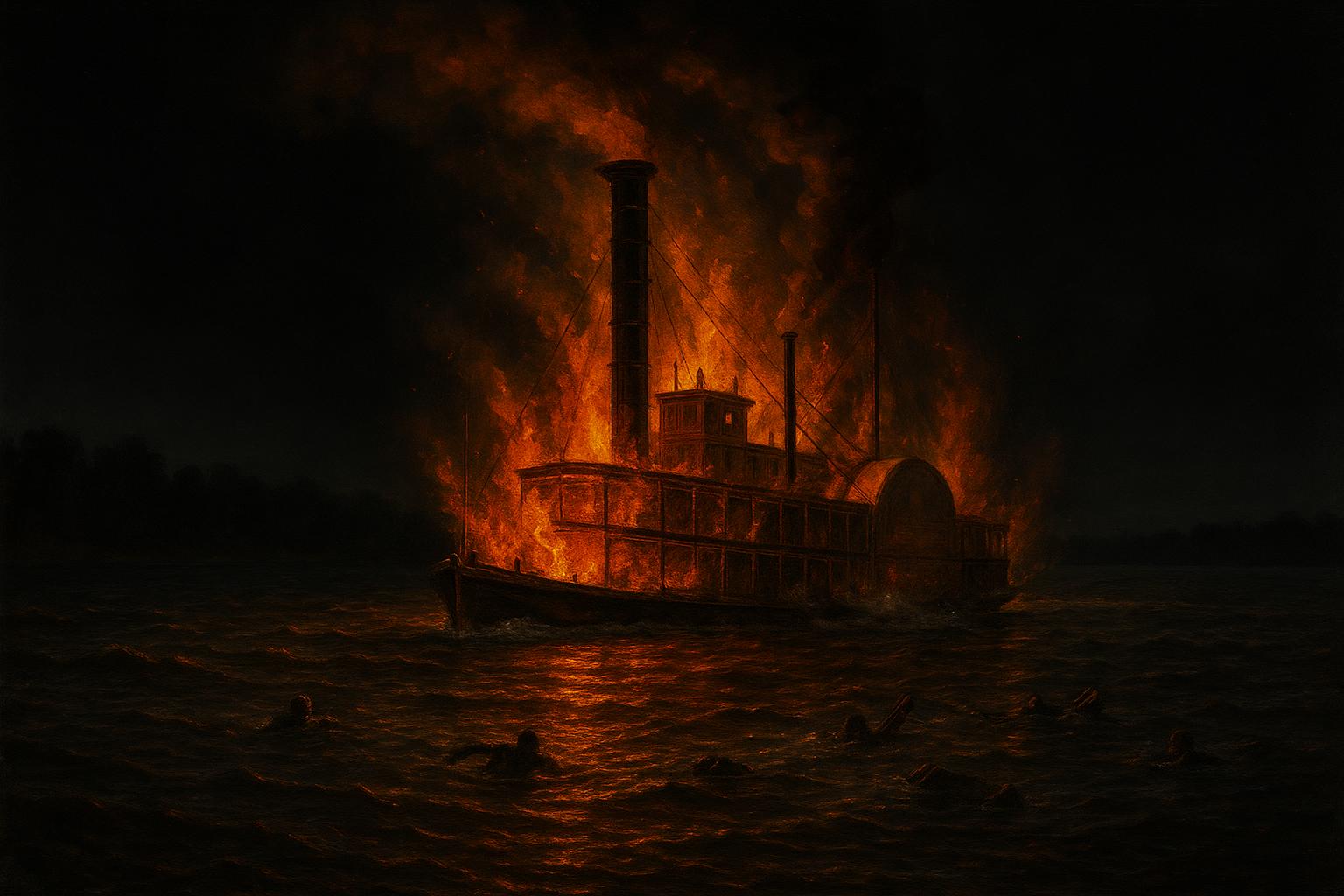
What the river has not displaced is its own record. The stretch of the Mississippi near Marion, Arkansas, where the Sultana went down has been the site of persistent accounts since 1865: voices heard from the water at night, lights on the river where no vessel is present, the sounds of men calling out in the dark. The men who came ashore were taken to homes and hospitals along the riverbank. Most of their fellow passengers did not come ashore at all. They are still there, in whatever sense the river keeps what it takes, and the river moves past Marion as it has always moved — continuously, without acknowledgment, carrying everything and releasing nothing.
The Sultana Disaster Museum in Marion, Arkansas, offers what the river cannot: names, numbers, and a fixed place to stand and account for the dead. From the museum, you can reach the riverbank and look at the Mississippi — still the same river, still flooding in spring, still moving north. The disaster is not over. It is simply underwater, and this is where the river keeps its history.
Story Source: www.sultanadisastermuseum.com
Address: The Sultana Disaster Museum, 114 E Military Rd, Marion, AR 72364
Accessibility Rating: Open to All — Freely accessible to the public with no advance requirement. Includes hotels, restaurants, bars, and public historic sites where visitors may walk in without prior booking.
Google Map
What Others Have Experienced
Along the stretch of the Mississippi River north of Memphis where the Sultana exploded on April 27, 1865, killing an estimated 1,168 Union soldiers — mostly men just released from Confederate prison camps — local accounts describe ghostly apparitions of uniformed soldiers appearing on the riverbanks after dark. Those who have spent time near the water in this area describe an unusual heaviness to the air that is difficult to attribute to environmental factors alone.
— from Medium
Disembodied cries for help have been reported echoing across the water at night in the area of the disaster, sounds that local residents and river workers describe as distinctly human in quality but with no source. The Sultana disaster — the deadliest maritime catastrophe in American history — has been called America’s forgotten tragedy, and those who know its history describe the river at the disaster site as carrying a specific quality of unresolved grief.
— from Medium
Eerie lights hovering over the water have been reported by multiple witnesses near the disaster site, appearing and disappearing without explanation in areas of the river that are confirmed to have no boat traffic at the time of the sightings. Paranormal researchers who have investigated the area note that the wreck of the Sultana itself — buried deep under silt and Mississippi floodplain farmland — is permanently inaccessible, making the river above it the only point of encounter with the site.
— from Medium