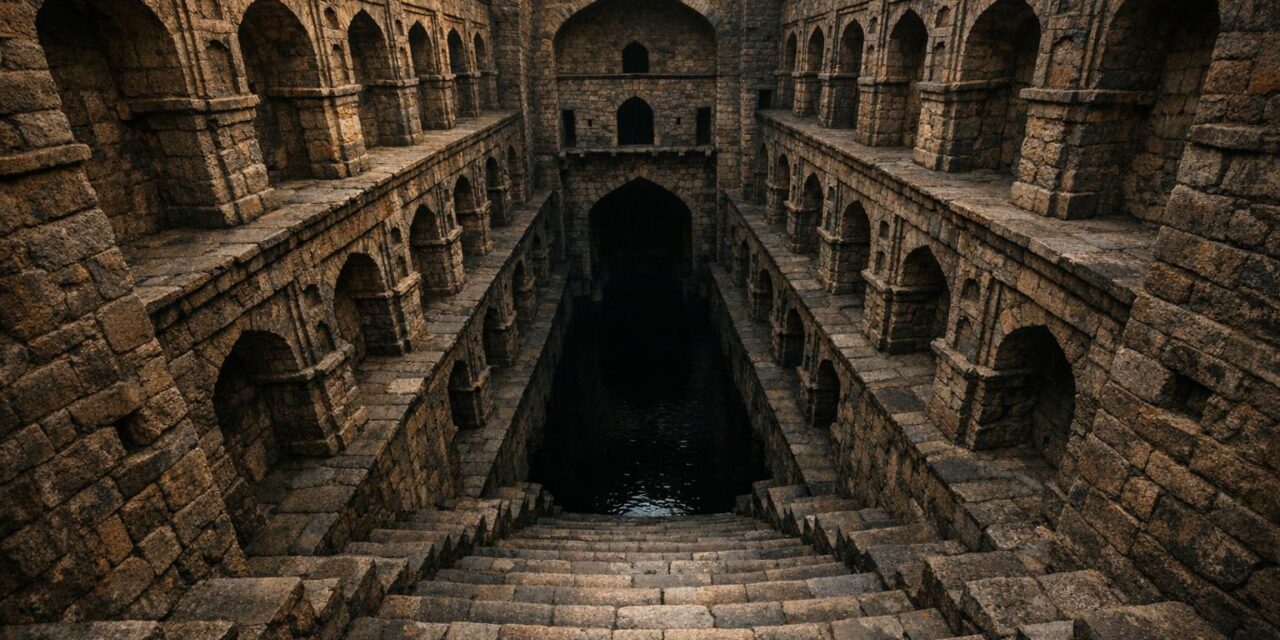
Turn off Hailey Road in Connaught Place and the city vanishes. A gate, a short path, and then the ground opens: Agrasen ki Baoli drops away in a long rectangular descent, its stone galleries narrowing tier by tier as the staircase deepens. The steps number 108. At the bottom, visible from the first landing, sits a pool of water so dark it seems to precede you — absorbing the sky rather than reflecting it, sitting in perfect stillness in a place where the sun has not reached in centuries. Visitors who look down at it from the top of those steps describe the same sensation: the impression that the water is not waiting so much as watching.
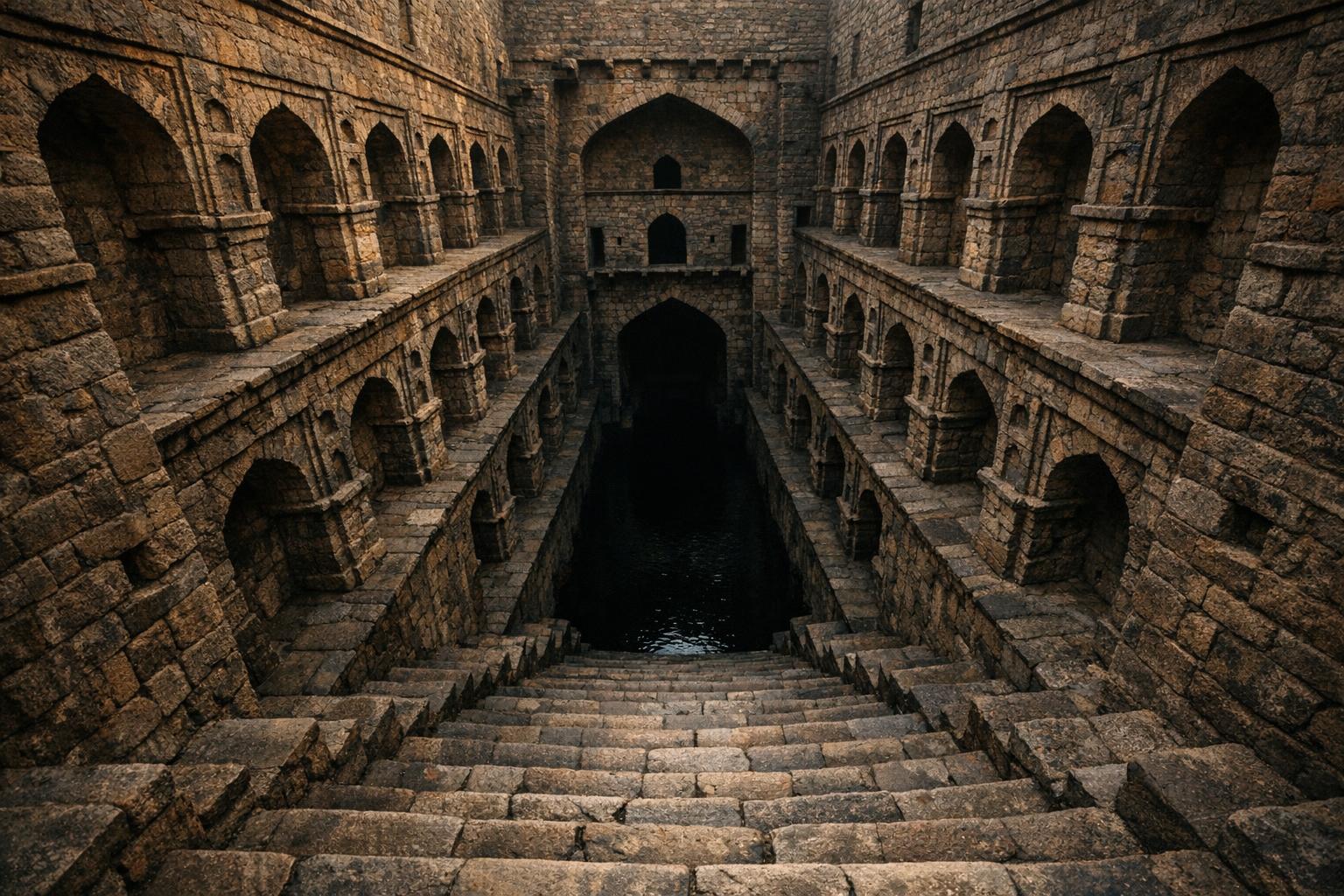
The baoli dates to the fourteenth century, though its name reaches further — into the mythology of the legendary king Agrasen, revered as founder of the Agarwal merchant community. For generations it was a civic gathering place: the arched galleries offering shade, the descending terraces tracking the seasonal water table, the structure a working monument to the labor of reaching water in a pre-modern city. What accumulated in the centuries of its use is harder to trace. Delhi’s folklore holds that the black water calls to the living — that something in the quality of the place lures visitors toward suicide, that demonic presences occupy the lower galleries, that the pull felt by those who descend alone is not imagination but intention.
Today Agrasen ki Baoli is an Archaeological Survey of India protected monument, open free to visitors at the center of one of Delhi’s busiest districts. Photographers come for the geometry of the descending arches. The haunted reputation brings everyone else. Most visitors stop partway down. The ones who reach the water rarely explain exactly where the decision to turn around came from — only that it came, somewhere in the middle of those 108 steps, before they could have said why.
Story Source: thirdeyetraveller.com
Address: Agrasen ki Baoli, Hailey Road, Connaught Place, New Delhi, Delhi 110001, India
Accessibility Rating: Open to All — Freely accessible to the public with no advance requirement. Includes hotels, restaurants, bars, and public historic sites where visitors may walk in without prior booking.
Google Map
What Others Have Experienced
A paranormal investigator who descended to the lowest level of the stepwell described the city noise from Connaught Place fading completely as she went deeper, replaced by an unnatural silence unlike anything she had experienced before. At the base she felt a cold, dense atmosphere and said the overall impression was of a space that felt actively unwelcoming rather than merely quiet.
— from Amy’s Crypt
Visitors have described the psychological effect of the stepwell’s symmetrical descending geometry — the repeating arches narrowing toward blackness at the base — as creating a hypnotic pull that made it difficult to look away or resist the urge to descend further than felt safe. Several visitors in one group independently described a feeling of being compelled downward by something they couldn’t name.
— from Third Eye Traveller
A visitor reported experiencing a sudden and intense cold at the lower levels on a warm afternoon, to a degree that stopped several members of the group mid-descent. The temperature drop was immediate and localized, vanishing completely the moment they climbed back up two flights of stairs — with no change in airflow to explain the shift.
— from FrightFind
One blogger described hearing an inexplicable murmuring sound emanating from the stone walls near the base level, clearly distinct from any noise drifting in from the street above. The sound would stop when they turned toward it and resume when they walked away, and they were unable to find any source for it despite an extensive search.
— from Moon Mausoleum
A visitor described the dominant emotional experience of Agrasen ki Baoli as a feeling of being drawn downward by the design of the space itself — the inward-tapering walls, the darkening water stains, the progressive silencing of the world above — in a way that made the legend of the black water feel less like folklore and more like an architectural fact. They said no photograph had prepared them for how the space actually felt to stand in.
— from WanderOn