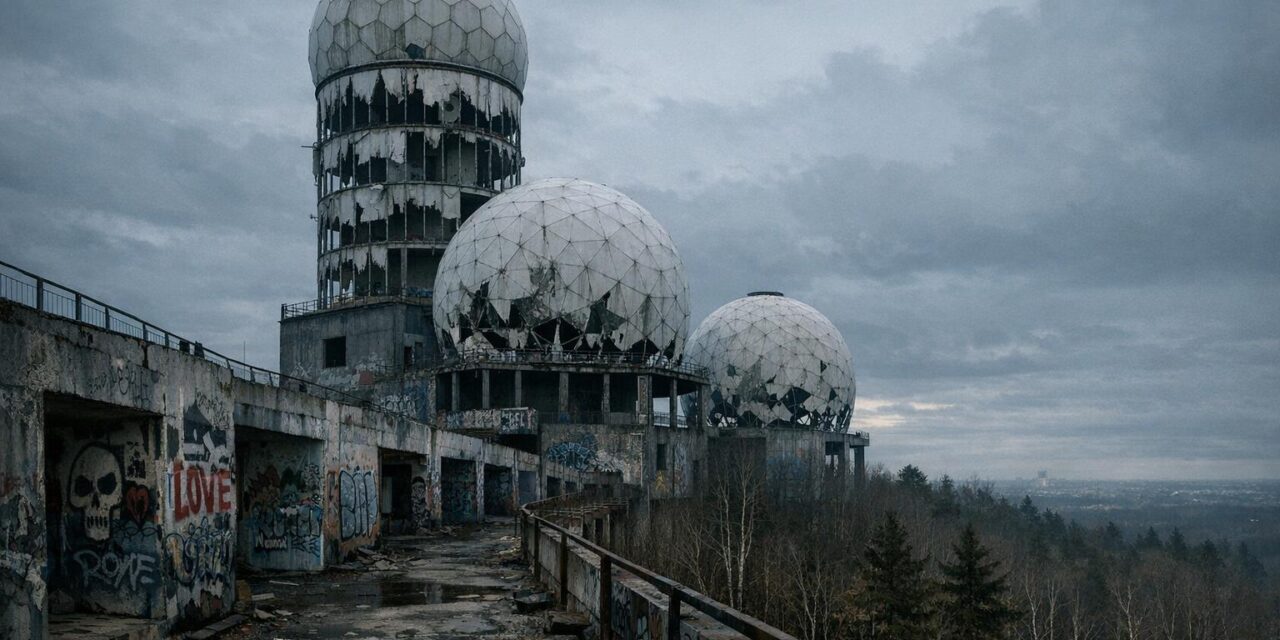
Teufelsberg — Devil’s Mountain — rises above the Grunewald forest on the western edge of Berlin with no natural origin. It is a hill built entirely from rubble: twelve million cubic meters of bombed masonry from the destroyed city below, compacted over a decade after World War Two. Beneath it, sealed and undemolishable, lies the skeleton of an unfinished Nazi military college. At its summit, five white radomes housed the NSA and British intelligence’s Cold War listening apparatus for thirty years. When the Berlin Wall fell in November 1989, the Field Station Berlin was locked and abandoned with notable speed. What remained was the hill, the domes, the concrete corridors — and a silence that the building’s acoustic geometry refuses to maintain.
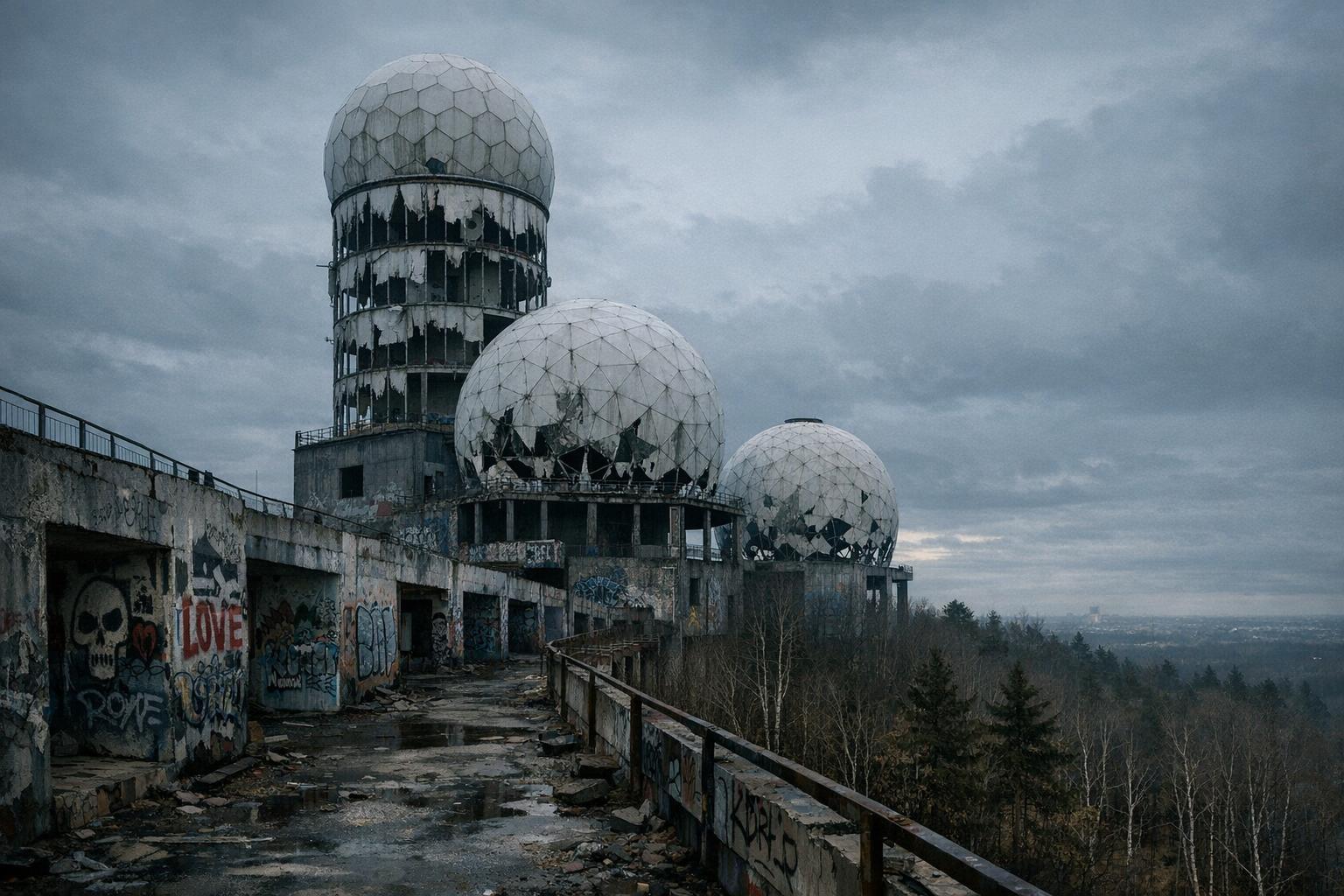
The analysts who worked inside the radomes intercepted Soviet and Warsaw Pact communications throughout the Cold War in sealed rooms where the curved walls focused and amplified every frequency. What they heard remains classified. What visitors hear in those same spaces today is reported with consistent specificity: voices from directions where no one stands, footsteps in corridors when the building’s other occupants are visibly elsewhere, and in the largest dome an acoustic phenomenon that returns a whispered word from multiple directions simultaneously, processed by geometry into something the ear receives as inexplicable. The eerie domes and corridors of Teufelsberg carry the reputation of the intelligence war conducted within them — a haunting of accumulated secrecy rather than named figures, of listening long practiced in rooms designed for exactly that purpose.
The site is open on a managed basis with guided tours most days from Teufelsseechaussee. Urban artists have covered every accessible concrete surface with successive generations of murals, and the domes have been partially stabilized. The largest dome demonstrates its acoustic properties to every visitor who enters. Beneath the art and the ruins, the unfinished Nazi college sits in its rubble, inaccessible and intact. The adventure traveler who climbs Teufelsberg stands simultaneously on the buried architecture of fascism and the abandoned infrastructure of Cold War surveillance, in a building that still seems — in its corridors, in its domes, in the sounds it makes — to be actively listening.
Story Source: www.visitberlin.de
Address: Teufelsseechaussee 10, 14193 Berlin, Germany
Accessibility Rating: Open to All — Freely accessible to the public with no advance requirement. Includes hotels, restaurants, bars, and public historic sites where visitors may walk in without prior booking.
Google Map
What Others Have Experienced
A visitor described Teufelsberg as one of the most profoundly eerie places they had encountered in Europe. The Cold War listening domes decaying atop a hill composed of the rubble of bombed buildings — itself buried under decades of forest growth — created a layered sense of historical violence that made the cheerful street art covering the walls feel almost surreal by contrast.
— from TripAdvisor
A travel blogger described the interior of the main radome as producing a remarkable acoustic effect: sound from any direction in the circular space reflects and amplifies into an unsettling murmur that seems to come from everywhere at once. They noted that being inside the structure at dusk felt unlike any building they had been in, and that the sound effect made it easy to understand why visitors routinely described the dome as haunted.
— from Earth Trekkers
A visitor who joined the guided tour described listening to a former Cold War analyst explain life inside the listening station — the isolation, the paranoia, the knowledge that the intelligence they gathered might one day trigger catastrophe — as one of the most affecting travel experiences of their time in Berlin. Standing in the decommissioned rooms while a man who had worked in them described the psychological weight of the work made the place feel less like a ruin and more like a wound.
— from TripAdvisor
A visitor described the site as simultaneously beautiful and deeply unsettling — the views over Berlin from the dome roof are spectacular, while the interior of the listening station, particularly the abandoned equipment rooms, carries an oppressive atmospheric weight that visitors and graffiti artists have not fully dispelled. They said it felt like a place that actively remembered what it had been used for.
— from Berlin Wanderlust
A travel writer described the walk through Grunewald forest to reach the site as itself part of the experience — the transition from suburban Berlin to the sudden appearance of the decaying Cold War installation on the hilltop producing a disorientation that primed them for what the site delivered. They described the overall experience as one of the most genuinely uncanny they had encountered as a traveler anywhere in the world.
— from Apenoni