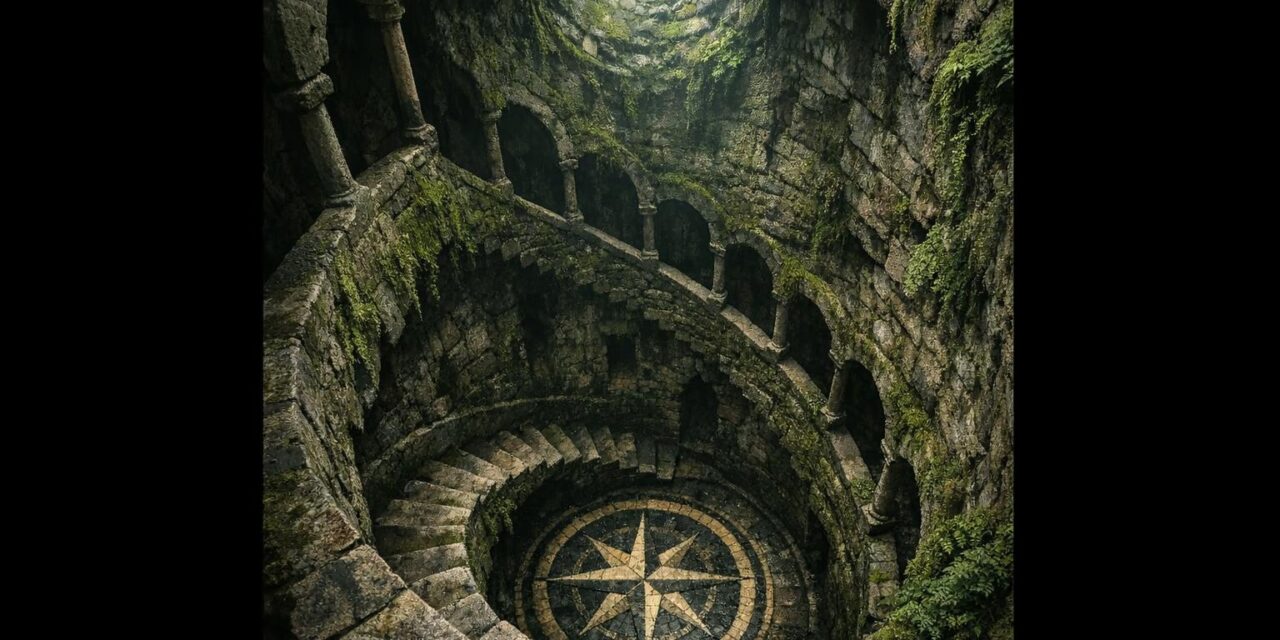
Quinta da Regaleira in Sintra, Portugal, was not built to be a home. It was built by António Augusto Carvalho Monteiro—a Brazilian millionaire, Freemason, and student of alchemy, the Knights Templar, and Rosicrucianism—as a three-dimensional encoding of everything he knew and believed. The Gothic Revival palace, designed by Italian architect Luigi Manini and completed in 1910, is covered in Masonic symbols, Templar crosses, and alchemical imagery. Every path in the garden leads somewhere that means something. Every chamber was designed to produce a specific effect on the person standing in it.
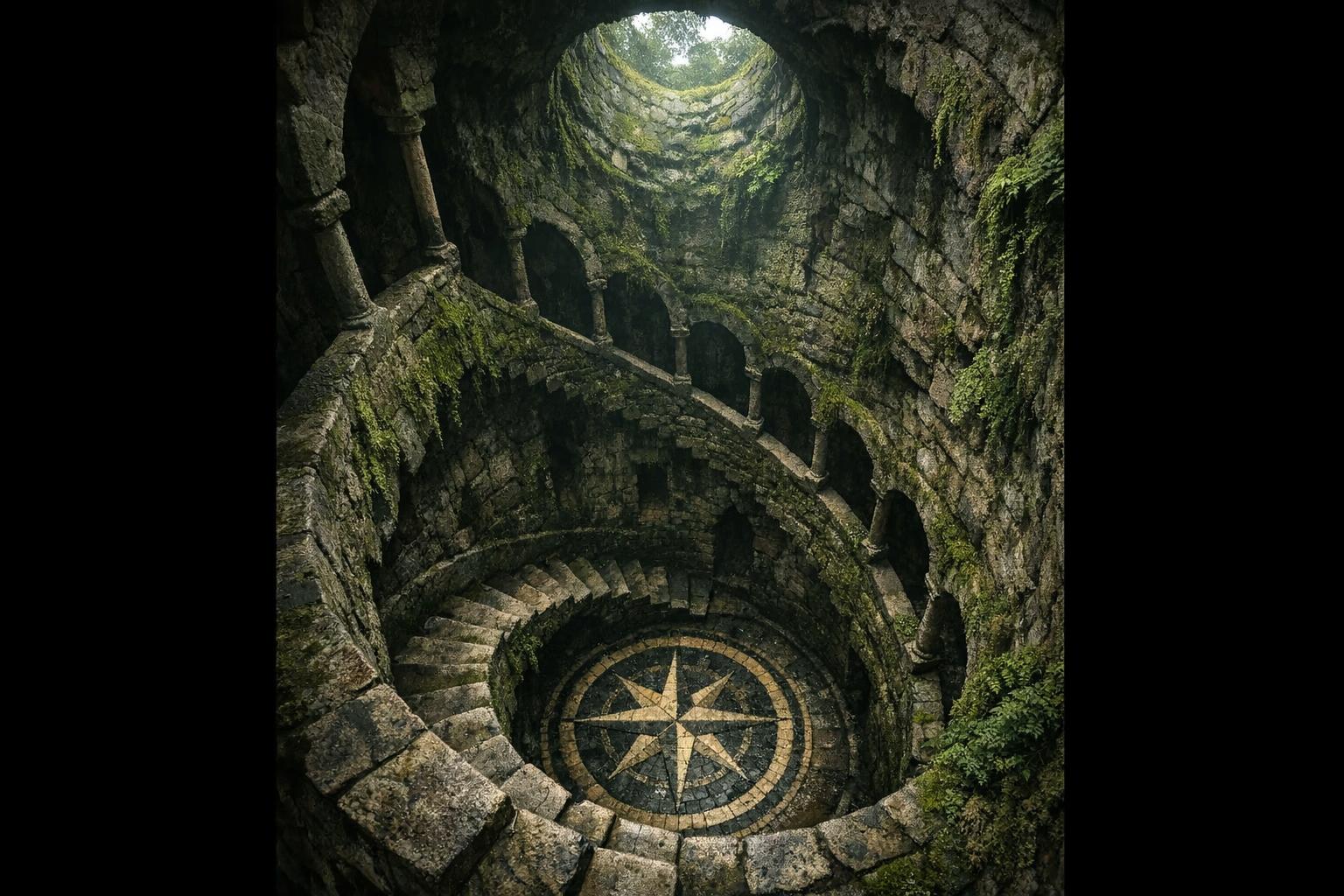
The most designed effect is underground. The Initiation Well—Poço Iniciático—descends 27 meters in a perfect spiral through nine levels, with carved Templar crosses in the walls and a Masonic compass rose in mosaic tile at the bottom. Nine levels corresponding to Dante’s nine divisions of Hell, or the nine steps of Templar initiation, or both simultaneously. A network of tunnels connects the well’s base to other points in the garden: a second well, stone grottoes, passages that emerge under waterfalls. Visitors moving through the tunnels in darkness and arriving at these points were experiencing a designed initiatory sequence. No documentation of what the ceremonies involved has survived. Carvalho Monteiro was careful about that.
What has survived: visitors who report seeing shadowy figures walking the garden perimeter, particularly near the well, that disappear when looked at directly. Whispers echoing through the tunnels when no one else is present. A heavy, oppressive weight near certain symbols on the palace walls. Sintra’s Atlantic fog amplifies whatever is already present in a place. Carvalho Monteiro built Quinta da Regaleira to produce altered states of consciousness. The architecture is still there, still working. The well is still open. The compass rose still points in the directions it was made to point.
Story Source: www.supernaturalspot.com
Address: R. Barbosa du Bocage 5, 2710-567 Sintra, Portugal
Accessibility Rating: Accessible
Google Map
What Others Have Experienced
Getting lost in the winding paths of the estate, one visitor said every corner opened onto something unexpected — a moss-covered statue, a hidden grotto, an archway leading nowhere obvious. The property felt designed to disorient and enchant in equal measure.
— from TripAdvisor
Descending into the Initiation Well, a visitor described it as an enigmatic space unlike anything they had encountered — a deep spiral staircase dropping to a Templar cross carved in stone at the bottom. The silence and the enclosed geometry made the experience feel genuinely ritualistic.
— from TripAdvisor
A visitor described two possible exits from the well: one path leading to a dead end where you look straight up through the opening as if from inside a grave, the other emerging into a garden with a waterfall. The contrast between those two outcomes made the symbolism feel viscerally real rather than academic.
— from TripAdvisor
Walking the caves and grottoes scattered across the grounds, one reviewer said the underground passages were dark and dripping and genuinely exciting to move through. The sense of being somewhere designed to make you feel small and uncertain was inescapable.
— from TripAdvisor
Inside the palace itself, a visitor noted details that seemed deliberately unsettling — oddly proportioned rooms, cryptic decorative elements, connections to the Knights Templar visible in every surface. The whole property felt less like a home than a question no one was meant to answer.
— from TripAdvisor