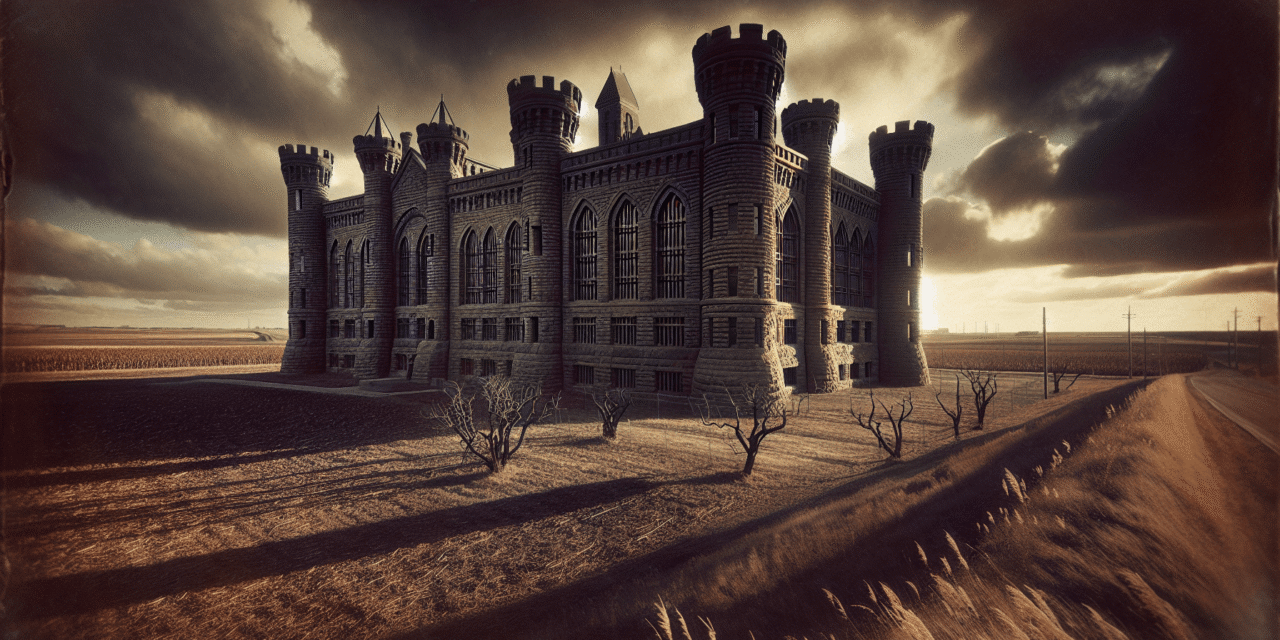
The Ohio State Reformatory rises from flat Ohio farmland outside Mansfield with the gravity of a building that knows what it has held—six stories of sandstone, Romanesque arches, and turrets, with a central tower reaching upward like a church that lost its faith. Construction began in 1886; the first inmates arrived in 1896, while work was still ongoing. More than 154,000 men passed through over ninety-four years. At least 200 didn’t leave.
The most documented death here is not an inmate’s. On November 5, 1950, Helen Glattke—wife of superintendent Arthur Glattke—was preparing for Sunday Mass in the family quarters on the third floor of the administration building. Reaching for a jewelry box on a closet shelf, she dislodged a .32-caliber handgun. It struck the floor and discharged. The bullet entered her left lung. She survived three days before dying of pneumonia. She was forty-one. Arthur Glattke remained, running the institution from the same building, until February 10, 1959, when he suffered a heart attack at his desk and died at Mansfield General Hospital.
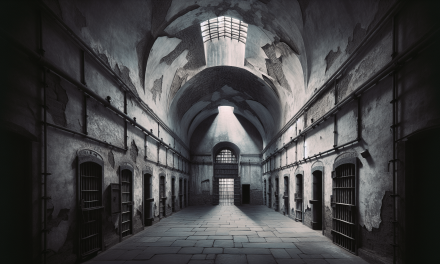
The reformatory closed in 1990 after a federal court found conditions unconstitutional. A preservation society took ownership, restored the building, and opened it to the public; it was also filmed as the prison in The Shawshank Redemption. Today it receives tens of thousands of visitors annually. The warden’s office is described as watchful—a heaviness several accounts have called specifically masculine. On the cell block’s upper tiers, footsteps move across catwalks where no one stands. In the solitary confinement area, cold spots gather near specific cells. In the basement, voices have been recorded with no traceable source.
Story Source: www.mrps.org
Address: 100 Reformatory Road, Mansfield, OH 44905
Accessibility Rating: Open to All — Freely accessible to the public with no advance requirement. Includes hotels, restaurants, bars, and public historic sites where visitors may walk in without prior booking.
Google Map
What Others Have Experienced
The reformatory is walkable with a self-guided audio tour and walk-up tickets — no advance booking required — which means visitors arrive with a range of preparation levels. Those who have researched the building’s history before visiting, including its use as the filming location for The Shawshank Redemption, describe the combination of cinematic familiarity and genuine institutional darkness as one of the more unusual experiences available at an American heritage site.
— from Ohio State Reformatory
The Gothic architecture of the reformatory — towering sandstone towers, vaulted corridors, and the largest freestanding steel cellblock in the world — creates an exterior that visitors consistently describe as more striking than they expected, and an interior that produces an immediate sense of institutional claustrophobia despite the enormous scale of the cell blocks. The combination of imposing grandeur and human-scale confinement is the building’s defining physical quality.
— from US Ghost Adventures
Helen Glattke, the warden’s wife who was fatally wounded by her own jewelry box pistol in the residential apartment, is the most consistently reported presence in visitor and investigator accounts. The apartment where she died — part of the guided tour — produces a disproportionate number of cold-spot reports, EVP recordings, and photographic anomalies relative to the rest of the building, with the domestic context of the space making the accounts somehow more disturbing than those from the cell blocks.
— from Haunt Scout
The solitary confinement block generates visitor reports that are consistent in specifics — a heaviness in the air, rapid drops in temperature, and a pressing sensation described as unlike anything produced by other parts of the building. Investigators who have conducted overnight sessions specifically in the solitary block describe it as the most consistently active area, with audio anomalies that proved difficult to explain after review.
— from TripAdvisor
The reformatory’s operation from 1896 to 1990 means it processed tens of thousands of inmates across nearly a century, with the documented deaths, violence, and conditions giving the paranormal claims a historical basis that more recently abandoned sites lack. Visitors who find the ghost tour underwhelming consistently describe the self-guided historical audio tour as providing enough material on its own to make the visit worthwhile entirely independent of any supernatural dimension.
— from National Property Inspections