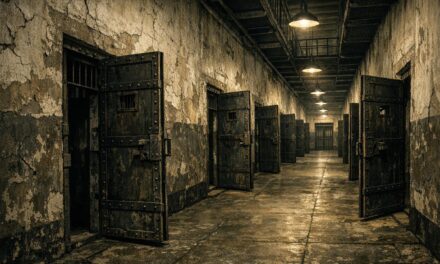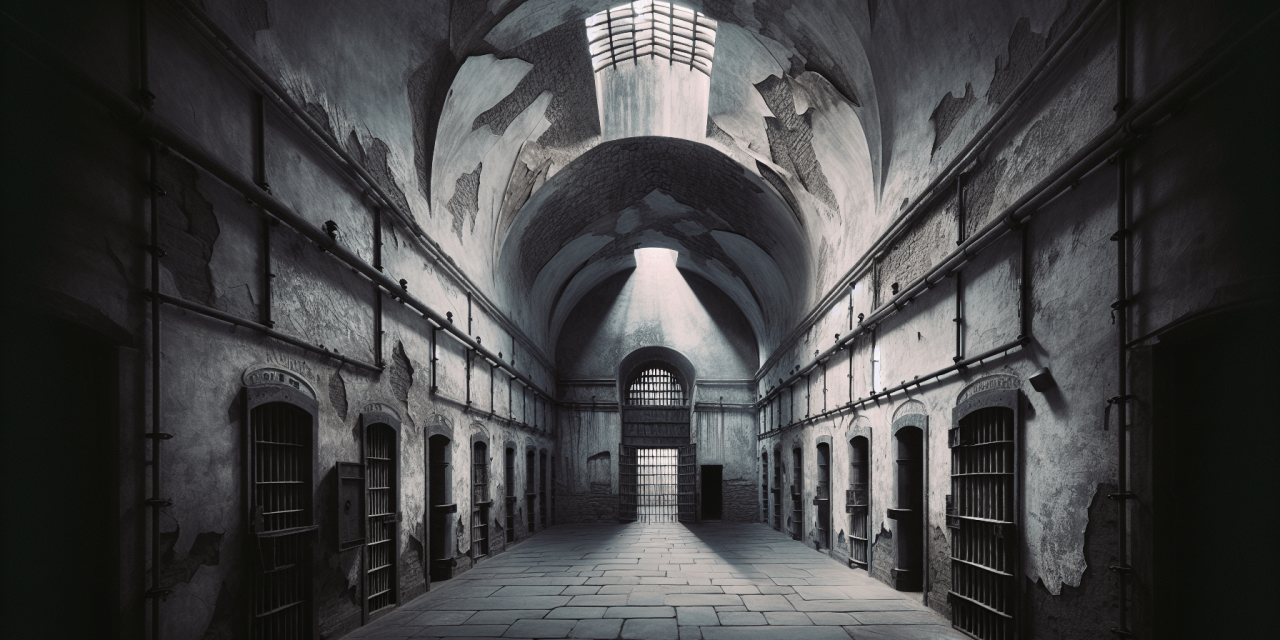
The iron door of Cell Block 4 closes with a clang that carries through a corridor where daylight barely reaches. Seven cellblocks radiate from a central hub on a hill in Philadelphia’s Fairmount neighborhood, built in 1829 by John Haviland as the first modern penitentiary—a plan replicated in more than three hundred prisons worldwide. The architecture still stands. So, for most visitors, does the feeling of being watched from the dark end of a gallery.
The Pennsylvania System demanded total isolation. Inmates lived, worked, and ate alone; when moved between cells, guards hooded them so they could not meet another man’s eyes. Quakers believed silence would produce penitence. What it produced, Charles Dickens wrote after visiting in 1842, was men who had forgotten how to speak and flinched at shadows. The system was dismantled by 1913; the prison ran six more decades. Al Capone arrived in 1929 and reportedly screamed at night in Cell Block 4 for James Clark, a ghost from the Saint Valentine’s Day Massacre. Willie Sutton tunneled out in 1945 after eleven months of digging and was caught hours later.
The prison closed and sat vacant for nearly two decades. It reopened in 1994 as a historic ruin and museum. A year later, a locksmith named Gary Johnson, hired to restore the corroded locks, said he looked up in a cellblock and saw dozens of anguished faces in the walls, vanishing when he tried to focus. Cell Block 12 is where visitors still glimpse a figure at the end of a corridor; Cell Block 6 is the one that laughs. Each fall since 1991, the museum has hosted Terror Behind the Walls—acknowledging openly that what happened here never required embellishment.
Story Source: Documentary titled “Eastern State: Living Behind the Walls” (Wayland Productions, 2008)
Address: 2027 Fairmount Avenue, Philadelphia, PA 19130
Accessibility Rating: Open to All — Freely accessible to the public with no advance requirement. Includes hotels, restaurants, bars, and public historic sites where visitors may walk in without prior booking.
Google Map
What Others Have Experienced
A visitor who approached the building skeptically described the effect of the penitentiary’s scale and condition as more atmospheric than any deliberately staged haunted venue — the wagon-vaulted cellblocks stretching into darkness, paint and plaster deteriorating in layers of peeling color, and preserved cells containing inmates’ personal objects creating a density of historical presence that is difficult to intellectually resist.
— from Middle Journey
Cellblock 4 is consistently identified by visitors and investigators as the most paranormally active area. Reports include shadowy figures at the end of corridors, cackling sounds with no clear source, and faces appearing briefly in cell doorways. The frequency and consistency of these reports across unrelated visitors makes Cellblock 4 the focal point of any paranormal-focused visit.
— from Ghost City Tours
The audio guide included with admission adds historical context that makes the paranormal dimension harder to dismiss — knowing the conditions former prisoners endured, including years of solitary confinement, gives the silence of the empty cells a specific quality. Multiple visitors describe the audio tour as the element that shifted their interpretation of what the building feels like to inhabit.
— from Philly Ghosts
The prison’s sheer physical scale repeatedly surprises first-time visitors — seven original cellblocks radiating from the central rotunda, most still intact and accessible. An average visit of two hours is consistently described by reviewers as insufficient for those wanting to take in the full space, particularly those drawn by both the architectural drama and the paranormal history.
— from TripAdvisor
The penitentiary’s combination of institutional history, architectural drama, and persistent paranormal reputation makes it unusual among American dark tourism sites in satisfying visitors from multiple perspectives simultaneously. History enthusiasts, architecture lovers, and paranormal researchers all report finding the experience substantive on their own terms, reflected in consistently high ratings across review platforms.
— from US Ghost Adventures