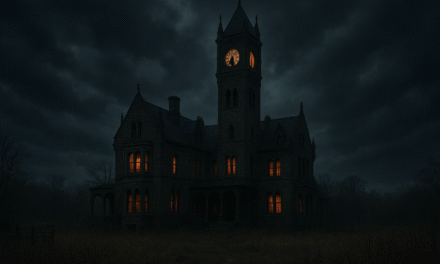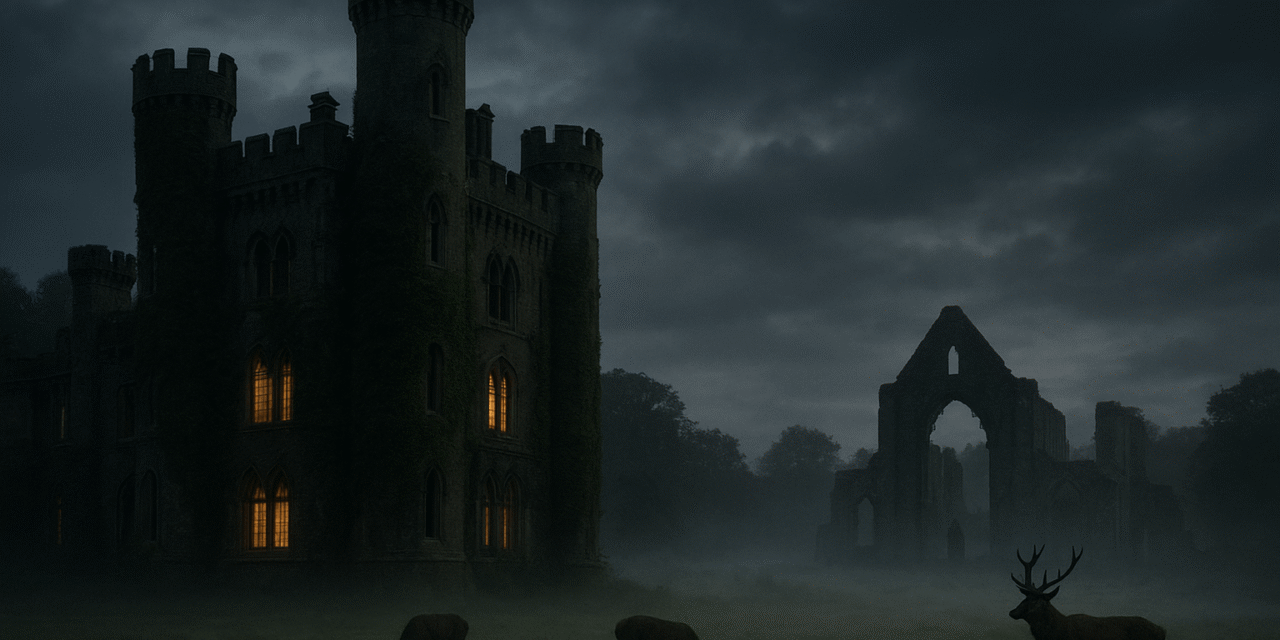
Margam, in South Wales, is a place where nine centuries of occupation have layered themselves so densely that the past is not so much over as underfoot. In the grounds of what is now Margam Country Park stand the ruins of a Cistercian abbey founded in 1147, the twelfth-century chapter house still largely intact, and the abbey church nave still serving as a parish church today. Two hundred meters away, a grand Gothic Revival castle built between 1830 and 1840 by the wealthy Talbot family looks out across the same grounds the monks farmed for four hundred years before Henry VIII’s dissolution ended their world in 1537. The monks left. The dead they buried in the abbey grounds stayed. The land absorbed both facts equally.
The figure most consistently reported at Margam is a robed male, seen at dusk near the abbey ruins, walking along a route that corresponds precisely to the old processional cloister path between the chapter house and the church—a path that no longer exists in the modern topography of the park. Grounds staff have reported this figure independently over decades, with no apparent coordination, describing the same details: solid until directly observed, then translucent or gone, indifferent to being seen, following a route visible only to itself. The castle contributes its own ghost: Robert Scott, a gamekeeper murdered on the estate in the nineteenth century, whose apparition is reported near the stable block and walled garden, and who—unlike the monk—appears to register the presence of the living.
The castle suffered a serious fire in 1977 and much of its interior remains in a state of incomplete restoration. Ghost hunting teams have investigated regularly, and the site operates today as Margam Country Park, open to the public. What it offers is not a single dramatic haunting but something more atmospheric: nine centuries of prayer, death, dissolution, and quiet decline, compressed into a thousand acres where the deer still graze at dusk and something in a robe still walks the old path home.
Story Source: www.margamcountrypark.co.uk
Address: Margam, Port Talbot SA13 2TJ, Wales, UK
Accessibility Rating: Booking Required — Open to visitors but requires advance reservation, ticket purchase, or tour booking.
Google Map
What Others Have Experienced
The most active presence at Margam is said to be Robert Scott, a gamekeeper shot dead by a poacher on the grounds in 1898. His dark figure is most commonly reported on the main staircase at the castle’s entrance. Those who have attempted to communicate with him during vigils report stones and pebbles being hurled at them by unseen hands — a signature response attributed to his angered spirit.
— from Amy’s Crypt
The upper floors of the mansion — once a Victorian nursery — generate some of the most unsettling reports. Visitors have described seeing small figures in Victorian-era clothing, and tour guides have heard the sounds of children giggling and running across the wooden floorboards when no children are present. In at least one account, a guide temporarily lost track of a child from the group, who later said they had been playing with “the other children.”
— from Amy’s Crypt
Ghost hunting events at the castle regularly produce intense activity: sudden icy blasts in sealed rooms, light anomalies drifting through the darkness, and stones physically thrown at investigators during vigils. Participants describe the castle’s many decayed corridors and grand staircase as genuinely disorienting — a quality of unease they say no amount of rational explanation fully dispels.
— from Haunted Happenings
The castle has drawn repeated attention from paranormal television productions — Most Haunted investigated in 2006, followed by Ghost Hunters International in 2010 and Paranormal Lockdown UK in 2018. Visitors who know this history often cite it as lending the site a credibility that purely tourist-oriented haunted attractions lack; the activity here has been scrutinised by serious investigators more than once.
— from Spooky Isles
Beyond specific apparitions, what visitors most consistently describe is the castle’s pervasive atmosphere: a feeling of being watched in empty rooms, black shadow figures glimpsed in peripheral vision along the corridors, and disembodied footsteps or voices heard when no one else is nearby. The building’s decay and violent history combine with its remote grounds to produce an unease that visitors say takes hold almost immediately upon entering.
— from Haunted Rooms UK