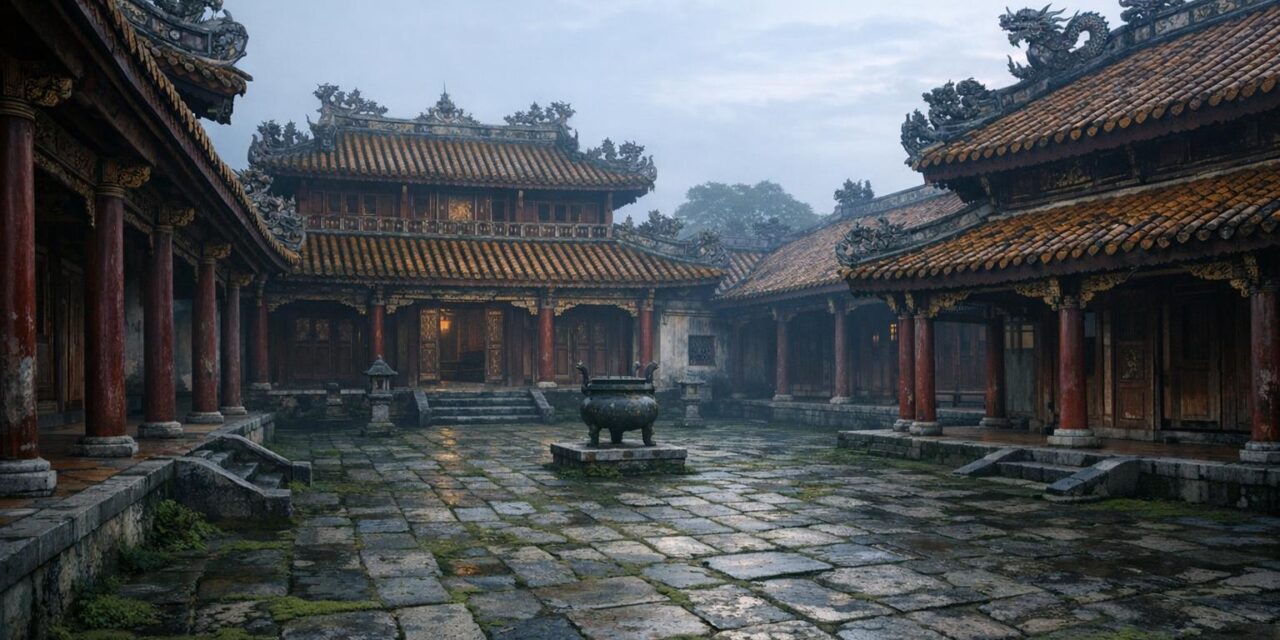
You enter the Imperial City through the Noon Gate, its tiered stage above the central archway marking the passage reserved exclusively for the emperor during the 143 years the Nguyen dynasty ruled from Hue. The Imperial City was completed in 1833 within a larger citadel complex on the Perfume River. At its heart sat the Forbidden Purple City — the innermost sanctum, reserved for the emperor, his family, and those who served them, its 3.7-meter walls making it the most private and protected space in the country. The Palace of Supreme Harmony still stands near the gate. The Forbidden Purple City, further in, does not.
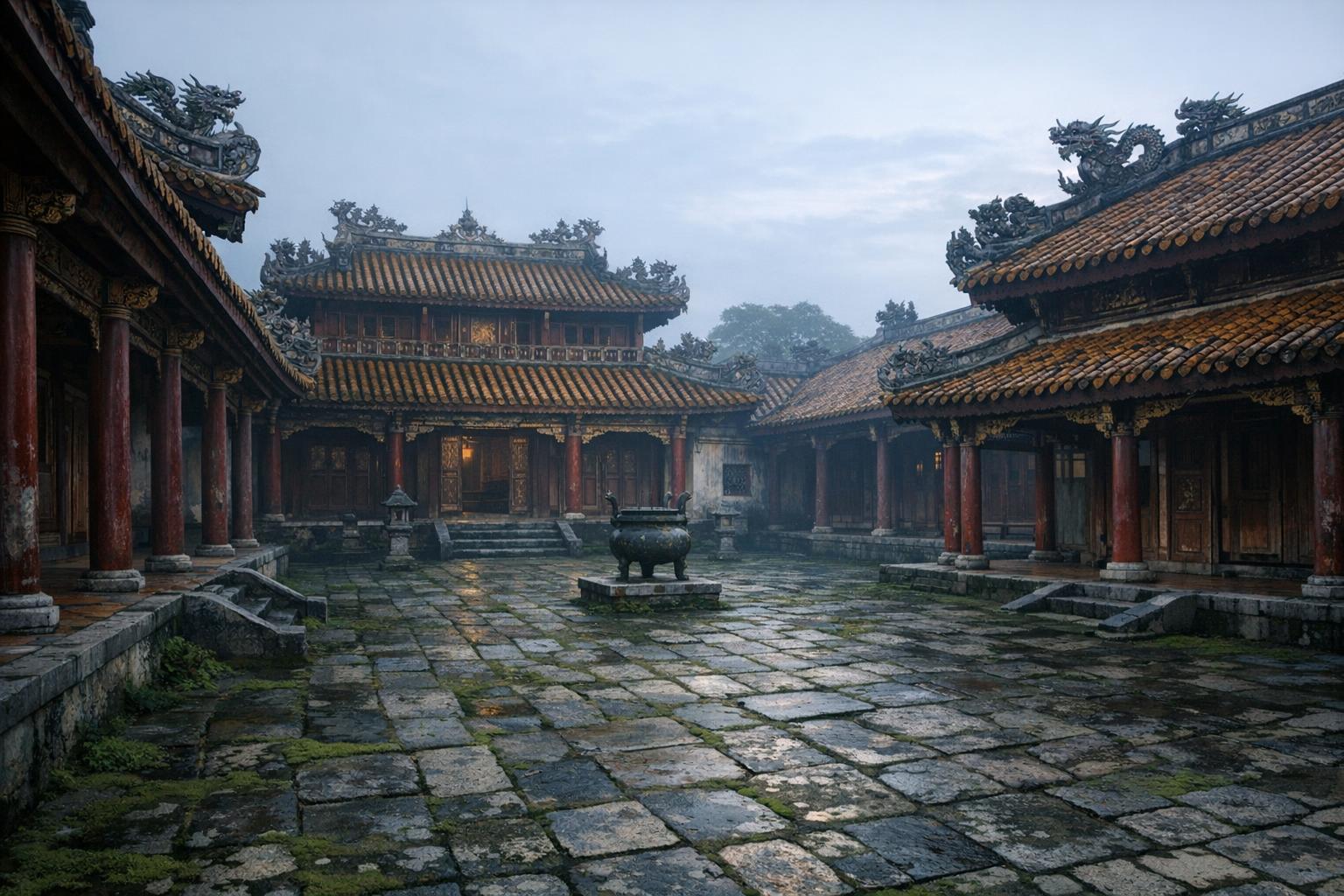
In January 1968, North Vietnamese forces occupied Hue during the Tet Offensive and held the Citadel for twenty-six days. The Battle of Hue destroyed most of the city. The Forbidden Purple City — that innermost sanctum, the space reserved for emperors alone — was flattened in less than a month of fighting. The walls remained standing. The buildings inside them did not. What the last emperor of the Nguyen dynasty left behind when the dynasty ended in 1945 was erased by a war that had nothing to do with dynasty and everything to do with what Vietnam had become in the intervening century.
The Complex of Hue Monuments became a UNESCO World Heritage Site in 1993, and restoration has been ongoing since. Entry is 150,000 dong — approximately seven dollars — and the site is open to all. The restored sections show what the compound once was. The ruined sections show what was lost. The walls of the innermost sanctum still stand around the absence of everything that used to be inside them.
Story Source: www.maptrotting.com
Address: Imperial Citadel (Kinh Thanh Hue), Hue, Thua Thien Hue Province, Vietnam
Accessibility Rating: Open to All — Freely accessible to the public with no advance requirement. Includes hotels, restaurants, bars, and public historic sites where visitors may walk in without prior booking.
Google Map
What Others Have Experienced
The complex arranges itself in layers — the outer walled citadel holds the Imperial City, and within the Imperial City, the Forbidden Purple City sits behind its own 3.7-metre brick walls as a further inner sanctum. Entering through the recently restored Noon Gate, the Palace of Supreme Harmony straight ahead contains scale models and images showing the full complex as it looked at its 1833 completion — useful before walking into the partially ruined sections beyond.
— from maptrotting.com
The Forbidden Purple City itself is mostly foundations now, leveled during the heavy fighting of the Tet Offensive in January 1968. Some sections are mid-restoration, others still overgrown, and the wilder parts have an atmosphere the rebuilt areas cannot replicate — you’re walking through a ghost of something, which is exactly the right feeling for a site that once housed the Vietnamese emperor exclusively.
— from maptrotting.com
One of the site’s strongest qualities is the freedom to wander anywhere without enforced routes or roped-off sections, making it easy to find quiet corners the main visitor flow misses entirely. Very little shade across the grounds, so a hat, strong sunscreen, and more water than you expect to need are non-negotiable in the Vietnamese heat. A knowledgeable guide makes a significant difference — the symbolism and dynastic history are largely invisible without context.
— from backpackerswanderlust.com
Walking through the complex, restored throne halls sit directly alongside gunshot-pitted archways and collapsed walls — the contrast between what the ongoing restoration has recovered and what decades of war, typhoons, and termite damage left behind is part of what makes the site so affecting. The Forbidden Purple City section bears the greatest losses, with most of its structures gone entirely.
— from TripAdvisor
The citadel grounds cover far more than most visitors expect — around 520 hectares in total, with long stretches of path connecting separate clusters of buildings, temples, and gardens. Arriving early pays off: cooler temperatures, better light, and the restored sections largely to yourself before midday. Budget at least three hours, and do not skip the outer ramparts, which give a sense of the original military scale the interior structures alone cannot convey.
— from TripAdvisor