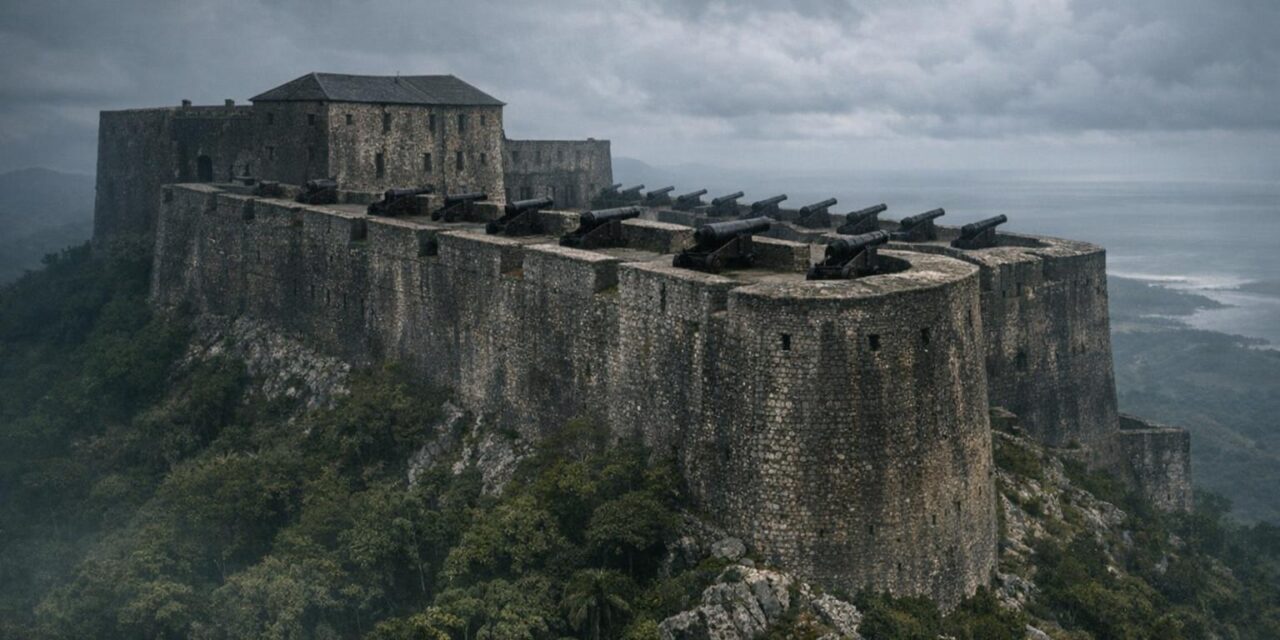
The Citadelle Laferrière does not yield its location without effort. It sits at the summit of a mountain in northern Haiti, seventeen miles from Cap-Haïtien, accessible only by a steep uphill path from the town of Milot — on foot or on horseback, through heat and elevation, the fortress hidden until you are nearly at its walls. King Henri Christophe began building it in 1820, forcing twenty thousand workers to carry stone up the mountain by hand, driven by a single conviction: that the French would return to retake the republic that had defeated them in 1804. He designed the fortress to house five thousand soldiers, stockpile a year’s worth of provisions, and expose any attacking force to simultaneous cannon fire from every direction. More than two hundred cannons still sit on its bastions, muzzles aimed at a horizon the French never crossed.
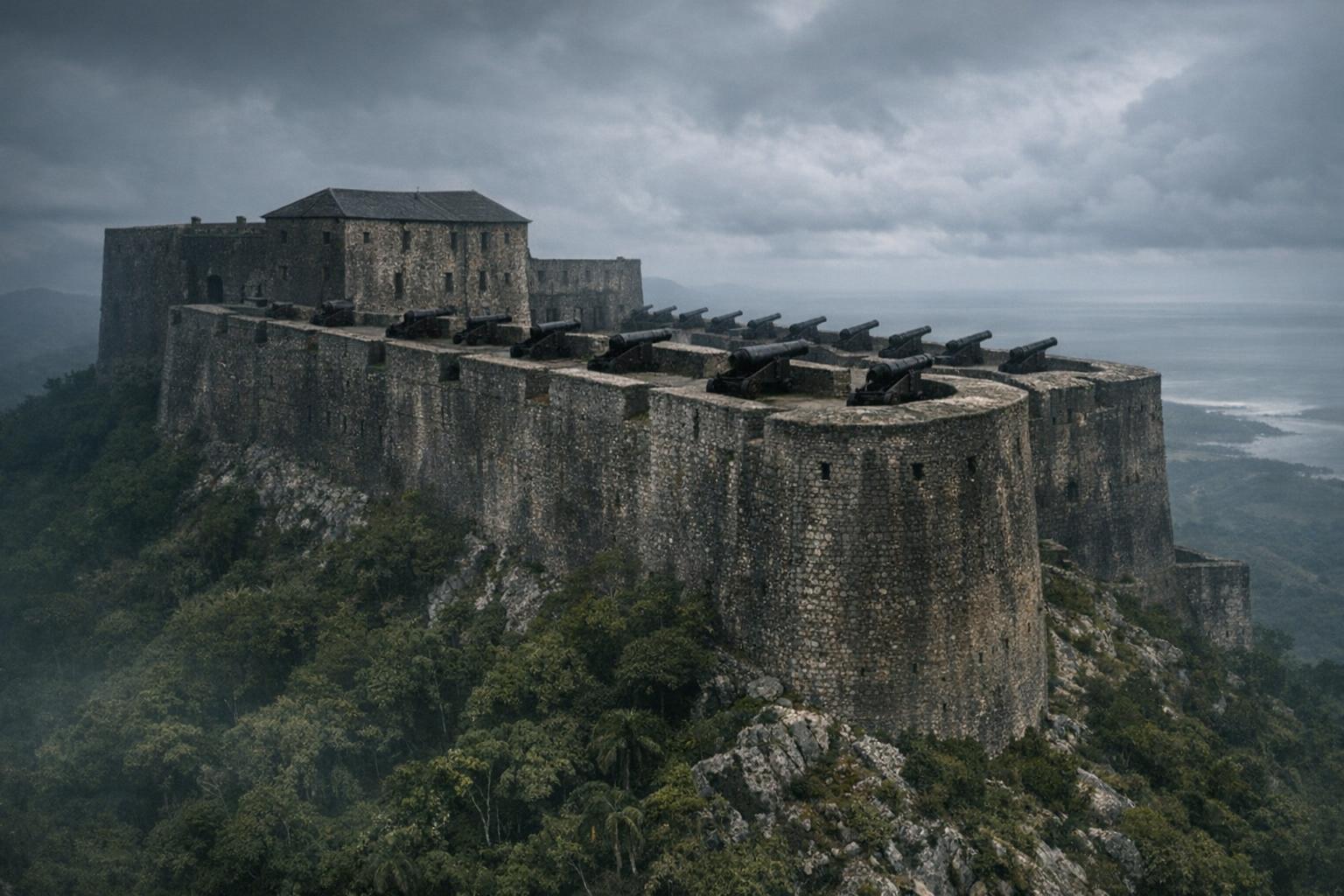
The attack Christophe prepared for never came. The Citadelle was completed in 1820, the same year a stroke left him partially paralyzed and a military uprising began among troops exhausted by the conditions he had imposed. Rather than surrender, Christophe took his own life within the walls of one of his buildings. His ghost, by long tradition, remains — haunting the stone that twenty thousand people were compelled to drag up a mountain under his orders. The weight of that history is not subtle. Visitors describe an atmosphere that exceeds easy explanation: something in the walls, something in the silence of a fortress built for a war that never arrived.
The Citadelle and the ruins of Sans-Souci Palace together form Haiti’s National History Park, a UNESCO World Heritage Site since 1982. The dry season — December through April — offers the most reliable access, with local guides from Milot essential for navigation. The storerooms are intact. The cannons are in position. The fortress is still waiting for the confrontation its builder spent everything to prepare for.
Story Source: haititourisme.org
Address: Citadelle Laferrière, Milot, Nord Department, Haiti
Accessibility Rating: Limited or Restricted Access — Partially accessible; some areas off-limits, permit required, or access is seasonal or irregular.
Google Map
What Others Have Experienced
The fortress was built from sugarcane, animal blood, and sand — no conventional foundation — by 20,000 workers over fourteen years on a 3,000-foot mountain. Not a single one of its hundreds of cannons was ever fired. The French never returned after Haitian independence, and standing at the top among the stacked cannonballs, that historical silence feels almost more powerful than any battle would have.
— from frannythetraveler.com
Approaching from below, the Citadelle rises like a ship permanently docked on the mountain’s crest — walls four metres thick and forty metres high, built to hold provisions for 5,000 people for an entire year. Henri Christophe, who ordered it and drove 20,000 workers to complete it, shot himself with a silver bullet in the year it was finished to avoid the revolt gathering against him. The French invasion he built it to stop never came.
— from traveladventures.org
The Gallery of Cannons is the standout section — heavy bronze guns captured from French, British, and Spanish forces during the independence war, some still mounted on their original 18th-century wooden carriages, considered one of the finest collections of its kind anywhere in the world. At its peak the fortress held over 360 cannons and was stocked with 50,000 cannonballs. None were ever fired in combat.
— from davestravelcorner.com
Vendors and horse handlers swarm the base before the climb, which can feel overwhelming, but the hike rewards the effort — views open up with each switchback, and the payoff at the top, hundreds of cannons and stacked cannonballs against the Caribbean sky, genuinely earns the comparisons to Machu Picchu visitors make constantly. Start as early as possible before the heat sets in at altitude.
— from TripAdvisor
The Palais Sans-Souci ruins at the base are part of the same visit and worth taking time with. Even at half-collapse, the scale of what Christophe built below the fortress gives the Citadelle above its proper context — together they tell the story of an entire post-revolution kingdom, not just a defensive structure. Budget a full morning for both sites rather than rushing either one.
— from TripAdvisor