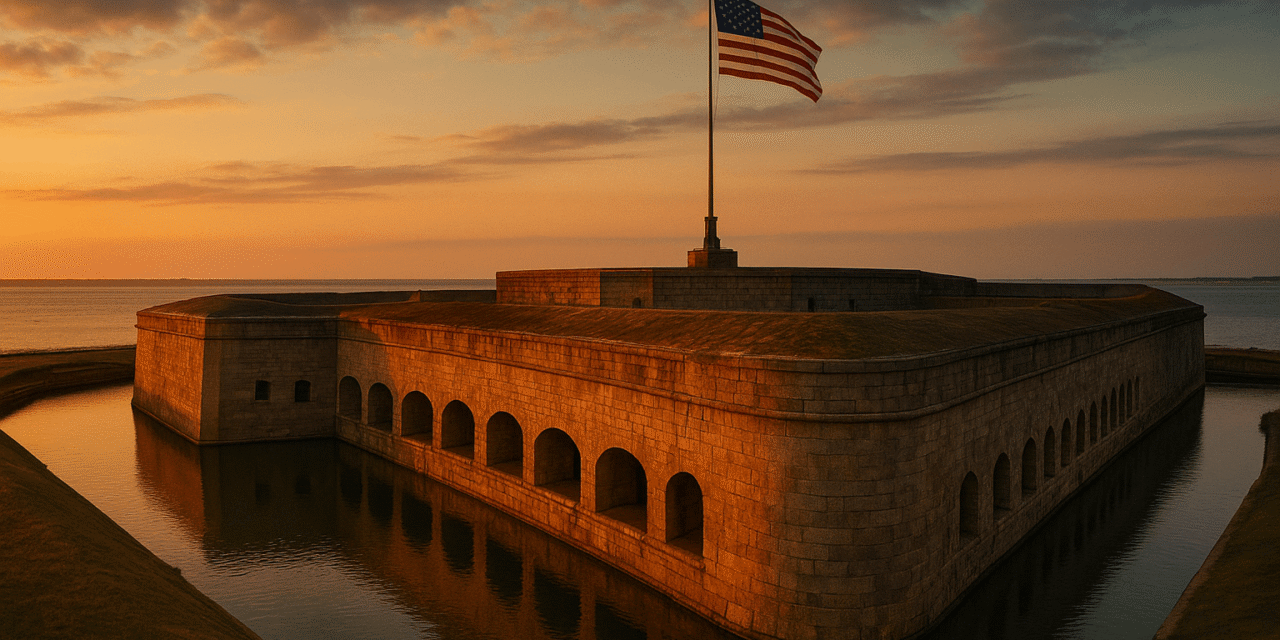
At the tip of Old Point Comfort, where the James River meets the Chesapeake Bay, Fort Monroe rises from its moat as the largest stone fort ever built in the United States. Completed in the early 1830s and designed with the input of a French engineer who had served under Napoleon, the seven-sided installation remained the only fort in Virginia to stay in Union hands throughout the Civil War—a Federal fortress in the heart of Confederate territory, flying the Union flag for four unbroken years.
The history that accumulated within its walls is specific and consequential. In 1861, General Benjamin Butler declared escaped enslaved people “contraband of war” here—a ruling that preceded the Emancipation Proclamation by more than a year and drew thousands of freedom-seekers to what became known as Freedom’s Fortress. In 1865, Jefferson Davis arrived as a prisoner, held in Casemate Number Two for two years without ever being brought to trial. And in 1828, a young Edgar Allan Poe served here as a sergeant major, working on his second poetry collection before securing his discharge and departing for West Point.
Fort Monroe became a National Monument in 2011. The ghost tours that now run through its casemates have accumulated a consistent record: unexplained cold in the room where Davis was held, a pale female figure seen crossing the parade ground across more than a century of reported sightings, and a quality of concentrated silence in spaces where Poe once wrote. With this much history pressed into its stone, the fort does not require embellishment.
Story Source: fortmonroe.org
Address: Fort Monroe, Hampton, VA 23651, USA
Accessibility Rating: Open to All — Freely accessible to the public with no advance requirement. Includes hotels, restaurants, bars, and public historic sites where visitors may walk in without prior booking.
Google Map
What Others Have Experienced
Jane Polonsky, who later wrote “The Ghosts of Fort Monroe” (1972), had her own encounter in the 1960s while living across the street from the Casemate Museum. Woken by knocking at her back door, she walked through her unlit dining room and found a man standing by the fireplace — arrogant in bearing, wearing a uniform she placed in the mid-18th century. He looked at her, then simply vanished. She backed out of the house onto the street, only to find her dog bounding toward her from entirely the wrong direction.
— from The United States Army
An anonymous resident who moved into an early-1900s house on base reported a series of unexplained events: a camera disappeared from its usual place and was found days later beneath the bathroom sink, a door closed audibly with no one near it, and both disembodied footsteps and voices were heard. Most distinctly, the resident glimpsed what appeared to be a woman in Victorian-era maroon dress tending a crib in the upstairs dressing room — visible only at the corner of the eye. Despite the activity, neither the resident nor his wife felt any sense of threat.
— from The United States Army
The most frequently encountered apparition at Fort Monroe is known as the Lady in White — identified in local accounts as Camille Kirtz, the wife of a Civil War-era officer. Her husband shot her after returning home unexpectedly and finding her with a French soldier. Her apparition has been seen walking the boardwalk in a white nightdress and lingering in a stretch of the grounds now called Ghost Alley, described as though still searching for the man she loved.
— from Colonial Ghosts
Jefferson Davis was imprisoned at Fort Monroe after the Civil War, wrongly accused of conspiring to assassinate Lincoln. During his confinement, he was escorted along the ramparts each evening so his wife, watching from a nearby house, could see that he was unharmed. His ghost is still reported walking those same ramparts after dark. In the house where his wife kept her vigil, witnesses say the window begins to vibrate without cause — attributed to her continuing presence.
— from The United States Army
A visitor staying in quarters on Tidball Street recalled being woken at 2 a.m. by a family member pointing to a wooden rocking chair moving steadily across the room as though occupied — with no one near it. It rocked for roughly two minutes before stopping abruptly. Separately, a paranormal investigation team captured an EVP recording in a building now used as office space: a child’s voice calling for a cat named Greta. Workers in that building report seeing a gray cat apparition dart around corners and vanish.
— from Virginia Haunted Houses