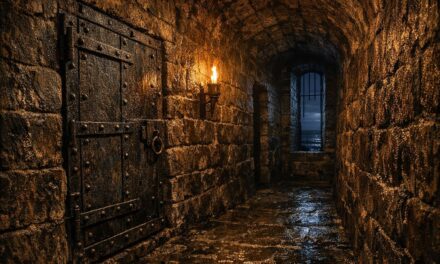
The ferry from Delaware City crosses only a few minutes of river, but on an October evening the silhouette of Fort Delaware arrives before you feel ready for it. The pentagonal walls rise from Pea Patch Island — granite and brick, built to endure — and the weight of what happened inside them settles over you well before you reach the dock.

Fort Delaware was constructed in the nineteenth century to protect the ports of Wilmington and Philadelphia and became a Confederate prison camp when the Civil War came. Nearly thirty-three thousand prisoners passed through over the course of the war; at peak capacity, nearly thirteen thousand were confined at once on a damp, flood-prone island. Dysentery, typhoid, and smallpox moved systematically through the overcrowded population. By the war’s end, approximately twenty-five hundred men had died at the fort — most buried across the river at Finn’s Point National Cemetery in New Jersey. The fort was abandoned after World War II and became a Delaware state park in 1951. The accounts followed: doors moving in empty corridors, shadow figures along the stone walls, children’s voices in the officer’s quarters, and a visitor’s photograph catching a blurred blue figure in a doorway. The Diamond State Ghost Investigators have spent fifteen years documenting such encounters, and DSGI President Gina Dunham — who has personally witnessed shadow anomalies and heard unexplained whispers and footsteps — frames the site with a phrase that has become something of a touchstone: “We are in their house. We have to be respectful.”
Fort Delaware State Park is accessible by ferry from Delaware City year-round. Daytime tours cover the Civil War history; fall paranormal tours, organized by DSGI with EMF detectors, infrared cameras, and audio recorders, sell out months in advance. The island also hosts one of the East Coast’s largest heron and egret rookeries. For the adventure traveler, there is nothing else quite like it: an island prison where twenty-five hundred men died, reachable only by water, where the accounts of what remains have been consistent enough across enough independent witnesses that the question of what still lingers inside those walls stays genuinely open.
Story Source: dnrec.delaware.gov
Address: Pea Patch Island, Delaware City, Delaware
Accessibility Rating: Limited or Restricted Access — Partially accessible; some areas off-limits, permit required, or access is seasonal or irregular.
Google Map
What Others Have Experienced
A paranormal investigator recalled an early visit to the fort that ended up shaping his entire career: during an evening investigation, he watched a half-bodied apparition with a disheveled, dirt-streaked beard linger near him for several seconds before vanishing. The encounter convinced him paranormal investigation was real, and he has since called Fort Delaware one of the most unsettling places he has explored anywhere in the country.
— from Delaware News Journal
A travel writer toured the fort during a full moon and described the experience as both eerie and beautiful, with the secluded island setting heightening every creak and shadow along the stone walls. She did not personally witness anything paranormal, but said other groups touring that same night reported experiences she could not explain.
— from Past Lane Pursuits
One visitor brought an EMF detector on a day trip with a group of teens drawn in by the fort’s haunted reputation, and described the readings as genuinely unsettling. The group missed hearing the site’s prison-escape stories firsthand, but said even the ferry crew was eager to share the lore during the crossing.
— from TripAdvisor
A longtime paranormal investigator who leads tours at the fort said she has personally witnessed shadow figures moving along the walls and heard unexplained whispers and footsteps during investigations. She compared the experience to being a guest in someone else’s home, saying she always tries to remain respectful of whatever still lingers within the walls.
— from DNREC Outdoor Delaware