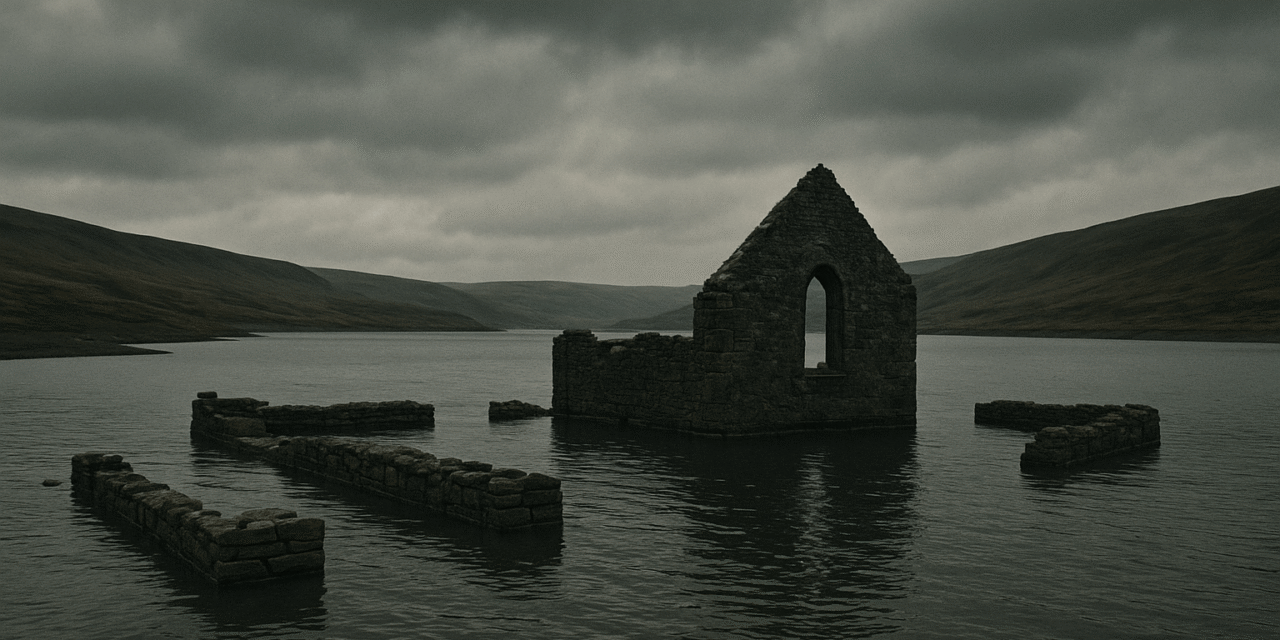
The reservoir at Llyn Celyn looks unremarkable from the road above — cold gray water, bare moorland hills, no sign of what lies beneath. But in drought years the surface drops, and when it drops far enough the ruins emerge: stone walls, a road, the foundations of a chapel and a schoolhouse rising silently from the lake. Capel Celyn does not stay buried. It surfaces. It refuses, with the persistence of drowned stone, to be forgotten.
In 1956, Liverpool Corporation introduced a parliamentary bill to flood the Tryweryn Valley and build a reservoir. Thirty-five of Wales’ thirty-six MPs voted against it. Local councils objected. Petitions were signed. None of it mattered. The bill passed. Work began in the early 1960s, and the community of approximately seventy people — farmers, schoolchildren, chapel-goers, Welsh speakers — were displaced from one of the last wholly Welsh-speaking villages in Wales. In 1965 the valley filled. The chapel was submerged. The graveyard, officially cleared before the waters rose, remains a source of unease in Welsh memory to this day. That same year, someone painted three words on a roadside wall: Cofiwch Dryweryn. Remember Tryweryn. The slogan has been repainted every time it has been damaged, for sixty years.
Liverpool City Council formally apologized in 2005. The reservoir still operates, still supplying water to the northwest of England. But Capel Celyn keeps surfacing in drought years, its ruins breaking the waterline like an argument that was never fully answered. Visitors who stand at the edge describe something that is not quite supernatural — more like witnessing an erasure that failed. Wales’ last Welsh-speaking village is still there. It simply waits beneath the water for the next dry summer to bring it back.
Story Source: www.itv.com
Address: Llyn Celyn Reservoir, Tryweryn Valley, Gwynedd, Wales
Accessibility Rating: Free / Outdoor Access
Google Map
What Others Have Experienced
During dry spells, when the reservoir level drops, the drowned village reasserts itself: cracked earth, fragments of crockery, and the stumps of long-dead trees push up through the mud where a living community once stood. In the summer of 2022, hundreds of Welsh visitors made the journey specifically to see the ruins emerging from the water.
— from North Wales Live
Visitors who pull off the road at the reservoir often describe an atmosphere difficult to name — a quiet but persistent sense that something beneath the surface refuses to be forgotten. One couple who stopped on impulse said they left feeling as though the place was trying to tell them something, prompting them to research the full history of the flooding afterward.
— from TripAdvisor
The small memorial chapel at the water’s edge was built from stones salvaged from the original village church. It is flanked by a garden of remembrance where families were given the option to relocate their dead before the flood. Visitors walk quietly past the old headstones while the reservoir stretches out behind them — the graves keeping watch over the water that swallowed everything else.
— from TripAdvisor
For Welsh visitors especially, the site carries a particular weight. One described spending time walking the area where the village once stood and finding the scenery beautiful but the knowledge of what lies beneath impossible to separate from it. Another called the history heartbreaking and said it should never be forgotten — sentiments shared by the hundreds who make the pilgrimage each time the ruins re-emerge.
— from TripAdvisor
When Liverpool City Council issued a formal apology forty years after the flooding, some welcomed it while others dismissed it as a hollow gesture, decades too late. The phrase “Cofiwch Dryweryn” — Remember Tryweryn — still appears on walls and road signs across Wales: a quiet insistence from a community that will not allow its drowned village to be forgotten beneath the waterline.
— from North Wales Live