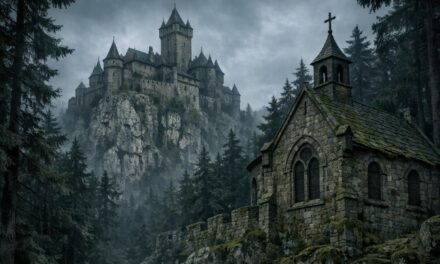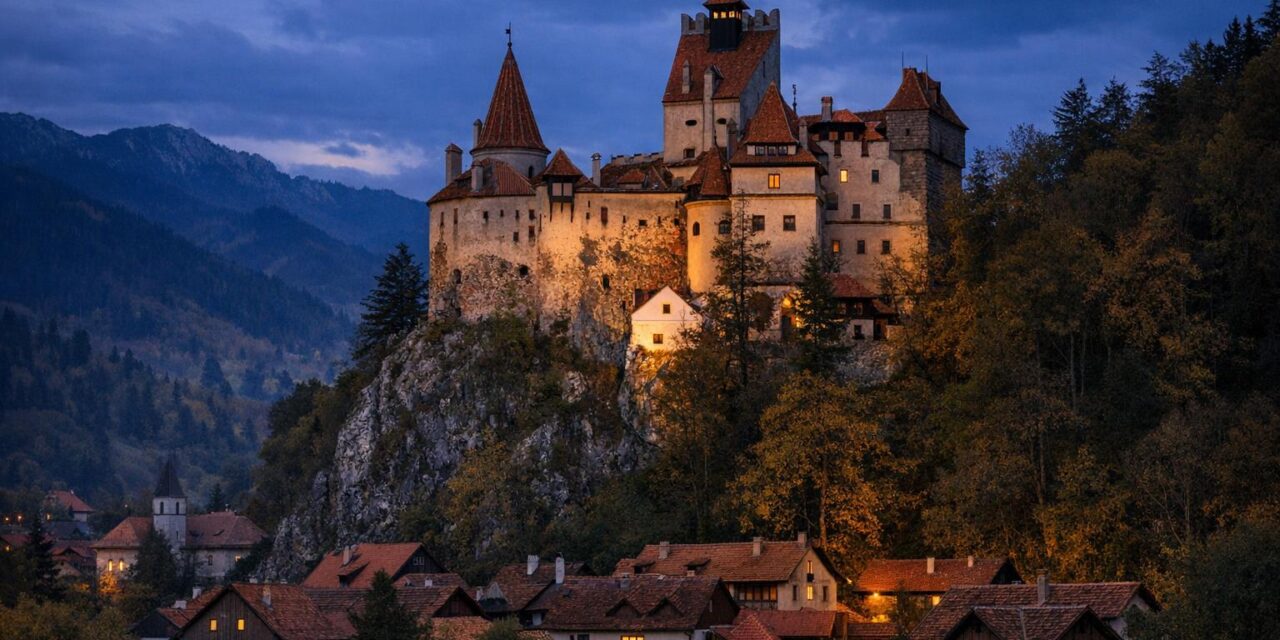
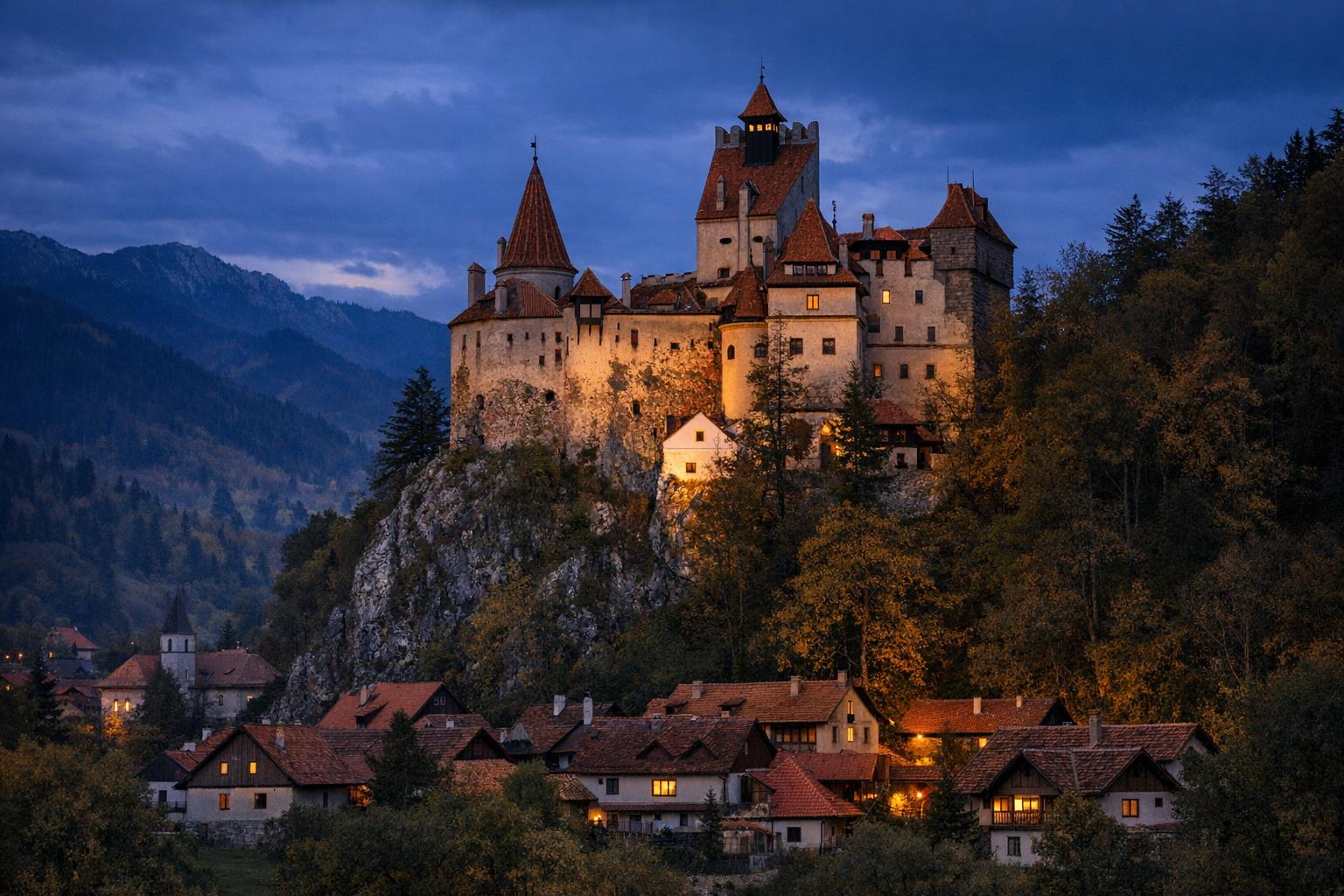
The bus drops you at the foot of a sixty-meter rock in the Carpathian foothills and the castle is right there — white-plastered towers, red-roofed turrets, souvenir stalls selling capes and plastic fangs. Bran Castle is marketed as Dracula’s Castle, a title built on thin historical ground. The connection is geographic: the castle sits at a pass that once divided Wallachia from Transylvania, a pass the real Vlad III may have crossed or briefly been held at as a prisoner. Tourism does not require certainty.
What is certain is the man the legend obscures. Vlad III was born around 1428, son of Vlad II Dracul — a member of the Order of the Dragon, the source of the name Dracula. As a child he was held at the Ottoman court as a hostage. When he came to power he applied what he had learned: systematic impalement. Enemies were staked upright in fields as warning. Contemporary accounts describe forests of the dying. Estimates of his kills reach the tens of thousands. He died in battle in 1476. Bram Stoker found the name in a library book in 1890. He never visited Romania.
Built in 1377 by the Saxons of Brașov, Bran Castle became a royal residence in 1920 when gifted to Queen Marie of Romania, who renovated it into a personal sanctuary and died wishing her heart preserved in a golden casket nearby. The communists seized it in 1947. The heart was stolen and later recovered. In 2006 the castle was returned to Queen Marie’s grandson Dominic of Habsburg and operates as a museum today. The real history is stranger than anything on the stalls outside.
Story Source: www.bran-castle.com
Address: Strada General Traian Mosoiu 24, Bran, 507025, Romania
Accessibility Rating: Open to All — Freely accessible to the public with no advance requirement. Includes hotels, restaurants, bars, and public historic sites where visitors may walk in without prior booking.
Google Map
What Others Have Experienced
A travel blogger who visited in May 2023 during shoulder season arrived at opening time to find the castle nearly deserted, allowing her to move through the medieval rooms at her own pace. She noted that the interior focuses almost entirely on Queen Marie’s royal residence rather than Dracula mythology, and only one section addresses the legend directly — visitors expecting gothic horror will be surprised, while those who come for history are well rewarded.
— from Travelling With Nikki
Visitors arriving with tour groups during peak season consistently describe the castle as overwhelmingly crowded, with narrow medieval staircases and passageways packed to the point where pausing to examine exhibits becomes nearly impossible. Several reviewers noted that the density of crowds can drain whatever atmosphere the dramatic architecture might otherwise provide, and strongly recommended arriving at opening time.
— from TripAdvisor
The castle’s own visitor documentation describes a range of unexplained phenomena reported over the years, including flickering lights, sudden cold gusts in sealed rooms, and a pervasive sense of being watched — particularly near the chapel and in the lower corridors. The spirit of a noblewoman in white is among the apparitions most frequently described, and some visitors report a chill in the courtyard even on warm days.
— from dracula-castle.ro
Despite debate over whether Vlad the Impaler ever used the fortress, what visitors consistently agree on is the power of the physical setting — Bran Castle rises dramatically from a cliff above a river gorge in the Transylvanian mountains, and its towers look genuinely menacing in the early morning or at dusk. For adventure travelers, the combination of medieval architecture, dark Transylvanian folklore, and mountain scenery is hard to match anywhere in Romania.
— from TripAdvisor