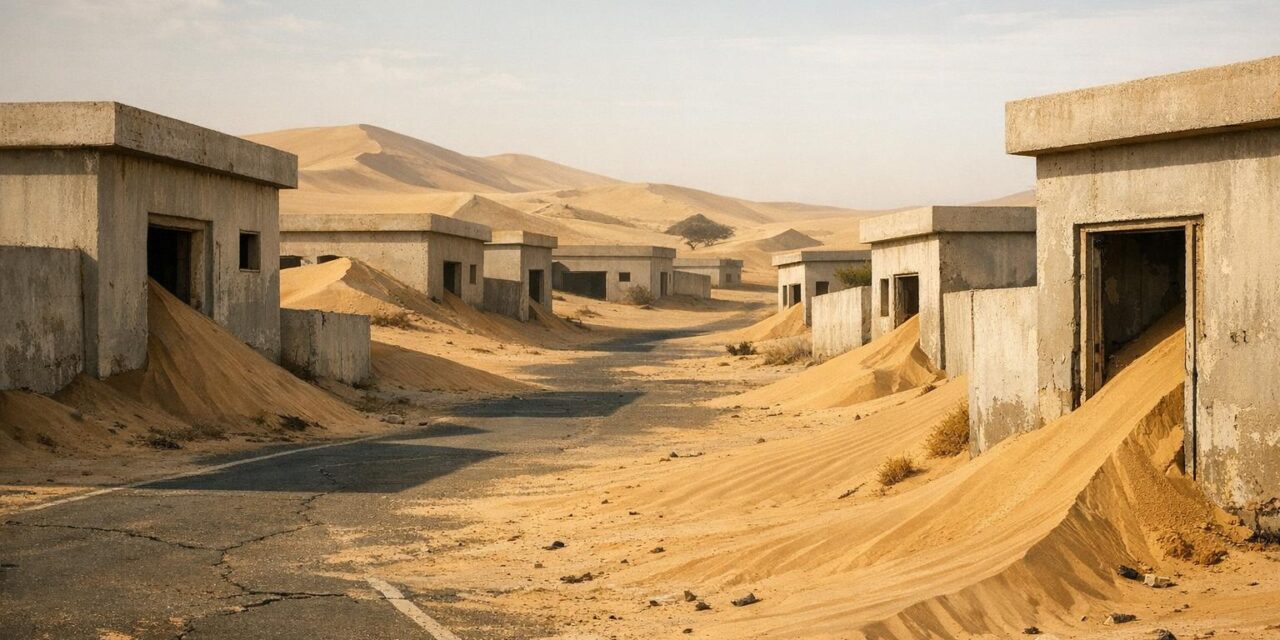
In the desert interior of Sharjah, about an hour’s drive east of the coast, the road runs flat across the sand until it ends at a village. The houses are still standing. Some of the furniture is still inside. The roads between the structures are still traceable. And no one has lived there since the 1990s. Al Madam was built as a public housing project after the UAE’s formation in 1971, intended to settle a Bedouin tribe that had until then led a semi-nomadic life across the desert. The oil discovered in 1958 had remade the country around them, and the new nation offered permanence. The tribe accepted, moved in, and stayed for roughly twenty years.
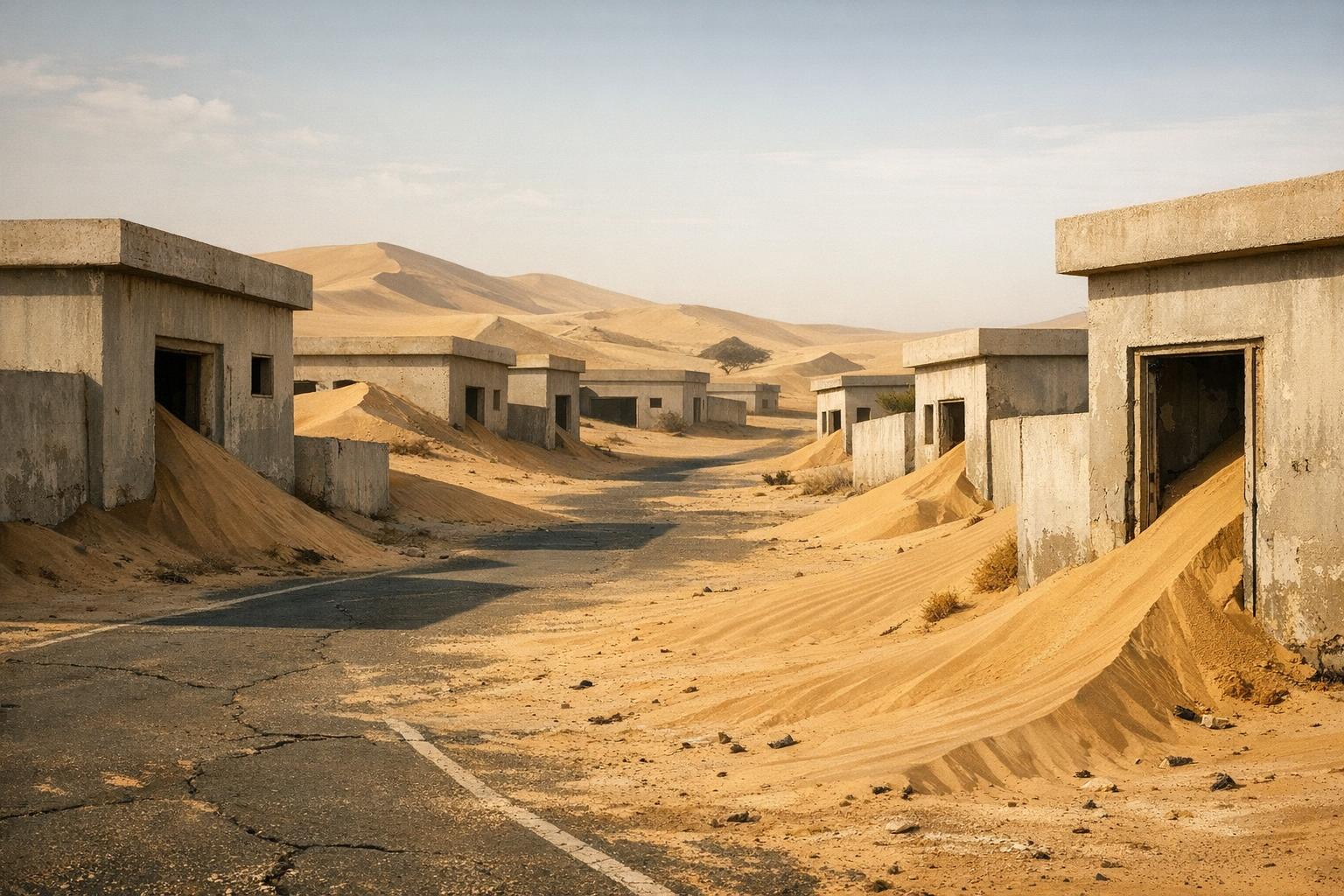
Then they left — all of them, apparently at once, without dismantling their lives. The practical explanations that have been offered are consistent: the desert winds were relentless, the natural conditions difficult, the distances to work and school long. But the departure’s totality, the belongings left behind, the doors simply shut and the roads abandoned, has never been fully explained by difficulty alone. In the folklore of the Arabian Peninsula, djinn — spirits that exist alongside the living, invisible and drawn to liminal places — are understood to take up residence in empty homes. The accounts that circulate around Al Madam are specific: the djinn were there before the houses were built, and when the families left, the djinn stayed.
Today the site is an official Sharjah tourism destination, listed for its value to adventure travelers, explorers, and photographers. The sand continues to rise against the walls. Several doorways are already buried. The village is not a ruin — nothing collapsed, nothing burned. It is simply a place where people once lived and then decided to stop, leaving everything where it stood, for the desert and whatever else is present to inherit.
Story Source: www.visitsharjah.com
Address: Al Madam, Sharjah, United Arab Emirates
Accessibility Rating: Open to All — Freely accessible to the public with no advance requirement. Includes hotels, restaurants, bars, and public historic sites where visitors may walk in without prior booking.
Google Map
What Others Have Experienced
Guests and staff have reported seeing a figure in 17th-century dress wandering the hotel corridors, disappearing through walls or vanishing when addressed. The apparition bears a reported resemblance to Count Frontenac — the Governor General of New France after whom the hotel is named — and has been described consistently enough across decades of independent accounts that hotel staff refer to him simply as the Gray Gentleman.
— from Scary Story Near Me
A woman who experienced the hotel’s White Lady described waking in the early morning hours to find a figure standing at the bedside with an expression of profound sadness. The apparition made no sound and vanished when the guest sat up, but the emotional impression — described as a feeling of grief that filled the entire room — lingered for the rest of the stay. The guest said she had never believed in ghosts before that night.
— from I Hope It’s a Ghost / Substack
A paranormal investigation team from Montreal who documented the hotel described encountering photographic anomalies in specific corridors and rooms, alongside staff accounts of a former maid still performing her rounds and the ghost of a worker said to haunt the west tower. They noted that the combination of the hotel’s age, its position above the St. Lawrence, and the density of historical events concentrated in Old Quebec made it one of the most credibly haunted buildings they had investigated.
— from Montreal Paranormal Investigations
A journalist writing about Canada’s haunted grand hotels described the Frontenac as distinctive among them for the sheer number of distinct entities reported, each with their own personality, history, and area of the building. Rather than general unease or unexplained sounds, the reports here are specific — particular figures, particular rooms, particular hours — in a way that suggested to the writer either a genuine concentration of paranormal activity or a story so deeply embedded in the building’s identity that staff and guests had begun to inhabit it.
— from NUVO Magazine
A visitor who stayed at the hotel specifically for the ghost stories described the atmosphere of the older sections of the building after midnight as genuinely different from the daytime experience — the long stone corridors, the drafts through the towers, and the sense of being in a building that has been continuously inhabited for more than 130 years combining into something that went beyond mere ambience. They described not seeing anything specific but feeling consistently as though they were not entirely alone.
— from Haunted Rooms Canada