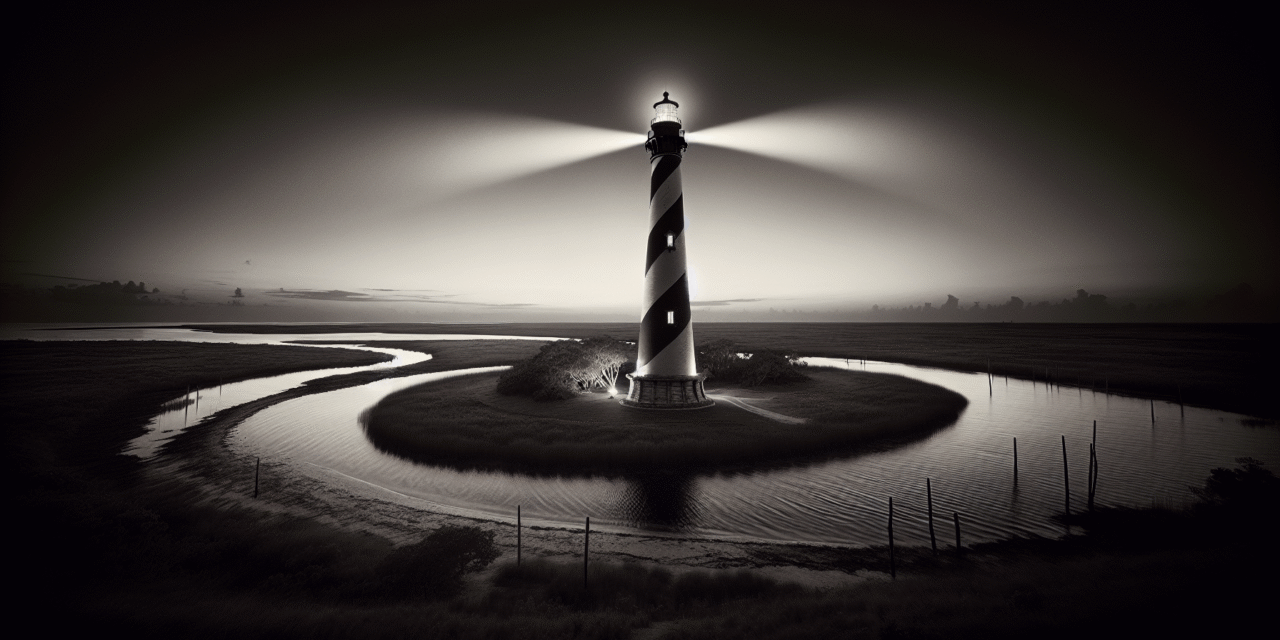
The St. Augustine Lighthouse has stood on Anastasia Island since October 1874 — 165 feet of black-and-white spiral tower, its first-order Fresnel lens sweeping nineteen miles out to sea, the oldest surviving lighthouse in Florida. During the three years of its construction, the superintendent of the project, Hezekiah Pittee, lived on the island with his family. His children grew up on the building site, playing on the grounds while the tower rose around them.
Workers ran a railway cart down a track toward the water to move supplies from offshore vessels to the building site. The Pittee children and their companions had been riding it for sport. On July 10, 1873, four girls climbed in together: Mary Pittee, fifteen; her sister Eliza, thirteen; a companion; and their youngest sister Carrie, four years old. The stopping board that would have arrested the cart before it reached the water was not in place. The cart broke free. Three of the four girls did not come back. The lighthouse they never saw completed was lit the following October.
What the lighthouse kept, in the decades that followed, was not silence. Lighthouse keepers and visitors reported the sound of giggling from somewhere in the upper tower — not moaning, not weeping, but something lighter and harder to dismiss. In the early 2000s, the Atlantic Paranormal Society filmed a shadow figure leaning over the staircase railing in a section of the tower where no crew member was present. The reports had been accumulating for more than a century before the cameras arrived. The giggling, most accounts agree, sounds like girls at play.
Story Source: www.staugustinelighthouse.org
Address: 81 Lighthouse Ave, St. Augustine, FL 32080
Accessibility Rating: Open to All — Freely accessible to the public with no advance requirement. Includes hotels, restaurants, bars, and public historic sites where visitors may walk in without prior booking.
Google Map
What Others Have Experienced
The lighthouse is open daily and can be visited with walk-in admission, offering 219 steps to the top and sweeping views of the St. Augustine coast. Visitors who research the history before climbing describe the ascent differently after learning about the Keeper’s daughters who drowned near the base — the girls said to still be heard laughing and playing on the grounds after dark.
— from Ghost City Tours
The “Dark of the Moon” nighttime tour is the only St. Augustine ghost tour with after-hours access inside the lighthouse itself — a detail visitors describe as making the difference between a walking tour with ghost stories and something that feels genuinely investigative. Ghost Hunters featured the lighthouse in two episodes, and the reported activity in the keeper’s house and on the grounds is among the most diverse in the city.
— from Visit St. Augustine
Multiple visitors describe sudden temperature drops and unexplained sounds at the base of the tower and in the keeper’s house, including footsteps overhead when no one else is in the building. The figure of a male keeper in period clothing observed in the lamp room during overnight investigations is the most frequently reported visual apparition, with multiple independent witnesses over several years.
— from US Ghost Adventures
Visitors who climb the lighthouse for the views often describe feeling something shift in the keeper’s house even before any ghost tour context is introduced — a quality of attention in the rooms, or a sense of the air being watched, that several describe as distinct from ordinary old-building unease. The physical beauty of the site and the bay views make it easy to forget the history, which makes the occasional moment of atmospheric intensity more surprising.
— from TripAdvisor
The lighthouse’s combination of genuine maritime history, documented paranormal investigation, and the specific tragedy of the drowned girls gives it a depth that purely supernatural-branded attractions lack. Visitors consistently note that learning the historical facts of what happened here — the real deaths, the real keeper, the real records — is what makes the alleged hauntings feel substantive rather than theatrical.
— from Ghosts and Gravestones