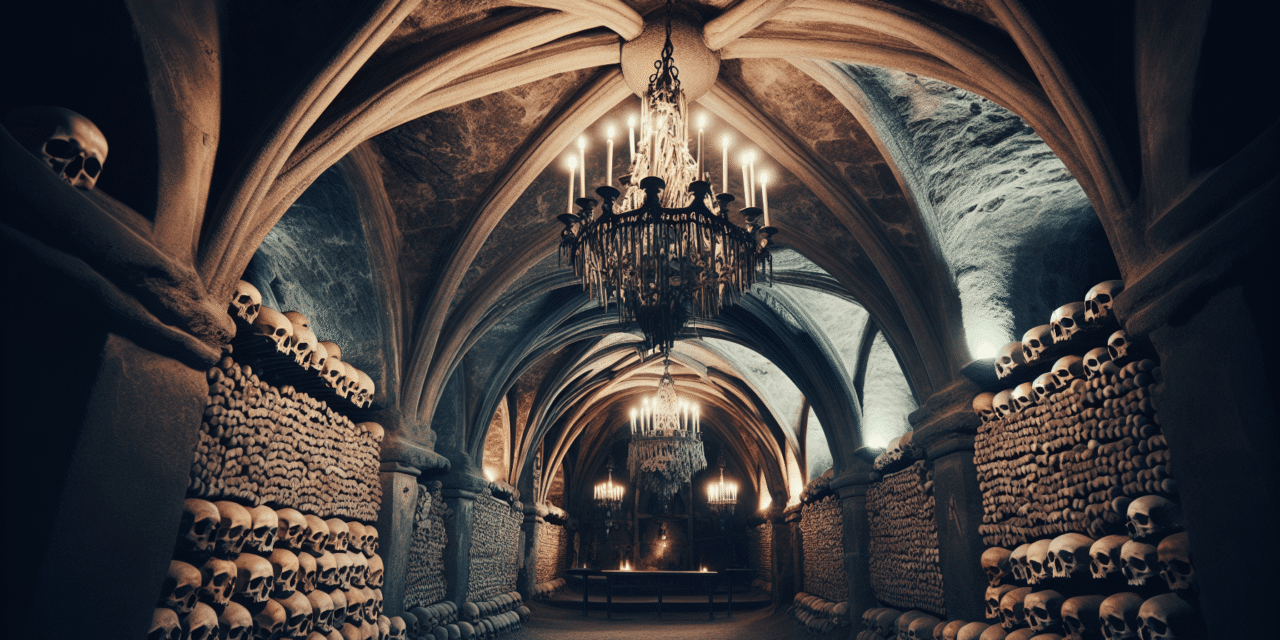
In a suburb called Sedlec, on the western edge of Kutná Hora, a modest Gothic church gives no indication from the outside of what it contains. You descend into the lower chapel and stand in cool underground air while your eyes adjust. Then shapes resolve: garlands that prove, on closer inspection, to be garlands of skulls. Columns of stacked femurs. A chandelier containing at least one of every bone in the human body. Between 40,000 and 70,000 people are arranged here with meticulous artistry.
The ossuary’s origins trace to 1278, when Sedlec’s Cistercian abbot returned from the Holy Land carrying soil from Golgotha and scattered it over the cemetery — consecrating the ground so thoroughly that the dying came from across Central Europe to be buried there. By the fourteenth century, plague, and the fifteenth, war, the dead had outpaced the earth. In the late 1400s, an unnamed half-blind monk exhumed thousands of skeletons and stacked them in the lower chapel in pyramidal mounds reaching the ceiling. He was not trying to make something beautiful. He was trying to make it fit.
In 1870, the Schwarzenberg family commissioned a woodcarver named František Rint to organize what the monk had left behind. Rint created the chandelier, the garlands, the Schwarzenberg coat of arms rendered entirely in bone. The philosophy was medieval and deliberate: memento mori — to contemplate the skull as clarifying discipline, not as spectacle. Every femur, the theology runs, carried someone to Mass once. To arrange such remains with beauty was a refusal to treat the dead as mere waste.
Story Source: www.sedlec.info
Address: Zámecká, 284 03 Kutná Hora 3, Czechia
Accessibility Rating: Booking Required — Open to visitors but requires advance reservation, ticket purchase, or tour booking.
Google Map
What Others Have Experienced
The scale of the ossuary is difficult to comprehend before entering — approximately 40,000 sets of human remains arranged into chandeliers, garlands, a coat of arms, and decorations throughout a small medieval church. Visitors consistently describe the experience as producing a cognitive response that is neither purely aesthetic nor purely horrified but something for which most find they have no existing category.
— from Nomadic Matt
The chandelier made of every bone in the human body is cited by virtually every visitor as the single most affecting object in the ossuary. The craftsmanship is undeniable — requiring anatomical knowledge and considerable skill — and visitors describe an uncomfortable admiration alongside the more predictable unease, a combination that most find harder to process than straightforward horror would be.
— from Travel Yes Please
The ossuary’s context within a still-functioning Catholic parish church is the detail visitors find most difficult to metabolize. This is not a museum or haunted attraction but an active place of worship, and the bones are treated by the church as consecrated human remains deserving of reverence rather than spectacle. Visitors describe this reframing as shifting the experience from curiosity to something more morally demanding.
— from Sacred Destinations
The bones’ origin — primarily plague victims and casualties of the Hussite Wars from the 14th and 15th centuries — gives the ossuary a historical weight that purely decorative bone churches lack. Visitors who research the Black Death’s impact on Kutná Hora before arriving describe finding it almost unbearable to look at the chandelier as art once the scale of what it represents becomes real.
— from So the Adventures Begin
The advance ticket requirement creates a metered flow of visitors through the small space that genuinely improves the experience. Even with timed entry, visitors describe the ossuary as difficult to navigate emotionally — the density of the material, the silence required by the religious context, and the impossibility of not reading the bones as individual people leave most visitors describing it as an experience they are glad to have had and have no desire to repeat.
— from Sedlec Ossuary