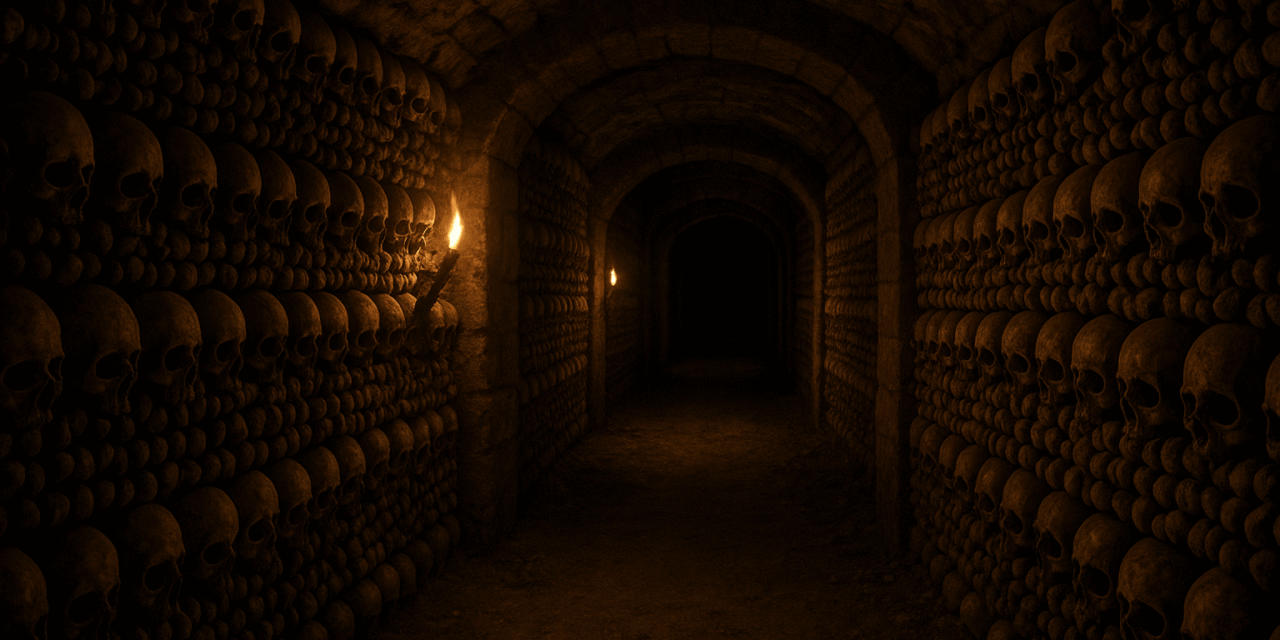
Twenty meters below the streets of Paris, where the temperature never changes and the year has no seasons, six million dead are arranged in the walls. The Paris Catacombs began as a practical solution to a catastrophic problem: by the 1780s, Paris’s overflowing church cemeteries were collapsing into neighboring cellars, contaminating wells, and poisoning the air in entire neighborhoods. In 1786, the city began transferring bones into the vast network of limestone quarry tunnels already honeycombing the ground beneath it—the same tunnels whose excavation had built Notre-Dame and the Louvre. Over the following decades, the remains of millions were lowered underground by torchlight, blessed by priests, and arranged in the long architectural displays that visitors still walk past today: skulls in geometric rows, femurs stacked like firewood, the bones of revolutionaries and aristocrats and plague victims mingled together without distinction.
The official tour follows two kilometers of the three-hundred-kilometer network, past walls of bones extending in every direction under the glow of artificial light. The doorway into the ossuary bears an inscription carved in 1812: Stop. This is the empire of Death. Most visitors slow to a hush within the first few minutes and do not fully recover until they emerge on the far side. The September Massacre victims of 1792 are here. So are guillotine victims from multiple phases of the Terror. During World War II, the French Resistance held meetings in the unauthorized tunnels above the bones; the German occupiers built a command bunker nearby.
The remaining three hundred kilometers are illegal to enter, yet a subculture called the cataphiles navigates them regularly—mapping passages, establishing underground gathering rooms, reporting things seen in the deep dark that resist conventional explanation. The bones do not mind either way. They have been waiting in the cold for a very long time.
Story Source: www.catacombes.paris.fr
Address: 1 Avenue du Colonel Henri Rol-Tanguy, 75014 Paris, France
Accessibility Rating: Booking Required — Open to visitors but requires advance reservation, ticket purchase, or tour booking.
Google Map
What Others Have Experienced
In 1793, during the turmoil of the French Revolution, a hospital doorkeeper named Philibert Aspairt descended into the tunnels and never returned. His skeleton was found eleven years later — identified by the keys still hanging from his belt — just a few meters from an exit he never found. Visitors near his memorial plaque describe a suffocating heaviness and, occasionally, the dim outline of a figure moving through the dark.
— from Unfound Journeys
Among the most frequently reported apparitions is a pale, translucent woman in white who drifts silently through the bone-lined corridors. Those who claim to have encountered her describe an abrupt chill and an overwhelming wave of sadness that seems to radiate from her presence. She is said to linger near the more ornate bone arrangements, as if searching for someone among the dead.
— from Unfound Journeys
Workers employed in the Catacombs have long described a recurring auditory phenomenon: distant singing echoing through the tunnels — Gregorian chants, eerie humming, and whispers in Old French. Those who’ve heard it consistently describe it as feeling deliberate rather than accidental, as though something below was trying to be heard.
— from The Catacombs of Paris
Since the Catacombs opened to tourists in 1874, visitors have reported seeing a shadowy figure in 18th-century clothing near the Crypt of the Sepulchral Lamp. In the most documented account, from 1990, a security guard described the apparition vanishing when approached — leaving behind only an unexplained cold spot in the air where it had stood.
— from Lores and Legends
One tour guide working the passages in 2007 captured what sounded like multiple voices speaking in archaic French phrases in a section where no visitors were present. Audio analysis could not identify a source.
— from Lores and Legends